Depressed copper prices in the 1920s and ’30s saw the eventual closure of mining operations in the Silver Bell district. The nearby Sasco smelter had shut down by 1921 and the Sasco townsite was abandoned.
The town of Silverbell would soon be abandoned — its population fell from 500 in 1920 to 35 in 1930, with many living along the railroad and nearby Red Rock.
Transportation of mail, supplies and passengers continued on the Arizona Southern Railway until Dec. 20, 1933. The rail spur from Silverbell to Red Rock was removed the following year and sold for scrap. The Sasco smelter works were also dismantled that year.
Asarco conducted geologic mapping and exploratory drilling in the Silver Bell Mountains during the late 1940s. The company discovered several rich chalcocite ore bodies that later became the El Tiro and Oxide open pits.
People are also reading…
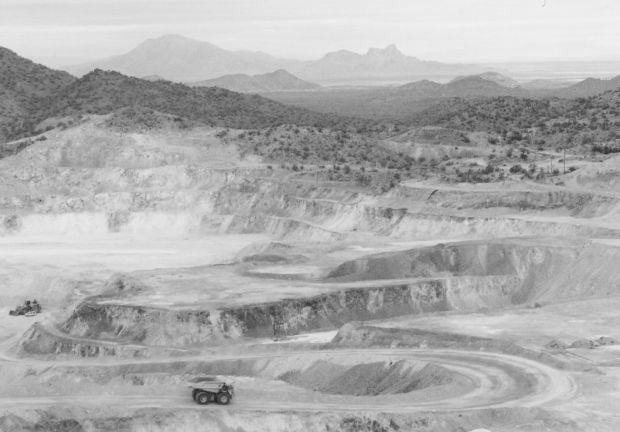
Asarco resumed mining operations around Silverbell in the early 1950s, catering to the demand for copper production by the U.S. government during the Korean War. Open pit mining replaced underground mining as the method of ore extraction. A 7,500-ton concentrator was built to process the ore in 1954.
In 1951 open-pit mining started at the site with stripping for the El Tiro and Oxide pits. In 1954, milling operations began for sulfide copper and molybdenum.
Two years earlier a new town called Silver Bell was established four miles southeast of the old Silverbell townsite at an elevation of 2,650 feet. The mill site was 100 feet higher than the town.
By 1967, mill and secondary crusher operations were expanded to 10,500 tons per day. The concentrates from the mill were trucked to Plata, a rail spur 15 miles northwest of Tucson. They were then loaded on rail via the Southern Pacific Railroad and shipped to the Hayden smelter.
Silver Bell reached a population of 800 with Asarco employing 300 workers in the 1970s. The town featured modern conveniences including a recreation hall, swimming pool, tennis court and baseball diamond.
A community of 175 houses, 24 apartments and 30 trailer spaces existed at the site. The second town and its post office lasted until 1984, when the mine and mill operations were suspended. Most of the town’s structures were taken down, and the town’s population dwindled.
Drilling was started in North Silver Bell to re-examine the ore body in 1988. Within a decade a $70 million extraction-electrowinning facility was in operation with an annual production of 22,000 metric tons a year of copper leach.
The leach-solvent extraction-electrowinning (SX/EW process) of acquiring copper from its ores has relatively minimal environmental impact and more energy-efficient production than traditional smelting methods. A weak solution of sulfuric acid is used in the process of acquiring copper from oxidized ores and mine wastes.
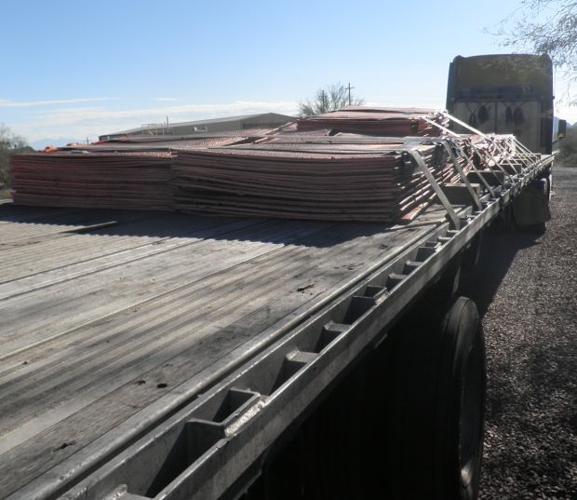
The final product is electro-won copper cathodes of 99.99 percent or higher purity averaging 300 pounds. Copper cathodes are then used to produce copper rods used in the manufacture of wire and cable.
Today, four open pits operate at the mine, whose primary owner is Asarco: the East Oxide, El Tiro, North Silver Bell and West Oxide. Every month 1.8 million tons of ore and waste are mined there. The average grade of the copper is 0.4 percent, and the reserve life of the 19,000-acre Silver Bell Mine extends through 2031.
William Ascarza is an archivist, historian and author. Email him at mining@azstarnet.com
Sources: “Alteration and Mineralization of the Paleozoic Sediments in the El Tiro Pit Area Silver Bell, Arizona,” talk presented in Tucson May 2, 1968, by Asarco geologist James A. Briscoe; “The History of Silver Bell or the Taming of the Toughest Town in Pima County,” Asarco Inc. (date unknown); http://www.asarco.com/about-us/our-locations/silver-bell-mine; David F. Myrick (1975), “Railroads of Arizona Vols. I-III”; Tom Phillips, Weishi Mang, Mathew Soderstrom and Keith Cramer, “Optimizing Metallurgical Performance at Asarco Silver Bell Mining LLC.”


 Northwest Tucson's Uptown project lands 2 restaurants, tasting room