When the United States celebrated its 100th birthday in 1876, Tucson was still a relatively new addition to the still-expanding nation.
But the dusty territorial capital gamely joined the party nonetheless.
Community members staged an enormous Fourth of July parade on streets draped in flags and bunting, then danced the night away as bonfires blazed and fireworks boomed.

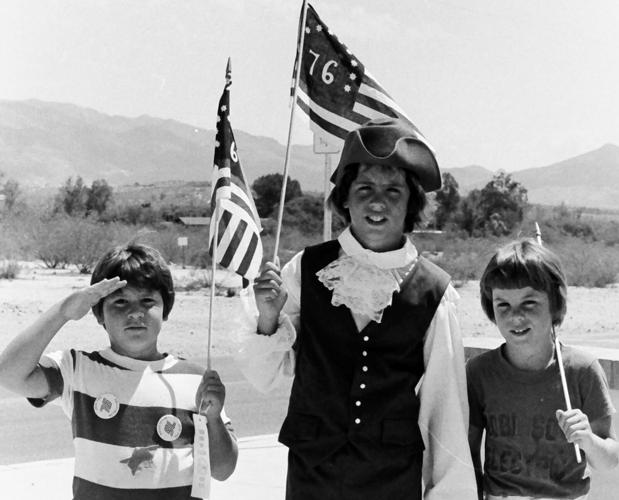
Participants in a kids' Bicentennial parade in Tucson on July 1, 1976.
Tucson had fewer than 7,000 residents back then — with incorporation still a year away, and the arrival of the railroad another three years after that — but you wouldn’t have known it on the day of the centennial shindig.
“Tucson acquitted herself magnificently on the Fourth just passed,” gushed the weekly Arizona Citizen newspaper. “People who have participated in many such celebrations in various States of the Union freely declare they never saw any to equal this, the size of the town considered.”
People are also reading…
As preparations continue for this year’s 250th anniversary of independence, here’s a look back at how Tucson marked some of America's earlier milestone birthdays:
Centennial
When the U.S. celebrated its 50th anniversary in 1826, Tucson was still squarely part of Mexico, along with everything else south of Oregon and west of Louisiana.
The map had changed significantly by the time the centennial rolled around, thanks to a war with Mexico and a $10 million real estate transaction brokered by James Gadsden.
On June 12, 1876, a committee of Tucson civic leaders met to hammer out the details of that year’s special Independence Day festivities.
The Arizona Citizen offered this charitable report on the proceedings: “What the meeting lacked in numbers was made up in tone and the weight of those who were there. It is almost always the case that the preliminary arrangements and work in devising any public entertainment or celebration devolves on a few public spirited citizens.”
Among those involved in the planning and fundraising were such prominent local names as Samuel Hughes, Tucson Mayor and businessman Estevan Ochoa and Territorial Gov. Anson P. K. Safford.
Several local businesses offered special promotions, including Tucson ice cream maker Francisco Forque, reportedly from France by way of Hawaii, who began serving his frozen treats in commemorative centennial glass bowls.

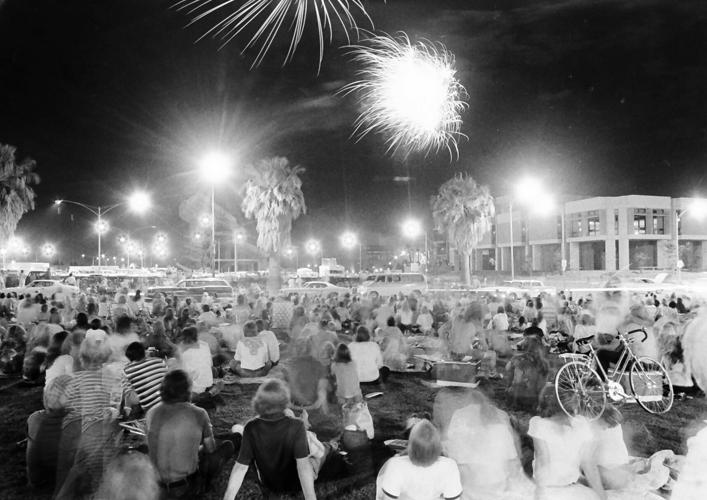
Fourth of July fireworks on the University of Arizona campus for the bicentennial in 1976.
Members of the organizing committee asked citizens of the Old Pueblo, especially those living along the parade route, to display flags and other appropriate decorations during the day and illuminations at night to make the celebration “one worthy of the first centennial of the American Republic.”
They also extended an invitation to those living in nearby Sonora, though the newspaper’s description didn’t make it sound terribly inviting: “It is believed that they will lose nothing but will gain much by coming together and reviewing the historical recollections of their native land and gaining a renewal of their faith in the wisdom, beneficence and grandeur of the American government.”
When the big day finally arrived, the program was carried out “with as much exactness as is possible under any circumstances, and without the least accident or injury to man, woman or child,” the Citizen reported.
The celebration began at 7 a.m. with a parade through downtown, led by the Sixth Cavalry band from Camp Lowell and a “six horse wagon with 100 young ladies representing 100 years of the Republic.”
Another wagon carried a working printing press, while other horse-drawn entries celebrated the local industries of agriculture, horticulture, manufacturing and mining and “the four races of man” (you’re probably better off not knowing anything more about that).
“The procession proper was fully a half mile long, and the sidewalks and streets were lined with people,” said the weekly newspaper in its July 8 edition. “Thousands of flags — embracing some of all nations — were flung to the breeze.”
The parade ended with a ceremonial gathering at Levin’s Park, near present-day Tucson City Hall, where the Declaration of Independence was read in English and Spanish, and speeches were delivered in both languages. The “ladies of Tucson” led the crowd in the singing of “The Star Spangled Banner” and “Hail Columbia.”
The U.S. Attorney for Arizona, E. B. Pomroy, delivered the centennial address. Local education pioneer John Spring gave a speech on Tucson history that proved so popular it was later published in the newspaper, with arrangements made to print extra copies.
That night, there were fireworks, a large bonfire at Main and Pennington and a dance at Levin’s Park that lasted “until July 4, 1876, was no more.”
There were no reports of disturbances, at least none that made the newspaper, but current author and historian John Warnock said the celebration was probably a lively one. Drinking, gambling, prostitution and even opium were all legal in 1876 Tucson, and according to the surviving diary of a saloonkeeper from that time, most of those activities were common among the citizenry, Warnock said.
Sesquicentennial
Maybe Prohibition was to blame for what happened on America's 150th birthday. The run-up to the big day in Tucson began with a public scolding from the Arizona Daily Star.
“The spectacle of a constantly decreasing interest in the proper celebration of Independence Day is again before us,” the newspaper observed in a June 21, 1926, editorial titled “What about July 4?”
Apparently, the Chamber of Commerce was struggling to find volunteers willing to help organize that year’s festivities. The editorial blamed the lack of enthusiasm on the growing ease of out-of-town holiday travel and general post-World War I resentment for what it called the “undue ‘flag waving’ … of self-appointed patriots.”
But the Star was in no mood for excuses. “Tucson must observe the day and must observe it fittingly, even if it means sacrifice,” the editorial concluded.
It’s unclear to what extent the community rallied to that cause.
Though the city’s population was approaching 30,000, its first traffic light was still a year away, and its daily newspapers offered little in the way of local news, opting instead for wire service reports from around the nation and the world, with an emphasis on murder and mayhem.
The Star and the Tucson Citizen reported little information about the local July 4 festivities, beyond a gathering of civic groups at the Masonic Temple for an Independence Day address by University of Arizona law school dean Samuel Fegtly.
The papers also printed short wire dispatches on the holiday plans in Ajo, Douglas, Globe, Patagonia and Flagstaff, where snow was brought down from nearby peaks for a summertime snowball fight in the streets. Nogales, meanwhile, was bracing for its biggest Fourth of July crowd ever, thanks to the holiday north of the border and a prize fight south of the border on the same day.

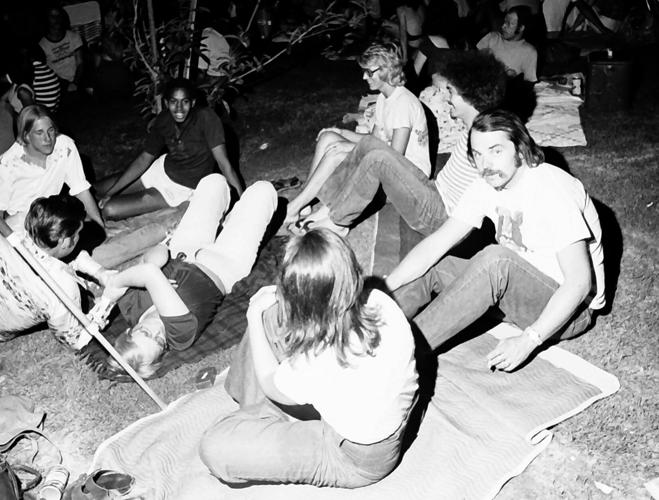
Students gather for Fourth of July fireworks on the University of Arizona campus in 1976.
Among the local businesses that took out ads to mark the sesquicentennial were the Southern Arizona Bank & Trust Co. and O’Rielly Motor Co., which used the occasion to offer the latest Chevrolet Coupe for $645. Jacome’s department store on Congress Street also had some July 4 specials to promote, including discounted straw hats, white flannel trousers and fabric to make clothes and curtains at home.
The Associated Press later reported a mostly “safe and sane” Independence Day around Arizona, while the Citizen noted that “holiday activities in Tucson … did not result in any unusual number of persons being booked at the police station for violating the various city ordinances.”
And what about the Star's editorial page? Its July 4 spread featured several tributes to Thomas Jefferson and the other men who signed the Declaration of Independence. Then it inexplicably ended its commentary with this random, one-sentence jab at the local population: “One thing is granted: there are too many automobile accidents in Tucson.”
Probably can’t blame Prohibition for that.
Bicentennial
Historian Chris Bradley is associate editor of the Arizona Historical Society’s quarterly Journal of Arizona History, but in 1976, he was a 13-year-old junior high school kid in Tucson, celebrating the bicentennial along with the rest of America.
He recalled gathering at a packed Arizona Stadium to watch the fireworks on the Fourth and going downtown to see the historical treasures on display during the American Freedom Train's stop in Tucson.
Mostly, though, the young Bradley stayed indoors. “You know, the Fourth of July in Arizona is always hot, so I remember watching a lot of the national events on TV at that time,” he said.
The nation’s bicentennial celebration was a coordinated, years-long effort, complete with its own space-agey, perfectly-1970s brand that looked like the logo for a NASA-run credit union.
Arizona’s Bicentennial Commission came along in 1972 and organized a host of events, including the state’s participation in a national wagon-train trip that ended at Valley Forge, Pennsylvania, on July 4, 1976.
The commission also made sure the state was represented in the bicentennial parades in Philadelphia and Washington, D.C. by a Tucson-based reenactment group of Old West fur trappers called the Mountain Men and an all-Arizona marching band of 200 high school musicians, directed by legendary U of A band director Jack Lee.
Tucson’s Bicentennial Committee, meanwhile, helped stage a parade, band concert and fiesta downtown on July 3, followed on the Fourth by a sunrise service, afternoon celebrations in four community parks and the fireworks at the stadium.
Of course, Tucson had a head start on the party planning. In 1975, the Old Pueblo celebrated its own 200th birthday with a series of events leading up to the Aug. 20 anniversary of its founding as a Spanish frontier fort in 1775.

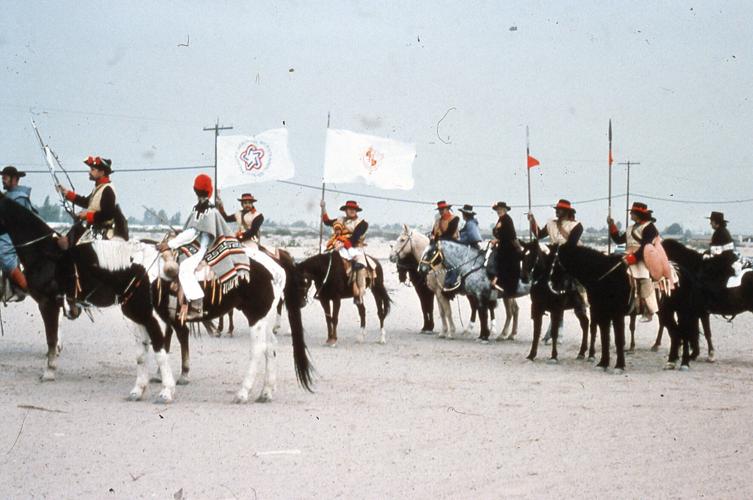
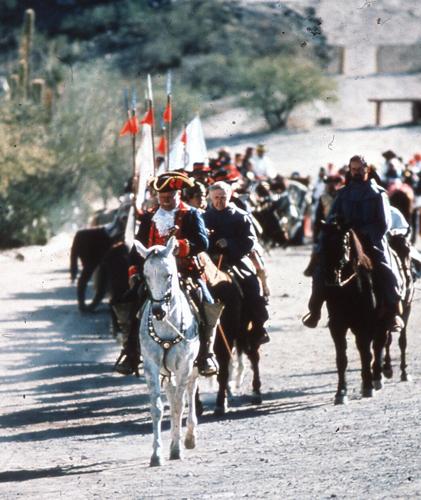
Juan Bautista de Anza, as portrayed by Yjinio Aguirre, leads a group of reenactors at San Xavier Mission in the fall of 1975, during a recreation of Anza’s expedition from Mexico to present-day San Francisco in 1775-76. Aguirre was also a member of the Arizona Bicentennial Commission that planned events for America's 200th birthday in 1976.
America’s bicentennial was also heavily commercialized, as demonstrated by all the newspaper advertising from that year. Jim Click opened his showroom to a voter registration drive and gave away a free American flag with every new Pinto or other model he sold. Sam Levitz claimed to have started his own “revolution” with his furniture warehouse concept. And Skate Country rolled in with — what else? — a "Skatennial Birthday Party."
Even the Star got in on the action, with weeks of promotions for a special 64-page July 4 commemorative section where anyone could buy ad space for as little as $17.76.
It was all too much for at least one local patriot.
“As an outraged citizen of the United States, I cannot tolerate being smothered in red, white and blue bicentennial sales pitches any longer,” wrote Suzanne Jameson in a letter to the editor printed by the Star that year in early June.
Meanwhile on Mars
Long-time Tucson resident Alan Binder missed the celebrations in ’76, because he was hunkered down at NASA’s Jet Propulsion Laboratory in California, trying to capture the first images ever taken from the surface of Mars. It was such a busy time, he never even got to see the fireworks.
“I was at (the) mission operations (center) almost every moment I was awake,” the 86-year-old recalled. “You could have burned the Earth down, and we wouldn’t have noticed.”
Binder served as principal investigator for the cameras on the two landers that NASA sent to Mars during the Viking program.

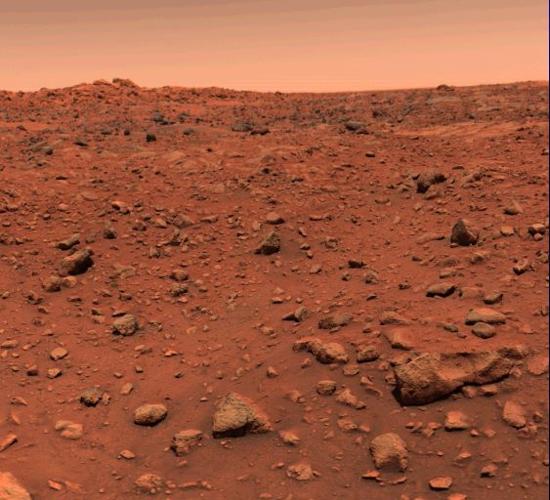
The first color photo taken from the surface of Mars, as captured on July 21, 1976, by the Viking 1 lander. NASA originally planned to land the probe on the Red Planet on July 4 in celebration of America's bicentennial, but the original landing site proved to be too rough.
The mission was designed with a patriotic flourish, he said. “From the very beginning, we wanted Viking to land on Mars on the Fourth of July as part of the celebration of the 200th birthday of America.”
Unfortunately, that plan had to be scrapped, after images from orbit around the Red Planet showed dangerously rough conditions at the original landing site for Viking 1.
Instead, the unmanned probe touched down at a safer spot on July 20 and beamed back its first images a few hours later.
“That was magical,” said Binder, who earned his Ph.D. from the University of Arizona in 1967 and returned to Tucson to settle for good in 1999, after an accomplished career in aerospace and planetary science. “By God, we landed.”
It was an experience well worth skipping the bicentennial for — and not just because he got to appear live on NBC’s “Today” show as some of the first pictures of Mars were unveiled to the world.
“We had no concept of what we were going to see at all. We thought it might be bland, so it was amazing to see the rocks and all the texture,” Binder said. “It was utterly amazing.”
Semiquincentennial
One of the most elaborate bicentennial events staged in Southern Arizona 50 years ago was a faithful reenactment of Spanish explorer Juan Bautista de Anza’s expedition from Mexico to present-day San Francisco in 1775-76.
Bradley said the recreation of that famous journey was spearheaded by the Arizona Historical Society and the state’s Bicentennial Commission, among others. It lasted from September 1975 until March 1976 and covered Anza’s entire route through what is now Mexico, Southern Arizona and California.
Bradley said several commission members played prominent roles in the ride. The group carried a flag with the bicentennial logo and sealed saddlebags containing copies of Anza’s original orders from the governor of Sonora and a letter to President Gerald Ford from Mexican President Luis Echeverría.

A group of riders, including one carrying a flag for America’s bicentennial, crosses through Pinal County in the fall of 1975, during a reenactment of Juan Bautista de Anza’s expedition from Mexico to present-day San Francisco in 1775-76.
“People wanted to find Arizona's place in the bicentennial, and one of the ways to do that was to play up events that had happened around the same time, even though they weren't directly connected with the American revolution,” Bradley said.
The Journal of Arizona History is planning a photo essay for its summer edition featuring recently uncovered photographs taken during the reenactment, which crossed through the Tucson area just as the Anza party did. The piece is one of many the journal is publishing in America's semiquincentennial year to highlight Arizona’s contributions to U.S. history. The theme of the journal’s current spring edition, for example, is “Arizona Histories, American Stories.”
So far, Bradley said, the general reaction to this year’s milestone anniversary seems significantly less enthusiastic than it was 50 years ago, though that’s not necessarily an indictment of where we are as a country right now. It could just be because 200 is a bigger milestone than 250 is.
“People kind of idealize the past sometimes, but times were tough in America in 1976,” he said. The Vietnam War had just ended, and the nation was still reeling from Watergate, Nixon’s resignation and a global oil crisis — all while being led by a president who was never elected even to be vice president.
“So we had a lot going on in the country,” Bradley said. “My sense of it is that people were happy to be able to celebrate something, you know?”
Only time will tell if Americans today feel the same way.
Visitors at the National Archives reflect on the nation's founding documents as the United States approaches its 250th anniversary.