Tucsonans have been saluting the flag since 1776, though it hasn't always been the same one.
Famously, the flags of five different governments have flown above the Old Pueblo over the past 250 years, as the region has changed hands through war, revolution, acquisition and political reclassification.
First came Spain, then Mexico, the United States, the Confederate States of America, the United States again and finally the State of Arizona.
But while those changing flags provide important signposts in the broader tale of Tucson, they don’t tell the whole story, according to David Turpie, editor of the Arizona Historical Society’s Journal of Arizona History.
People are also reading…
“As a historian and a history lover, I definitely think it’s fascinating to look back in the past and place Tucson in a large context,” he said. “The main issue, if I have one, with the five-flags (theme) is it completely ignores Indigenous peoples.”
The Tohono O’odham are “the real founders of Tucson,” Turpie said, but that often gets lost or erased when the focus shifts to the colors carried by colonizers.
The Kingdom of Spain laid claim to what is now Southern Arizona as far back as 1540, but its white banner with the red-and-gold royal crest at its center made few appearances here until the latter half of the 18th century.
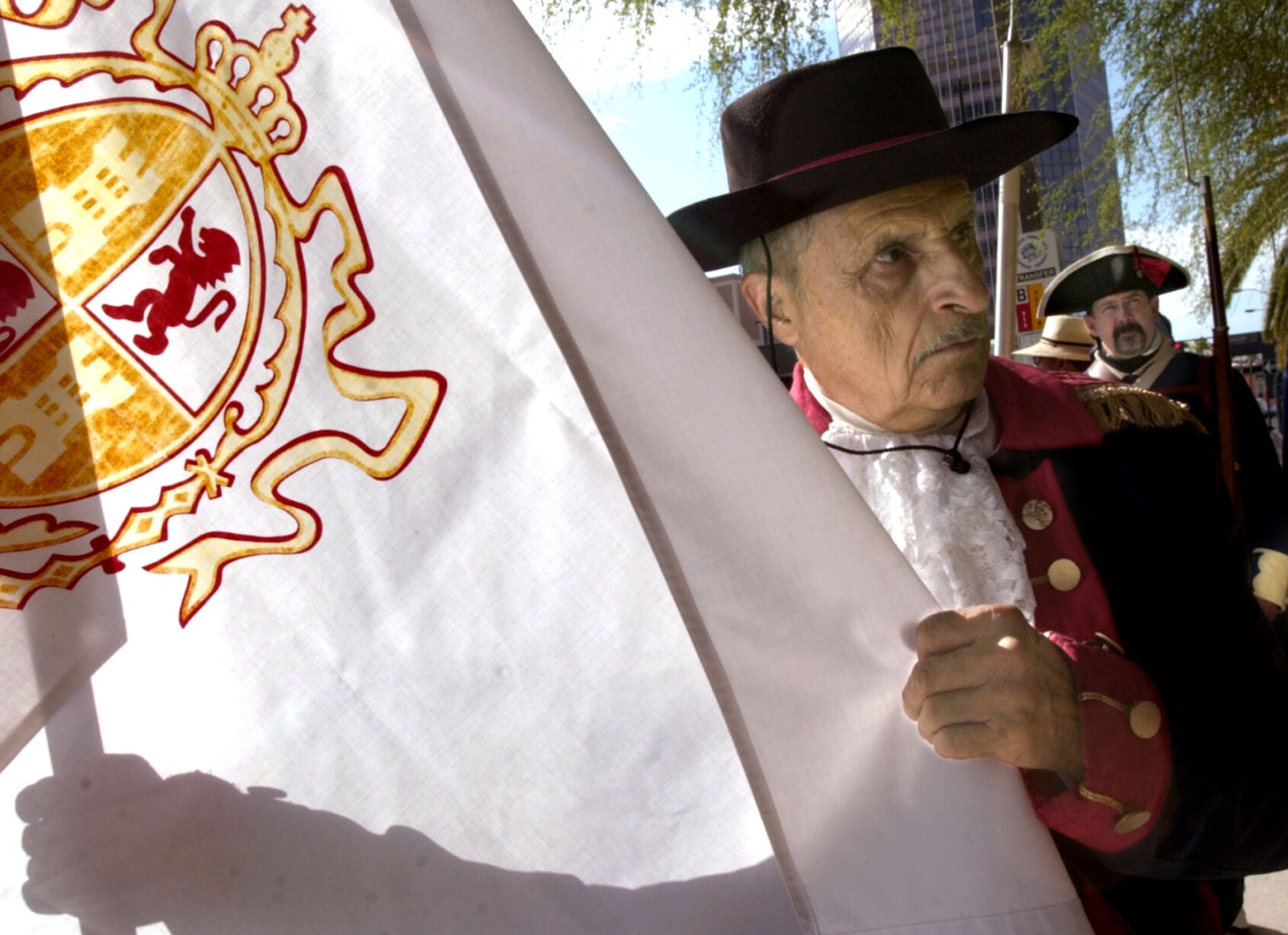
Hector Soza, who traces his roots back to one of the first soldiers to serve at the Tucson Presidio, holds the Spanish flag before its presentation at the historic Pima County Courthouse to celebrate Tucson's 230th birthday in 2005.
The flag may have been carried up the Santa Cruz River Valley in 1775, when Spanish officer Hugo O’Conor conducted his site survey and issued his proclamation establishing the Presidio San Agustín del Tucson on Aug. 20 of that year.
The flag of Spain became a fixture here in late 1776, with the arrival of troops sent from Tubac to build the Presidio and defend the kingdom’s northern frontier in the New World.
Spanish rule lasted until 1821, when Mexico won its independence and a new flag was hoisted above the adobe-walled fortress of Tucson: vertical stripes of green and red framing a golden eagle perched on a prickly pear and wearing a crown against a white background.

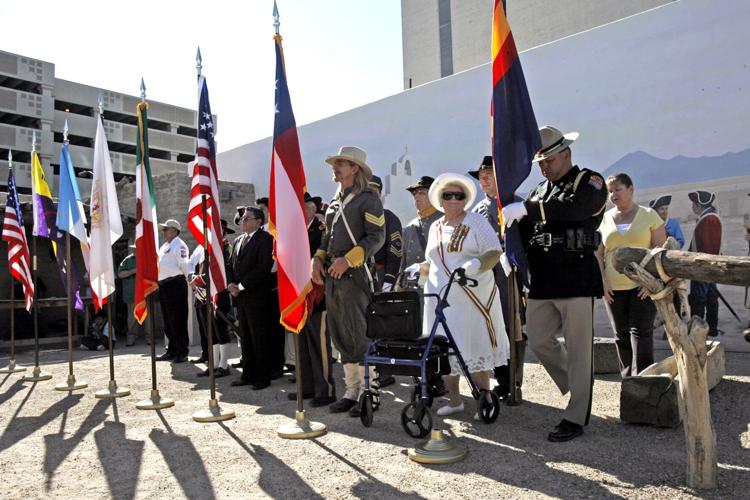
Participants in the ceremony at the Presidio San Agustin del Tucson stand near the various flags that have flown over the city as they mark its 233rd birthday in 2008.
The Presidio would remain under Mexican control for the next 35 years, with one brief but notable exception in 1846. For a day or two in December, members of the U.S. Army’s Mormon Battalion took control of the Presidio without firing a shot as they marched through the Old Pueblo on their way to California.

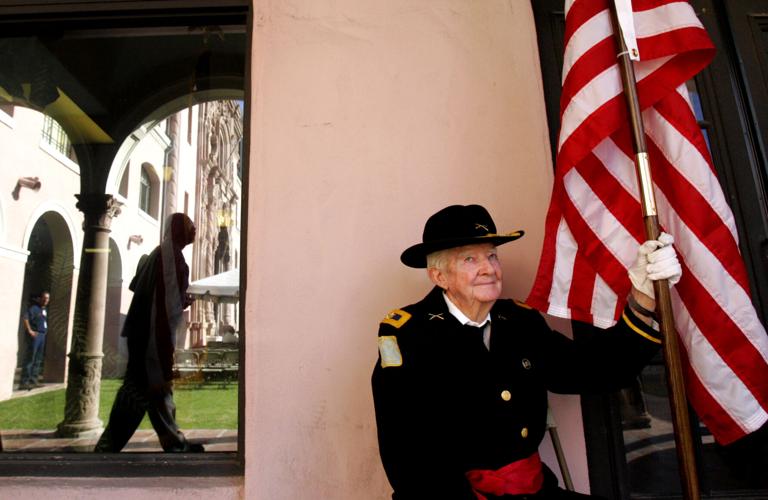
Wayne Goodman, representing the United States Mormon Battalion, holds the American flag during a 2006 ceremony at the historic Pima County Courthouse celebrating Tucson's 231st birthday.
As legend has it, those volunteer soldiers from the Church of Jesus Christ of Latter-day Saints were the first to unfurl the American flag over Tucson, though their version of Old Glory probably had just 27 or 28 stars on it, depending on how up to date it was.
The Americans took their flag with them when they left, clearing the way for Mexican troops to retake the Presidio, also without a fight.
Mexico would hold onto Tucson for the rest of its war with the United States and beyond, finally withdrawing its soldiers in 1856, two years after the Gadsden Purchase claimed all of Arizona south of the Gila River for the U.S.
But the flag shuffling didn’t end there. For about 80 days in 1862, the Stars and Stripes were replaced by the Stars and Bars of the Confederacy, after a small secessionist force rode into Tucson in late February and was driven out by Union troops from California in May.

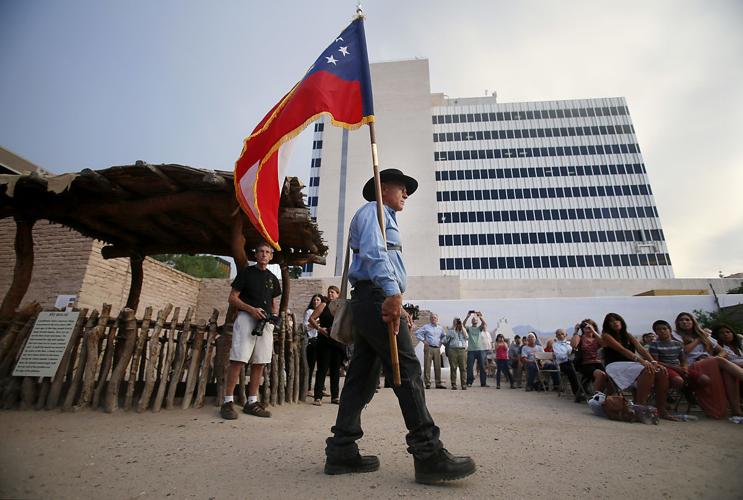
A member of the Sons of the Confederate Veterans carries the Confederate flag during Tucson’s 240th birthday celebration at Presidio San Agustín del Tucson in 2015.
The Old Pueblo gained its fifth and final flag with statehood in 1912, though it took another five years after that for the Arizona Legislature to approve the state flag’s final design without the signature of then-Gov. Thomas Campbell.
While Tucson’s five flags outrank many American cities, the undisputed leader appears to be Laredo, Texas, with seven different flags: Spain, France, Mexico, the Republic of Texas, the Confederacy, the United States and the short-lived Republic of the Rio Grande, which enjoyed 10 glorious months of independence in 1840.
All this flag history goes back so far that even some of the efforts to commemorate it now rank as historic in their own right.
In 1929, the Daughters of the American Revolution placed a marker along Alameda Street in El Presidio Plaza downtown to commemorate that first American flag that was raised by the Mormon Battalion in 1846.
Then, in 1972, as buzz was building for Tucson’s bicentennial in 1975 and America’s bicentennial in 1976, a ceremony was held to raise the five flags on poles donated by Union Bank at what was then a new city park in the wedge where Broadway Boulevard and Congress Street come together downtown. What was meant to be a historic display of the Old Pueblo’s importance quickly drew criticism from the editorial page of the Tucson Citizen, which pointed out that the banners chosen to symbolize Spain, Mexico and the Confederacy were historically inaccurate.
The five flagpoles are still there today in Veinte de Agosto Park, even if the flags themselves are gone.

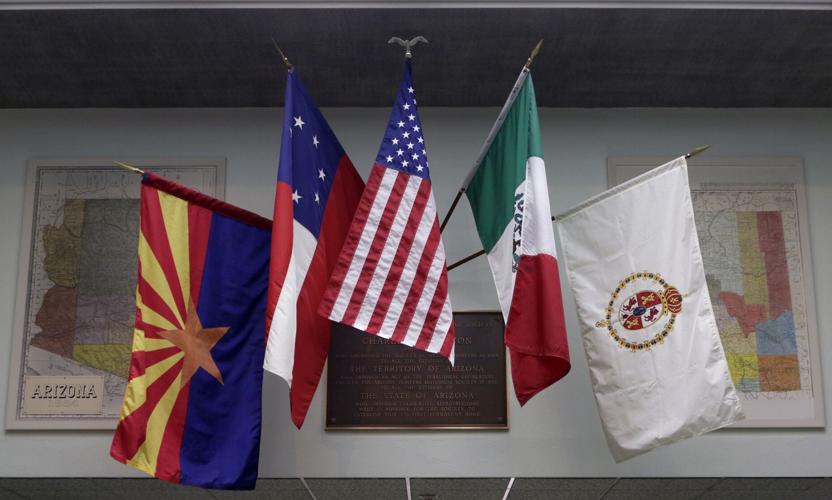
The five flags that flew over Tucson at one time or another hang in the lobby at the Arizona History Museum in a photo from 2014. The aging flags have since been taken down.
One of the few places to see all five flags in one place these days is during Tucson’s annual anniversary celebration hosted by the Presidio Museum. That event also typically features the flags of the Tohono O’odham Nation and the Pascua Yaqui Tribe.
Ironically, perhaps, it’s the flag with the shortest shelf life that has stirred the most controversy in Tucson in recent years.
For decades, the Confederate battle flag — that familiar blue X with white stars on a red background — was carried during the Tucson Rodeo Parade, but the committee that organizes the annual event decided to make a change 10 years ago, amid persistent complaints about what is widely considered a symbol of hate.
Initially, committee members chose to switch to the more historically accurate Stars and Bars flag of the Confederacy, the one most likely to have flown over Tucson. Then they decided to ban secessionist banners altogether in 2020.
“We made the decision on our own to forego any controversy,” said Herb Wagner, a long-time rodeo parade committee member who also serves as its unofficial historian.
The ban prompted the Arizona Division of the Sons of Confederate Veterans to drop out of the parade altogether after years of participation. Members of the group refused to take part if they weren’t allowed to carry their colors, Wagner said. They haven’t been back since.



 How America's Revolution got help from Tucson Presidio patriots