
When Apollo 11 lifted off from Cape Canaveral at 9:32 a.m., July 16, 1969, it was already 9:32 p.m. of the same day in my little world located 5 miles south of DaNang RVN. I was an Infantry Captain assigned as a Military Advisor to the 4th Battalion of the 51st ARVN Regiment in my eighth month of my first Vietnam tour. I had been with this South Vietnamese Battalion the whole tour and knew the Battalion Staff and Company Commanders well. A number of the officers in the Battalion had trained in the U.S. at either RangerSchool or AirborneSchool and several had attended one of the Officers Basic Courses. The South Vietnamese soldiers were about as Americanized as their meager income would allow and they had an appetite for our music, cigarettes and beer. Lesser known to me, the North Vietnamese also shared some of that appetite. The window to reality for us all, Vietnamese and Americans alike, was the radio and almost every one on both sides of the conflict had access to a small one to carry in the field. They brought us music, the sound of a woman’s voice and news. The Armed Forces Vietnam Network provided a 24 hour English radio station. Both the North and South Vietnamese had their own radio stations with a news and music slant that reflected their political origin.
People are also reading…
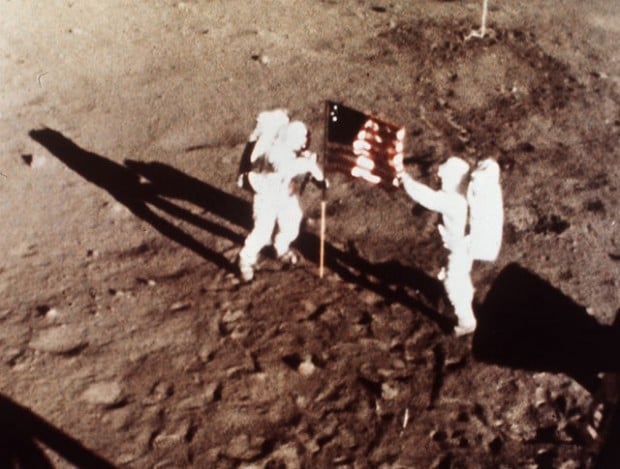
One hundred and nine hours after the Apollo 11 lift off from Cape Canaveral, my ARVN Infantry Battalion was approximately 20 miles southwest of DaNang and in contact with elements of a North Vietnamese Infantry Regiment which we had found the day before. When it was approaching 10 p.m. EDT on July 20, 1969, in the USA, it was 10 a.m. on July 21, 1969, on the hot humid lowlands of I Corp RVN. Moonrise was early morning around 3:30 a.m. and by 10 a.m., a 40% moon was almost directly overhead. The Apollo 11 crew was completing their pre EVA checklist, and AFVN Radio was carrying every word. We were all in awe of the history and the event.
Contact with the NVA elements around 9:30 a.m., had for short periods, been somewhat heavy. Vietnam was a land of constant sound of warfare. Artillery fire from the big U.S. Marine firebases would roll across the plains of our base camp near DaNang. But, in the field and much further away, the sounds could be heard from the impact of shells. This was a sound like a rolling thunder from the rounds as far away as 10 or 15 miles and a sort of “crack/whump” for the close in fire that I was usually directing at the request of my Montagnard Major who was in command of the ARVN Battalion. When in contact, the pop of small arms fire and the crack of rounds passing nearby us were constant reminders of the lethal business at hand. Aircraft were constantly overhead, particularly as a result of our relative close proximity to the big DaNang Airbase. However, by 10:15 a.m., it had slowed to a trickle of sporadic weapons fire and I commented to my American Team Sergeant, Sgt. Ed Kadle from northern California, on how quiet it had become. There seemed only to be the sound of constant flies and an occasional crackle of the radio mixed with the humid smell of sweat and unwashed bodies as we lay crouched in the sun, looking up and the moon, listening to the radio transmissions of Buzz Aldrin and Neil Armstrong. If for me, Vietnam was ever surreal, it was at that time, because as Neil Armstrong opened the hatch the war stopped dead in its tracks at about 10:30 a.m., July 21, 1969 in RVN.
Crosby McDowell


 For sale: Tucson's Park Place mall