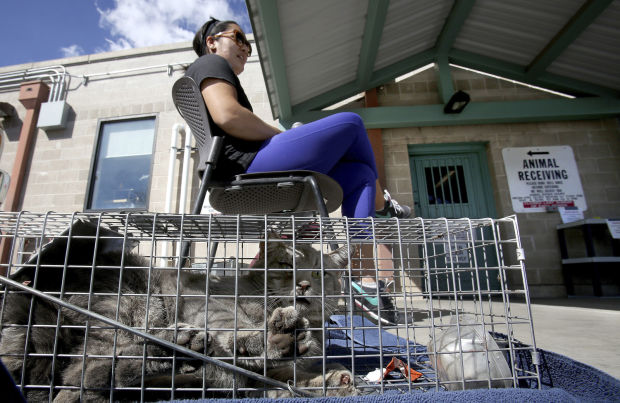
Sixteen hundred feral cats are euthanized in Tucson every year and leaders of a proposed new program hope to take that number to zero.
Tucson’s “Community Cats” program would trap, sterilize, vaccinate and rerelease feral and “free-roaming” local cats.
Supporters say it is the most humane way to reduce the number of stray cats in the community.
Among other things, it’s heartbreaking for shelter workers to put so many cats down — virtually all the feral cats that come into the county shelter are euthanized unless they are kittens that can be domesticated.
Critics who see feral cats as a nuisance and destructive to birds and other wildlife worry about rereleasing the cats back into the community once they’ve been sterilized.
The fate of the plan lies with the Pima County Board of Supervisors, which will be asked next month to approve $200,000 per year in funding for the three-year program.
People are also reading…
A majority of the funding for the $1.5 million program will come from a partnership between the Best Friends Animal Society and PetSmart charities. Best Friends chose Pima Animal Care Center for the grant after a competitive selection process but in order for the program to be carried out the county must make a financial commitment.
“Trapping and killing is not working,” Barbara Brown of the Community Foundation of Southern Arizona told a public meeting of about 100 people who turned out to hear about the community cat program Wednesday night. “We need a new equation for our cats.”
Brown, who is also chairwoman of the Pima Alliance for Animal Welfare, believes the program will be a game changer for cats.
Best Friends has helped direct similar programs in five other communities that have resulted in a reduction in cat euthanasia and increases in live releases of cats, said Holly Sizemore, director of national programs for the Best Friends Animal Society, a nonprofit organization based in Utah.
“We want to help both cat lovers and loathers,” she said. “What we’ve found is that the communities where we do this really get behind it.”
Sizemore said the Pima County program is expected to sterilize about 5,000 cats per year — both feral and stray in order to curb breeding. In one year alone one cat can produce 12 kittens, and the numbers multiply quickly when those cats have offspring.
Cats sterilized through the Community Cat Program will have the tip of one of their ears removed to identify them as having already been spayed or neutered. Advocates say the ear tip removal is painless.
Sizemore and other program leaders say the goal of year one would be reducing cat euthanasia by 25 percent. In the second year the goal would be a 10 percent reduction in cat intake at the county shelter.
The eventual goal is to move the live release rate at the Pima County Animal Care Center, which cannot turn away any animals, to 90 percent or more. The current rate is 76 percent.
The shelter takes in a staggering 24,000 animals per year, about 8,000 of them cats. It is currently overcrowded with about 1,000 animals, 400 of them cats. By international sheltering standards the shelter capacity is 175. There are typically cat cages stacked up to the ceiling.
Workers would welcome a plan to reduce unwanted animals, and also a plan that would put an end to euthanizing feral cats, said Karen Hollish, who is the shelter’s director of fundraising.
Hollish said the program through Best Friends is a rare opportunity to make significant change in the way the Tucson area treats its animals.
Best Friends community cat project coordinator Desirée Triste-Aragon said the Albuquerque program has seen double-digit decreases in cat euthanasia since it implemented a similar program. Its live release rate of cats is now 91 percent. The shelter’s overall intake of cats and kittens has declined by 32 percent and the euthanasia rate dropped by 79 percent.
“The city of Albuquerque has not killed a single feral cat in 2ƒ years,” Triste-Aragon told Wednesday’s audience.
There was even one recent week when there were no cats in the shelter — a huge turnaround.
The Pima County program would target nine ZIP codes — 85705, 85706, 85710, 85711, 85712, 85713, 85714, 85716 and 85719.
Best Friends would supply three employees, plus equipment, supplies, training and marketing, some medical assistance and two cargo vans. The Humane Society of Southern Arizona and Santa Cruz Veterinary Clinic would provide sterilizations.
Kendall Kroesen, urban program manager for the Tucson Audubon Society, attended Wednesday’s meeting and expressed concern about the amount of local wildlife killed by feral cats. He says he has not seen peer-reviewed scientific data that shows trap and release programs reliably reduce the number of feral cats in the community. He also questioned how humane it is to rerelease the cats outside as outdoor cats get hit by cars and eaten by coyotes.
Sizemore and other program leaders say a study in Jacksonville where feral cats were microchipped before being rereleased showed only a small percentage of those that had been sterilized suffered premature deaths from cars.
Others at Wednesday’s meeting wondered who feeds the cats when they are rereleased, and also what happens when people don’t want them rereleased near their homes. Sizemore says Best Friends officials try to work with neighborhoods on both of those issues.
There’s rarely a problem finding people to feed the cats, and Best Friends can help with humane deterrents if people don’t want the cats on their property, Sizemore said. Some of the cats in other communities end up being adopted by the people feeding them, she said.
Triste-Aragon says some feral kittens trapped through the program in Albuquerque have been placed up for adoption.
Pima County Supervisors Chairwoman Sharon Bronson expects the board will consider funding the program on Aug. 5 meeting. She is supportive, though she does not know how other supervisors will vote.
“In the long term it makes economic sense and from a compassion, humanitarian standpoint I also think it’s the right thing to do — two good reasons to move it forward,” she said.
Supervisor Richard Elías is also supportive, though he stressed he hasn’t seen all the details of the proposal yet.
“My sense is that this is something that goes along with a whole new kind of way of looking at animal care. All of us are interested in less euthanasia,” he said. “The time for change has come.”



 Tucson's newest Shake Shack gets neighbors