

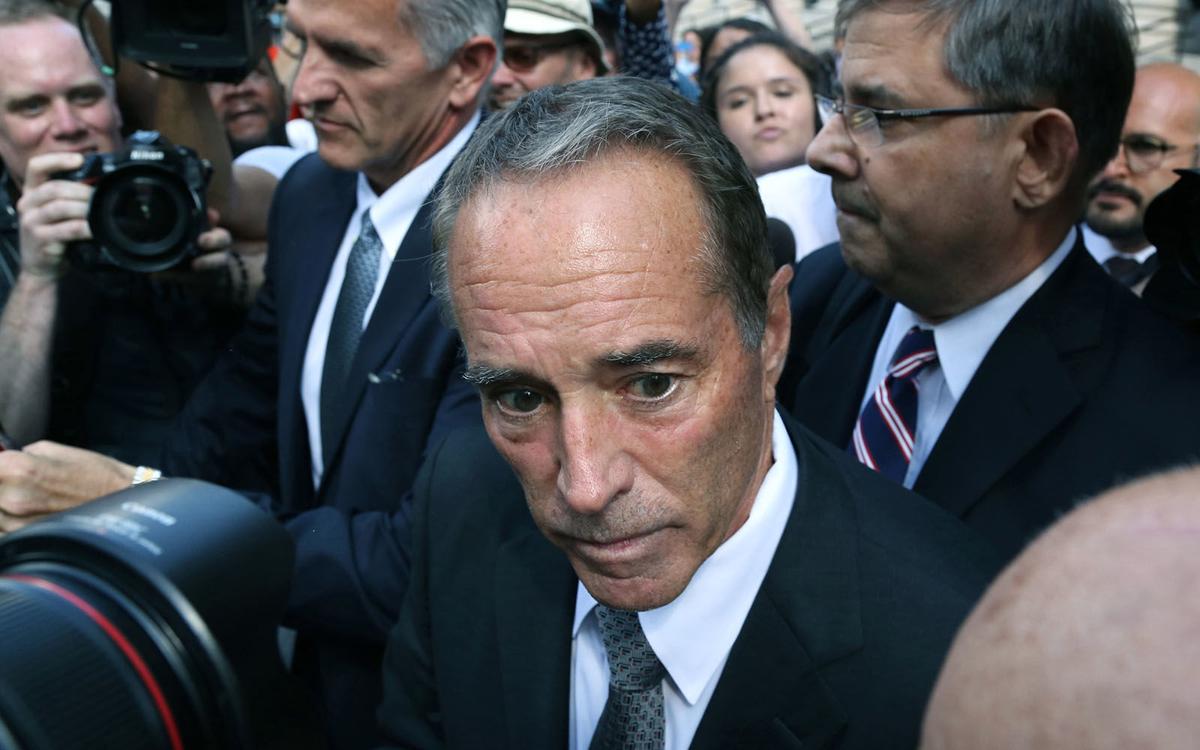
WASHINGTON – Chris Collins' guilty plea and resignation from Congress haven't exactly led to a wave of reform sweeping across Capitol Hill.
Instead, efforts aimed at preventing congressional wrongdoing remain exactly where they were before Collins left Congress on Oct. 1.
They're nowhere in sight.
The House Ethics Committee abandoned its probe of Collins on the day he resigned, but remains quietly working on a separate reform package. Meanwhile, a broad reform bill lays on its deathbed in the Senate. And larger-scale proposals that would have prevented a Collins-like scandal from recurring – like a ban on lawmakers owning individual stocks – still rank as nothing but talking points.
That leaves advocates of change worried that the Collins insider trading case may end up as a blip on the congressional radar screen, even though it highlighted broad ethical concerns that remain unaddressed.
People are also reading…
"While this insider trading scandal appears at its end, the scandal involving Collins’ own stock portfolio and the blatant conflicts of interest it created – as he pushed for pharmaceutical industry legislation – remains unabated," said Donna M. Nagy, a law professor at Indiana University who has been pushing for a ban on lawmakers owning stocks in companies affected by legislative activity.
Nagy's comment points to the often-overlooked fact that Collins, through his actions as a board member of an Australian biotech named Innate Immunotherapeutics, actually spawned more than one scandal.
The second and much more noticed one resulted in Collins, his son, Cameron, and Stephen Zarsky – Cameron Collins' prospective father-in-law – pleading guilty in federal court earlier this month. That scandal stemmed from a phone call the then-congressman made to his son, in which the elder Collins set off a string of illegal insider trades by noting that Innate's only product, a multiple sclerosis drug, had failed in clinical trials.
But long before Collins' August 2018 arrest, the Office of Congressional Ethics had been probing his relationship with Innate. And that investigation led to an October 2017 report in which the office said it has "substantial reason to believe" that Collins had broken federal law by engaging in another, earlier episode of insider trading.
In that case, the ethics office found that Collins likely violated federal securities law in 2015 and 2016 by spreading inside information about Innate in emails in which he was trying to persuade investors to drop more money on its stock.
That allegation now appears dead in the water. Federal prosecutors never touched it, focusing instead on Collins' now-infamous phone call to his son in June 2017.
And while the ethics office turned its findings over to the House Ethics Committee for further investigation, that panel never acted publicly on that other Collins insider trading allegation. In fact, the Ethics Committee abandoned its Collins investigation entirely on the day of his guilty plea.
"The House received Representative Collins’ resignation on October 1, 2019," the Ethics Committee said in a news release. "As a consequence, the Investigative Subcommittee and the Committee no longer have jurisdiction over him. The Committee considers this matter closed."
However, the Ethics Committee is still privately pondering reforms that it might suggest in the wake of Collins' arrest.
"Our task is very narrow," and totally focused on preventing lawmakers from serving in outside positions that could pose conflicts, Rep. Van Taylor, a Texas Republican, said in July, at the first and so far only meeting of a House task force aimed at drawing up new ethics rules in response to the Collins scandal.
The House in January passed one such reform, which would bar federal lawmakers from serving on the boards of public corporations such as Innate.
But that change is part of a controversial bill called H.R.1, or the "For the People Act." That measure would create public financing for House campaigns, implement automatic voter registration, boost campaign finance reporting requirements, end the partisan gerrymandering of congressional districts and bolster federal efforts to prevent foreign meddling in U.S. elections.
Republicans regard several of those proposals as daggers aimed at their hearts, which is why Senate Majority Leader Mitch McConnell, a Kentucky Republican, has vowed to never bring the measure to the Senate floor.
"I don’t see anything in here salvageable,” McConnell told reporters earlier this year. “This is a solution in search of a problem. What it really is is a bill designed to make it more likely Democrats win more often.”
Senate Minority Leader Charles E. Schumer, a Democrat, disagreed.
"We must shine a light on the dark money and nefarious practices that corrode our democracy; the For the People Act is a crucial step in doing so and should be passed immediately,” said Schumer, who acknowledged the bill had become "yet another tombstone in Majority Leader McConnell’s legislative graveyard."
Equally dead, it seems, are more ambitious proposals such as that of Nagy, the Indiana University law professor.
She noted that Collins didn't just provide investors and family inside tips about Innate. He also pushed – and helped write – the 21st Century Cures Act, 2016 legislation that could have benefited the company by making it easier for Innate to conduct clinical trials in the United States.
There's only one way to prevent lawmakers from that sort of self-interested legislating, Nagy said: By banning them from owning stocks in companies that could be affected by the legislation they try to pass.
"Similar restrictions on stock ownership are currently in place to protect the public from self-interested decision-making by federal judges and agency officials," she said. "The Collins scandals show why such conflicts-of-interest safeguards are urgently needed for the legislative branch as well."


