What began last year with a handful of people at a muddy World War II crash site in Poland is expanding into a global campaign, based in Tucson, to help bring home the remains of hundreds of missing American service members.
The newly formed Arizona Center for the Missing in Action will provide much-needed manpower and other support to ongoing recovery missions around the world by the federal Defense POW/MIA Accounting Agency. This summer alone, the new center is sending students from Arizona’s three public universities to assist with DPAA missions at four different sites in Europe.
“It kind of exploded, in a good way,” said U.S. Army Lt. Col. Rich Ingleby, who helped launch the center at the University of Arizona earlier this year and will serve as its director.
People are also reading…
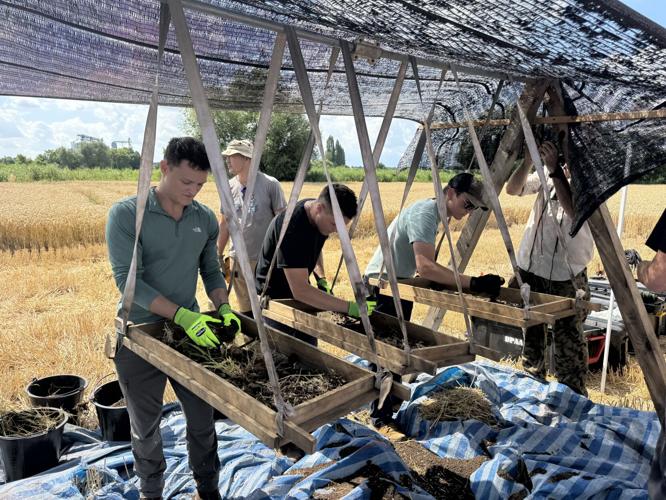
The idea came to him while he and four student volunteers from the U of A were digging through mud last summer in search of aircraft wreckage and other evidence at a DPAA dig site in a wheat field in southwestern Poland.
“You're out there working on those (sifting) screens, and there’s nothing but time to chat and time to think,” said Ingleby, the U of A’s Army ROTC commander.
What struck him was the scale of it all. Here he was mucking through the thick clay at a crash site where forensic archaeologists had been working off and on for six years, and in all that time they had only made it about halfway across the suspected debris field from a B-17 bomber that was shot down in 1945, leaving seven crew members unaccounted for.

University of Arizona Army ROTC cadets, from left, Jonny Ellwanger, Zach Ellwanger and Carson Criswell sift mud through screens on a farm in southwestern Poland as part of a recent archaeological dig at the crash site of an American B-17 bomber shot down during World War II.
Now multiply that by hundreds of recovery sites around the world where DPAA is working tirelessly to identify almost 81,000 American service members lost since World War II, and a daunting math problem begins to emerge.
Maybe with more hands and more help, Ingleby thought, this vital work could be sped up a little.
“Clearly, we're not going fast enough, and there's an extensive amount of recurring costs associated with these missions, coming back in (year after year) with gear and people and all that,” he said. “How do we do this faster?”
Immediate impact
As soon as he returned from Europe, he began planning the new initiative with Jesse Stephen, the Tucson-based chief of innovation for DPAA, who helped organize last year’s joint recovery mission to Poland.
Ingleby said the goal of the Arizona Center for the Missing in Action is to supply people and support for future DPAA missions, with a special emphasis on finding the approximately 383 service members from Arizona who remain unaccounted for.
In the coming days, the center will send one group of ROTC cadets from Arizona State University to a B-24 crash site in Poland and another from Northern Arizona University to a B-17 crash site in France.
Meanwhile, 10 students and four faculty members from the U of A, Ingleby included, will soon depart for Germany for a five-week study abroad program that will put them to work at two B-17 crash sites where three crew members have been missing since the waning days of the Second World War.
Ingleby said the two sites were “below the cut line” of DPAA’s annual budget and wouldn’t have seen any work in 2026 if not for the team from the U of A. “So first year, we’re making a big impact,” he said.
The students will spend three weeks at one location and two weeks at the other, with about two days in between to experience a bit of German culture.
At both sites, they will continue the work of previous DPAA missions by digging and screening soil in search of pieces of the aircraft and personal effects that could help identify missing men roughly their same age.
Along the way, the students will complete coursework that includes readings, a site-specific MIA research dossier, field journaling, presentations and a final paper. Ingleby said the curriculum is designed to get the students “engaged in the mission and give them something they can keep to remember what they did.”
Force multiplier
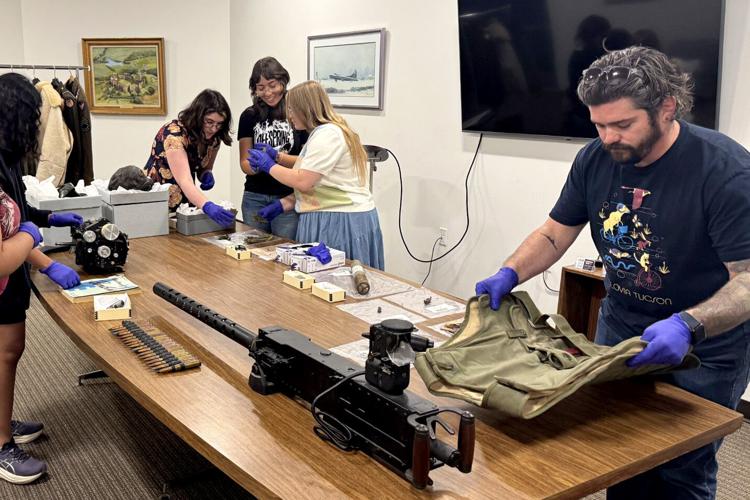
In preparation for the trip, some of the participants took a special tour last month of the 390th Memorial Museum at the Pima Air and Space Museum in Tucson, where they examined parts from a B-17 and spoke with two veterans who flew missions in the bombers during World War II.

Students from the University of Arizona examine parts from a B-17 bomber during a special tour of the 390th Memorial Museum at the Pima and Air Space Museum in preparation for their summer study abroad trip to Germany, where they will assist with a forensic archaeological dig at two World War II era B-17 crash sites.
Ingelby said the U of A team will be joined at the sites in Germany by students and volunteers from six other American universities to form a workforce of almost 40 people.
“By participating in partner field work to support recovering our missing heroes and returning them to their families, these students help fulfill our nation’s solemn promise to not leave any of our sailors, soldiers, Marines or airmen behind,” said G.R. “Rocky” Gillette, DPAA’s director for partnerships and innovation, in a written statement.
Since 2015, when the Pentagon tasked a single agency with the recovery of missing Department of Defense personnel, almost 1,800 Americans have been identified. During fiscal year 2025 alone, DPAA conducted 188 field activities and accounted for 231 missing service members.
To become a reliable “force multiplier,” Ingleby said, the new center hopes to raise enough money to send students from the U of A, ASU and NAU on at least one recovery mission each year and make the trips “completely cost-free to DPAA.”
From there, Ingleby aims to bring in other participants from around Arizona, including private universities, community colleges and the like.
Efforts are also underway to expand the program to other states, with the U of A’s new center as the blueprint. Ingleby said Texas A&M, the University of Wisconsin and the Louisiana State University-New Orleans are already on board.
If he and his team can get 20 to 50 universities to open centers of their own, that could mean an additional 20 to 50 recovery missions each year that DPAA couldn’t otherwise afford.
“And now that math problem starts to get a lot more actionable,” said Ingleby, who is grateful to have found a meaningful new mission just in time for his retirement from the Army early next year. “I think Arizona's going to make a big impact that way.”
'Dream mission'
Eventually, he thinks the center will be able to manage entire recovery missions on its own, from the initial research to finding and excavating potential recovery sites — all in coordination with DPAA but without needing any of the agency’s personnel or funding.
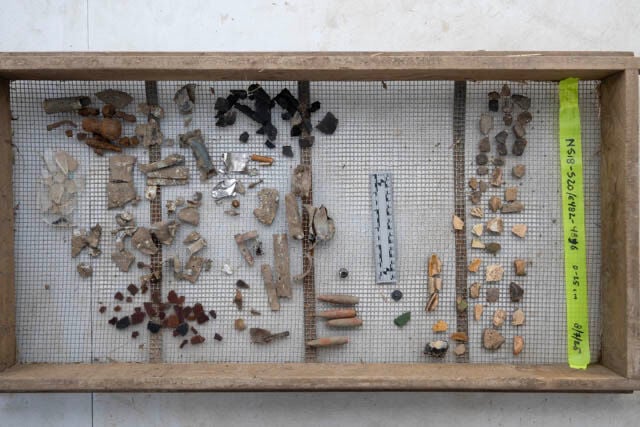
This assortment of artifacts were collected during a couple days of digging and sifting at the crash site in Poland of an American B-17 bomber shot down during World War II. The items on the left are from the airplane. The stuff on the right is old pottery.
“That's the real goal: from research to recovery on our own,” he said. “If we can get one center — let alone multiple centers — completely off of DPAA’s dime, now we're making a massive impact.”
Ingleby also wants to see the center open “an actual physical location,” where the families of Arizona’s missing service members can share their stories, conduct their own research and connect with experts and each other. “Then, as that network builds, maybe we do some get-togethers regularly,” he said.
Ingleby’s “dream mission” involves a B-25 bomber that went down during the Second World War, with two men from Arizona on board, near the Kuril Islands in the Pacific, between Japan and Russia’s Kamchatka Peninsula.
Assuming the wreckage is at a reachable depth, a recovery like that would require chartered boats and highly trained divers with deep-sea gear. A preliminary estimate places the cost at around $400,000 — “expensive, but really not at the same time,” he said. “That may just be too far of a stretch for (DPAA) to even look at, but because we're looking at our Arizona missing, maybe we can get there and do it for them.”
Blaze Smith is director of the ROTC programs and Veterans Education and Transition Services, or VETS, at the U of A. He’s also one of the faculty members headed to Germany next month to help out with the recovery missions.
“It's really humbling,” he said. “I mean, I haven't even done it yet, and I can already tell you that it's going to be one of the most powerful experiences of my life.”
As far as Smith is concerned, the new MIA center is the perfect fit for the U of A, with its roughly 8,000 “military-connected students” and standout programs in anthropology and archaeology.
“What this program means for our students, and for this community, is that we get to continue to answer the call to service. We can send veterans who are going to school here on missions to help repatriate missing in action service members,” Smith said. “It's super important, and I'm really excited to be a part of it.”

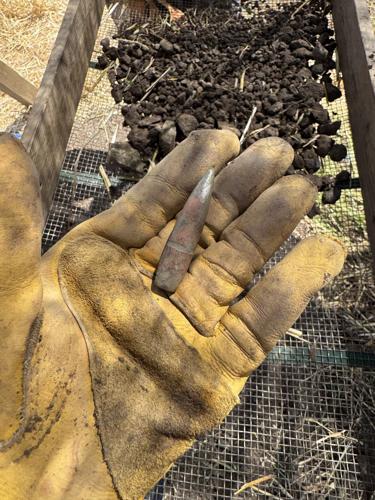
A 50-caliber slug from one of the B-17's anti-aircraft guns.
More meaning
Though the center is now an official university department, Ingleby said, much of its work is expected to be paid for with grants, sponsorships and donations to its nonprofit foundation.
He added that the students taking part in this summer’s study abroad mission to Germany are largely paying their own way, though some of them received help from donors or assistance from the School of Anthropology. They’re shelling out thousands of dollars because “they want to be a part of this,” he said of the students. “It’s really impressive.”
U of A anthropology professor James Watson said he signed onto the digs in Germany this summer because he was drawn to “the importance of the mission” and “the idea that we have the potential to recover missing service members from these sites and bring some closure to some of those cases.”
He also sees it as an ideal way to give students some important, real-world training.
“We're working towards offering a minor in forensic anthropology, and so this will build into that as an opportunity for the students to not just learn about it in the classroom, in the capacity that they already can, but actually get field experience in the process,” he said.
After all, the only way to know if you’re cut out for field work is to get out there and do it.
“It's not until you're living in a group for a month, getting dirty every day and digging holes that you really appreciate whether or not you want to do this as a profession full time,” said Watson, who started his career in forensic anthropology and now serves as associate director and curator of bioarchaeology for the Arizona State Museum at the U of A.
To hold an artifact in your hands and feel that direct connection to the past can be a powerful thing, he said, "but doing this type of work with DPAA and the center adds a whole other dimension of meaning.”
"It's not just simply the ability to handle and interact physically with history. It's also serving living families and their missing loved ones," Watson said. "I think it will be that much more impactful."




 New effort could ID dozens of USS Arizona unknowns