
PHOENIX — Depicting the human body is so easy even a caveman can do it.
But although artists have attempted to show us who we are since, oh, the beginning of human history, we have never seen ourselves with the astonishing accuracy on view in a blockbuster exhibition opening today in Downtown Phoenix.
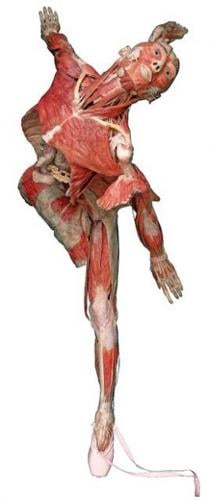
That's because "Body Worlds 3" at the Arizona Science Center shows us the real thing — bodies that were donated by their original owners for exactly this purpose and preserved through a revolutionary process called plastination.
More than 200 specimens are displayed, ranging from the three smallest bones in the body (in the ear) to organs, tissue, circulation and nervous systems and entire bodies.
The German who created "Body Worlds," the first version of which opened in Japan in 1996, is Dr. Gunther von Hagens, an anatomist who is often labeled an artist these days.
People are also reading…
"Nothing against artists," he said with a broad smile Thursday morning at a media preview of the show. "But I am a doctor and an educator more than anything else."
And "Body Worlds" is endlessly enlightening, to be sure. In addition to provoking thoughts on mortality, the show inspires thoughts about the way we live and the way we use — or abuse — our bodies.
How can a smoker or drinker not contemplate quitting when faced with the stark juxtaposition of a smoker's black lung next to a nonsmoker's lung and the reality of a healthy liver next to one burdened by years of alcohol consumption?
That is the desired effect, according to Dr. Angelina Whalley, a surgeon who was trained in Heidelberg before she became professionally and personally involved with von Hagens (they were married in 1992).
"I always hoped to cure disease, one patient at a time," she said. "But with this work, I am able to inspire healthy change. It is profoundly moving to see a group of teenagers leave a cigarette pack behind because maybe they decide that smoking is not so cool."
Said von Hagens about the smoker's lung on display: "I'm a physician of 20 years and I always like to link emotion to humanity. I like that this image sticks to people like the tar sticks to that lung."
While squeamishness might be a natural response from some, that reaction is almost always overwhelmed by pure fascination, von Hagens said.
"Why 'Body Worlds' opens the hearts of the peoples is because it is beauty beneath the skin, beauty that is not skin deep but throughout the body," he added.
The show has already been seen by more than 20 million people around the world.
Amy Weinstein, 29, a Tucson native who now lives in Seattle, saw the show last year.
"I thought it was a fantastic opportunity to view parts of the human body that were previously unaccessible," said Weinstein, who works as a book buyer for Amazon.com. "I also thought that the display of our blood vessels was particularly beautiful, and almost artistic."
Weinstein had dinner plans with her father after she saw "Body Worlds."
"Somehow I didn't feel like eating meat after the exhibit."
Although one of the most provocative specimens is seen holding his own skin, the body's biggest organ, most of the humans are seen minus skin.
Asked why, the doctor said: "Skin is everywhere. We see that every day in every way, from the movies to the Internet and everywhere else. I want to show what is beneath."
And it's a show that is expected to attract hundreds of thousands of visitors, said Chevy Humphrey, executive director of the Arizona Science Center.
"This exhibition comes to Arizona from Vancouver, and several of the whole-body specimens have never been seen in the United States until now," she said.
The preservation process developed by von Hagens allows people another choice about what to do with their bodies after death.
"Already we have more than 7,000 people, mostly in Germany, who have donated their bodies and who are still living."
Future generations will learn a great deal from their generosity, he said.
For now, "Body Worlds" provides an education about ourselves that until now was simply unimaginable.
if you go
What: "Body Worlds 3: The Anatomical Exhibition of Real Human Bodies."
Where: Arizona Science Center, 600 E. Washington St., Phoenix.
When: Today through May 28.
Hours: 9 a.m. to 7 p.m. daily.
Tickets: $22, with discounts available.
More info: www.azscience.org and www.bodyworlds.com


 Tucson's newest Shake Shack gets neighbors