Today's pecan groves in Sahuarita started out well over 100 years ago as fields of guayule, planted by very wealthy private investors as a means of bolstering the U.S.' fighting efforts during World War I.
Today, as the groves are being sold by owners Farmers Investment Co., the fling with that rubber product stands as one of the farm's four incarnations since the guayule operation started in 1916. They include more than 40 years of cotton growing under two different owners, as well as the pecan growing that started in 1965.
Since 1965, the groves and their operators, the Walden family, have twice been steeped in prolonged legal and political conflicts. Both times it was against nearby copper mines, and both times it was at least in part over groundwater.
People are also reading…
The most recent conflict, over the proposed Copper World mine, shows no sign of abating even as its developer, Hudbay Minerals, has announced plans to start mining in 2029.
Back in 2016, the Intercontinental Rubber Co., founded by financiers Joseph P. Kennedy, Bernard Baruch and J.P. Morgan, began growing the guayule on what was then known as Continental Farm on lands next to the current unincorporated retirement community of Green Valley, along the Santa Cruz River's east bank.
Guayule is a natural source of rubber. The U.S. government encouraged its production out of concern that the German Navy would cut off the world's principal rubber sources that grew in the Far East.
A small town built up in the area of the guayule fields in Continental to accommodate the farmers and their families. A post office, a general store, a schoolhouse, a church, barracks, a chemistry laboratory, a railroad station and a cemetery sprung up quickly. But the guayule project was abandoned after the war ended.
In 1922, Queen Wilhelmina of the Netherlands bought the company and the farm, and rented it out to cotton farmers until 1948. Then she sold it to Keith Walden, a California native and son of a citrus and walnut farmer in the San Fernando Valley.
Keith Walden started his own citrus farm in California in 1937 while in his mid-20s. He founded Farmers Investment nine years later, says a tribute to him published by the Arizona Farm and Ranch Hall of Fame, into which he was inducted in 2009.
Realizing the costs of farming in California were soaring, Walden, using additional capital from Colonel Henry Crown of Chicago, bought the then-10,000-acre Continental Farm in the Santa Cruz Valley in 1948. He moved his wife and two sons, Richard and Thomas, to Continental in 1949.

Dick and Nan Walden, owners of the Farmers Investment Co. pecan groves in Sahuarita, photographed in 2010. By the end of this month, an undisclosed out-of-state partnership will take over FICO’s farms in Sahuarita, Continental and San Simon after 71 years of ownership by the Walden family.
Besides growing cotton, he ran as many as 9,000 head of sheep and opened a cattle feedlot that played host to up to 20,000 head of cattle. He closed the feedlot during the 1970s, acknowledging that its odor was no longer compatible with the fast-growing Green Valley.
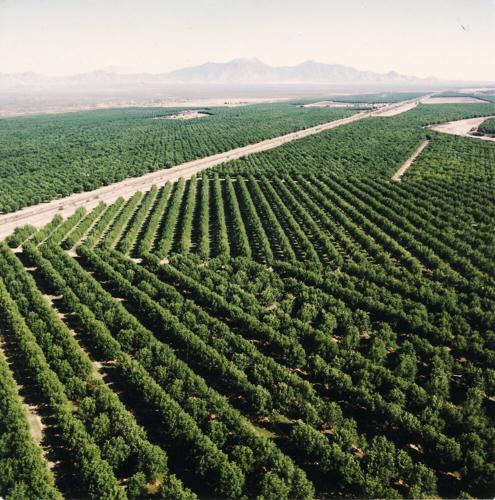
Today, the groves in Sahuarita and in San Simon, together, hold about 390,000 trees. Back in the 1970s and early '80s, the Sahuarita groves alone had 300,000 pecan trees, but the groves were thinned later that decade to give the trees more space.
And in the 1960s, Keith Walden traveled to Washington to lobby for construction of the Central Arizona Project, to bring in an outside water source from the Colorado River in place of his farm's already declining wellfields.
Competition for groundwater
But long before CAP water was scheduled to arrive in the Tucson area in 1991, the pecan groves became ensnared in a controversy over groundwater rights, a controversy that led directly to the enactment of Arizona's pioneering Groundwater Management Act.
In 1969, FICO sued six mining companies in Superior Court here, claiming they were illegally pumping water that the groves needed for irrigation. The mining companies countersued the following year, arguing, in the words of the Anaconda Co., that the farms "were not using reasonable methods of conservation."
Farmers Investment pointed out that its land had been used for agriculture for more than 60 years. The mines and the city of Tucson, which later got drawn into the lawsuit, didn't start pumping in the Santa Cruz Valley until the 1950s, FICO said.
The mines, however, countered that Farmers Investment could dramatically reduce water use by watering its trees individually rather than flooding its fields, long the customary method of irrigation in the Southwest.
Bruce Babbitt, who was Arizona's attorney general at the time, recently recalled the roots of the conflict, saying, "FICO was an enormous groundwater user. It looked across at the mining going on, on the other side of the valley.
"Quite understandably, it was pretty insightful on their part. They said, 'We can’t tell you we’re being damaged right now, but we can tell you that the mines pumping will ultimately destroy our pecan growing industry,'" he said. "Keith Walden was a smart guy. He saw that if the mines continued pumping, it would ultimately seriously impact his operation."

An undated aerial view of the FICO pecan groves south of Tucson.
The competing claims were complex enough that in 1974 — nearly two years before the Arizona Supreme Court rendered a final ruling — filings and other proceedings in the case filled 24 volumes at the Superior Court clerk's office in Tucson.
The final ruling, in August 1976, sent shock waves across the state's water world. The high court ruled in FICO's favor, concluding the city of Tucson and the mines couldn't legally transport groundwater from city wells underneath land they owned near FICO's groves to their own operations — the copper mines and the city water system in Tucson.
The ruling had "dire consequences for the city," threatening its access to its wells 35 miles south of Tucson that provided about 12% of its drinking water supply, City Manager Joel Valdez said shortly after the decision came down.
Several mining companies said that if the decision stood, they'd have to close their Tucson-area operations, which would threaten their investments totaling $300 million to $400 million.
"There was panic," recalled Babbitt.
‘A gun it couldn't shoot’
But FICO never moved to enforce the court's ruling by seeking an injunction to shut down the city and the mine's pumping, because of the massive economic impacts and political controversy that would cause, recalled Kathleen Ferris, a longtime Phoenix water attorney who was heavily involved in drafting the 1980 groundwater law.
She recalled that in a documentary she later produced on the groundwater law, retired mining attorney Jim Bush said, "FiCO knew it had a gun that it couldn't shoot."
Babbitt became governor in 1978 and orchestrated the legal fix to this conflict by pushing through the groundwater law that clearly spelled out which parties had the right to pump which water supplies.
That came after the court ruling prodded the Arizona Legislature to form a commission to look for solutions to this and other water conflicts burgeoning across five Arizona counties, including Pima, where subdivisions were gradually replacing farms.
Four years and endless negotiations and hearings later, Babbitt signed the Arizona Groundwater Management Act. It settled the Tucson area's water fight between the mines, the city and FICO, while simultaneously authorizing the state to limit future pumping by cities and farms, but not mines.
The law said transporting groundwater across property lines within a groundwater basin was permissible, said Ferris. The city, FICO and the mines all operated within the same basin.
But "they can't go searching for water far away," outside the groundwater basin where they operate, Babbitt said, except for five western and northern Arizona basins that later gained exemptions from that restriction.
FICO officials themselves weren't at the table for the negotiations over the bill, he said.
"There were no other parties other than FICO that had any real interest in supporting their position," Babbitt said. "FICO just kind of faded away" from the groundwater law negotiations, he said.
Didn't take CAP water
Later that decade, Keith Walden's son Dick, who became president of the company in 1983, declined, along with other Tucson-area farmers, to plan to take CAP water.
The Waldens and other Southern and Central Arizona farmers had advocated for the CAP to Congress back in the 1960s as an agricultural lifeline.
But the Waldens and the other Tucson-area farmers in line for getting CAP water were eventually put off by the water's high cost — twice that of pumping groundwater — and by federal rules, since repealed, that would have required them to sell off their lands that exceeded 960 acres to get the federally subsidized water.
Their decision proved to be a blessing in disguise for FICO. When the CAP water started being delivered in the middle 1980s to Phoenix and Pinal County, farmers and irrigation districts in Pinal County willingly took it, only to realize by the early 1990s that it was so expensive they couldn't afford it, as a University of Arizona economist had warned 15 years before.
The Pinal County farmers escaped bankruptcy only because officials running the CAP eventually approved bargain-basement rates for the water in the 1990s.
When CAP water started being delivered to Tucson in the early 1990s, none of the farms here took a drop.
Fight against copper mine
The most recent controversy in which the Waldens have been involved started in the middle 2000s when Canadian mining company Augusta Resource Corp. bought thousands of acres of land on the Santa Rita Mountains' east slope and proposed to put the U.S.' third-largest copper mine there. The mountain range is east of the FICO property in Sahuarita.
Dick and his wife, Nan Stockholm Walden, almost immediately joined numerous environmental groups and tribes in a fight against the project that continues today. Augusta and Hudbay Minerals Inc., which bought out Augusta in 2014, promised hundreds of permanent jobs and thousands of construction jobs and billions of dollars in tax revenues. But the Waldens and other opponents raised concerns about the mine's effect on groundwater levels, its expected destruction of prime habitat for the endangered jaguar and other imperiled species, and its construction impacts on cultural sites.
Echoing FICO's groundwater wars with the mines during the 1970s, the Waldens once again raised alarms that the new mine's pumping would dry up their farm's wells.
That stance brought them plenty of criticism from mine supporters. They noted that the Waldens used three times as much water and pumped 66% more groundwater in an average year than Hudbay will pump for what it now calls the Copper World mine (a previous version of the proposal was called the Rosemont Mine).
The Waldens have responded by spending — jointly with the mining company Freeport McMoRan — $17 million to build a pipeline to extend CAP water down to the farm and smaller pipelines to deliver the water from a central spot at the farms to the groves.
That CAP water is now owned by the city of Tucson and Freeport, which obtained a formal state designation of the pecan groves as a Groundwater Savings Facility because the CAP water has reduced the farm's pumping.
The Waldens gave verbal support to all the lawsuits that mine opponents have filed over the years, although FICO was not a plaintiff in the suit that stopped the Rosemont Mine in 2019. That case led to landmark federal court rulings that Hudbay couldn't dispose of its waste rock and mine tailings on federal land, which essentially shut down the mine proposal.
In the ensuing years, FICO has since been a plaintiff in four more recent lawsuits against the mine. But with Hudbay having moved its planned mining operations onto private land on the Santa Ritas' east slope, where there are no federal regulations, FICO and other opponents have not yet found a path to stopping the project again.
‘Hard to fight a battle with pecan money’
Hudbay has said it expects to start construction on Copper World by the end of 2026 and to start mining in 2029.
Still, Nan Walden told the Star, "The Waldens continue to be active supporters of Save the Scenic Santa Ritas," the leading mine opposition group.
"FICO has pioneered water sustainbility by establishing its farm as a Groundwater Savings facility. Nan and Dick support the efforts of SSSR and the broader coalition to protect our drinking water through conservation of our precious groundwater," she said last Wednesday in a text message.
The Waldens declined to respond to a question from the Star as to whether they're still providing financial support to the mining fight, as they had done for many years.
"Dick and Nan Walden have been very helpful for many years in the battle to prevent open-pit copper mining in the northern Santa Ritas," said Gayle Hartmann, former longtime president of Save the Scenic Santa Ritas.
"Because the family has a long history in the nearby Santa Cruz River Valley, they understand the negative impacts associated with mining on the edge of the valley. Especially, they understand that such a mine would use an enormous amount of groundwater table in an area with a growing population and a limited supply of water," Hartmann said.
Hudbay has promised to build a pipeline to deliver CAP water for the mine.
Asked to comment on FICO's sale and the Waldens, Hudbay said in a statement, "Hudbay looks forward to meeting with the new ownership group. As large commercial entities in this region, we share common interests and see a great opportunity to work constructively for the long-term prosperity and well-being of our community."
For FICO CEO and President Brian Driscoll, the outcome of the mine conflict will revolve around money.

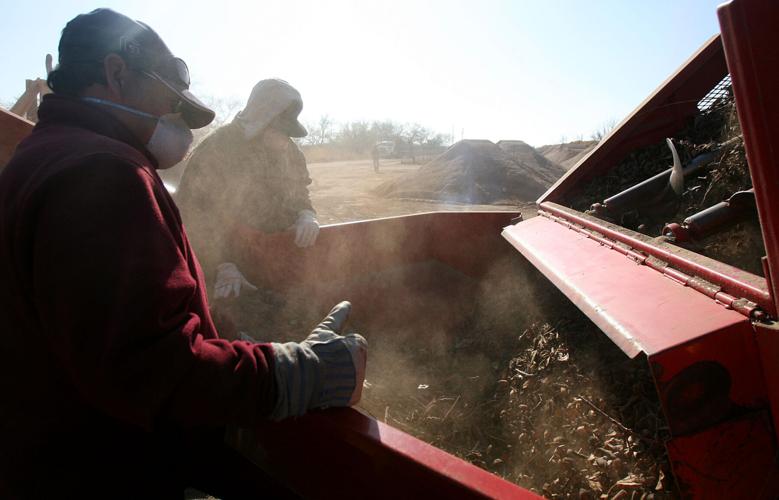
Workers watch for large debris as harvested pecans are dumped onto an elevator for transport in one of the orchards owned by FICO, operating as the Green Valley Pecan Co., in this 2010 photo.
“You have to have a lot of pecans to fight that battle. Quite honestly, the mine makes more money than pecans make. It’s just hard to fight a battle with pecan money,” he said.
A fixture in this region
However the mine conflict turns out, it could well be the Waldens’ last battle. By the end of this month, an undisclosed out-of-state partnership will take over FICO’s farms in Sahuarita, Continental and San Simon after 71 years of ownership by Keith and Dick Walden and their families.

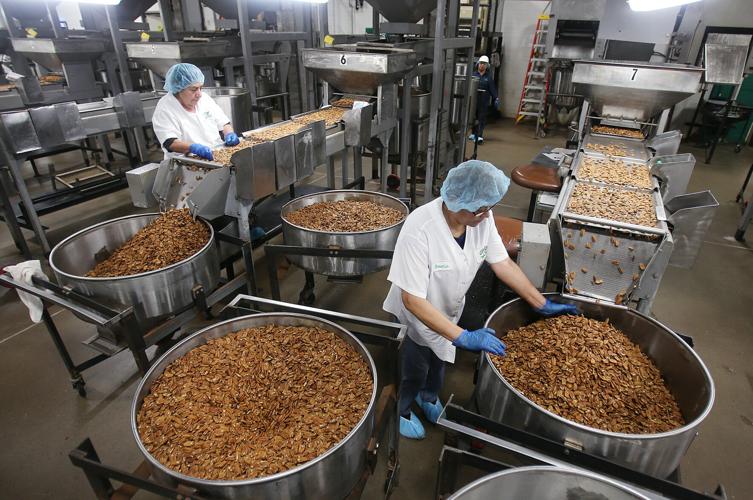
Workers weed out pecans during a final visual inspection inside the plant at FICO's Green Valley Pecan Co. in a 2014 photo.
After staying on for a six-to-eight month transition period, CEO Driscoll and his wife plan to move to northern New Mexico because “we don’t want to be hotter” after living in the Tucson area for 40 years, he said. Dick and Nan Walden will retire to their homes in Amado, south of Tucson and near Santa Barbara, California, while staying active in environmental issues.
Through economic booms and busts and through one controversy after another, Farmers Investment Co. has been a fixture in this region since just after World War II, but its era is coming to an end.
Contact Tony Davis at 520-349-0350 or tdavis@tucson.com. Follow Davis on Twitter@tonydavis987.

Tony Davis
Reporter