Over the last nine years, one University of Arizona office has helped generate $3.3 billion in economic output, $1.2 billion in labor income, and $122.2 million in tax revenue.
Over the next five years, it's projected to add another $2.46 billion, $855.5 million, and $90 million, respectively.
That office is Tech Launch Arizona (TLA), and its business is turning good ideas into impactful companies.
I sat down with Doug Hockstad, the university’s chief innovation officer and TLA’s executive director, and Paul Tumarkin, director of marketing and communications, to understand how those numbers came to be.
In 2012, the University of Arizona made a strategic bet: the research happening across campus — by graduate students, faculty, researchers, and staff — wasn't just academically valuable. It was commercially valuable too. TLA was created to prove it.
People are also reading…
The process starts with an invention disclosure, moves to a patent or some other form of intellectual property that protects the inventor's ideas, and rolls out to market with a license that turns the idea into revenue. In fiscal year 2026 alone, that pipeline produced 372 invention disclosures and 11 new start-up companies.
TLA's job is to manage all of that intellectual property on UA's behalf — assessing market opportunity, gauging competitive impact, and charting a path to traction and growth. Along the way, as new ventures take shape, startup teams get access to subject-matter experts, industry-specific attorneys, manufacturing and commercialization partners, experienced entrepreneurs, and — critically — capital.

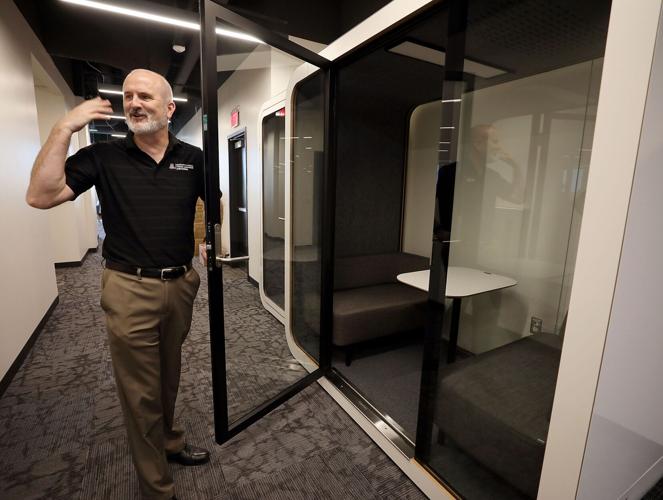
Doug Hockstad, the University of Arizona's chief innovation officer and executive director of Tech Launch Arizona, gives an office tour in 2022, when TLA moved into The Refinery at The Bridges,1600 East Idea Lane.
For UA, the payoff usually comes as royalties on sales plus a small equity stake. Those royalties are TLA's main revenue source, averaging about $10 million a year for the university.
Capital, though, is often the hardest part of the equation for early-stage companies — so TLA and UA built several vehicles to solve for it:
— UAVC, an independent but affiliated venture capital fund, founded by Fletcher McCusker and Michael Deitch. They provide early-stage funding to help a fully developed product start generating revenue, aiming for a transition event where both the inventor and the fund see meaningful returns.
— A philanthropy-backed fund steps in even earlier, when almost no one else will, typically investing $100,000–$200,000 in start-up capital in exchange for equity. The goal is to make the fund evergreen — its returns fund the next round of bets.
— The Wildcat Investor Network, the newest of the three, taps UA alumni as investors, with TLA acting as convener and manager.
Here are a few quick examples of the successes that have come out of the TLA process:
— Intraocular Lenses for cataract patients. They allow more light into the eye, dramatically improving vision. These lenses have been implanted in millions of eyes worldwide.

Tech Launch Arizona moved into new office space in 2022.
— SinphoníaRx, a software that identifies conflicts between medications a patient is taking. McCusker licensed the platform, and grew and sold the company.
— NeuroID, a global leader in behavioral analytics that was commercialized through TLA and acquired by Experian.
As a land-grant university, part of UA's mission is Arizona's success. TLA's purpose, according to Hockstad, is societal and economic "impact" — a direct implementation of that mission.
Which brings the story back to those numbers at the top of this column. Behind the $3.3 billion in economic output, the $1.2 billion in labor income, and the $122.2 million in tax revenue — with more on the way — are a lot of moving parts, carefully managed by Hockstad, Tumarkin, and their team.
Tech Launch Arizona launches and grows companies. It grows Arizona's economy. And it grows the University of Arizona's impact far beyond its campus.