Recently obtained documents reveal that the Buffalo Police Internal Affairs team accused two officers of lying to an investigator, under oath, about the bogus cocaine charge they lodged against a Black motorist last year.
But one of the officers has already beaten the departmental charges. The other might win as well. Meanwhile, the district attorney told The Buffalo News he doesn’t think he can convict either of perjury and will not bring a case.
Body camera video of the traffic stop in March showed Officers John M. Davidson and Andrew T. Moffett never should have charged Morgan T. Eaton with cocaine possession.
Their field test told them the substance in his vehicle was not cocaine. The felony they placed anyway could have sent the father of four to prison for a year or more.
People are also reading…
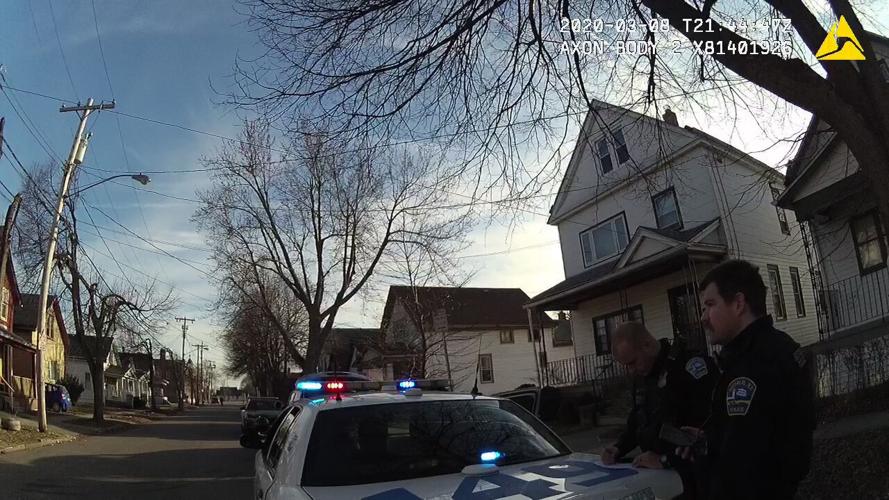
Officer Moffett examines a capsule and comes away doubting that each capsule contains cocaine.
The charge was dropped months later when the crime lab found that the mystery powder inside some gel capsules was not a controlled substance. Eaton and his fiancée say the capsules were suppositories she purchased for a yeast infection.
An Internal Affairs transcript obtained by The News shows Officer Davidson had a memory gap when he sat for a formal interview last summer, four months after the arrest. He couldn’t remember if a field test had been done or not. The head of Internal Affairs later accused him of perjury and violating department standards.
Davidson, however, took his matter to arbitration and won in April. He’s back on the job.
Moffett’s transcript shows him directly contradicting the video’s most critical moment. He told Internal Affairs his field test confirmed the pills contained cocaine, even though he insisted at the scene that, “It’s just not coke.”
Moffett’s case has yet to go before an arbitrator, but there are signs his departmental charges, too, might not stick. He remains suspended with pay.
DA won't prosecute
Erie County District Attorney John J. Flynn refused last year to criminally prosecute the officers for lodging the felony, reasoning it would be difficult to prove they knowingly lied on the court documents charging Eaton with the felony. Flynn, at the time, did not know of the statements to Internal Affairs.
But that doesn’t change his view.
“I don’t have enough for a perjury charge,” he said.
Flynn said he could not convict Davidson of perjury for answering “I don’t know” and “I don’t remember” because a prosecutor can’t get inside someone’s head to learn what they do know and do remember.

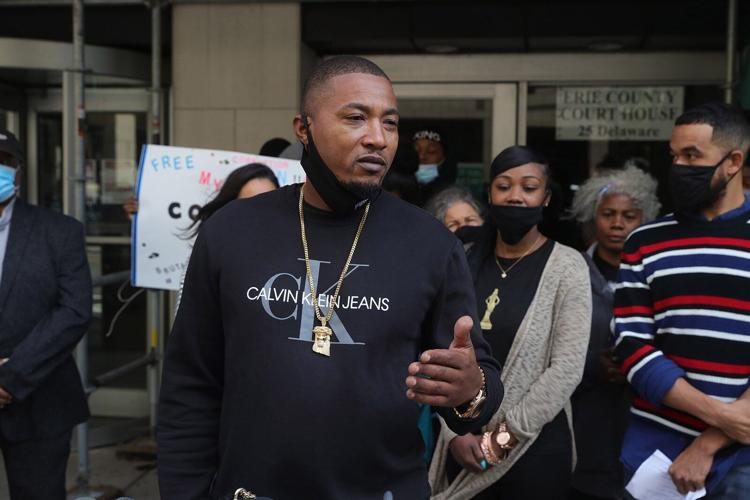
At a protest on Wednesday, Oct. 7, 2020, outside the Erie County District Attorney's Office, Morgan Eaton and a group of protesters demanded that District Attorney John Flynn prosecute Buffalo police officers involved in the March 8, 2020, arrest of Eaton on a cocaine possession charge, despite a field test conducted by police that showed the capsules he possessed were not cocaine.
Moffett’s statement is different, Flynn agreed, before explaining his reasons why a perjury case against him would still fail.
For one, Moffett was never reminded he was under oath when he was called in for his second Internal Affairs interview, on Aug. 19, when he said the field test showed a positive result for cocaine. Compounding that problem: The police department has been unable to produce a transcript Moffett signed affirming the standard clause that his statements are true “under penalty of perjury.”
Flynn said one of his assistant prosecutors asked Moffett in recent weeks about his departmental charges – because Moffett will be a witness in a criminal case. The prosecutor learned, Flynn said, that Moffett maintains the white powder produced a “faint blue” color on the test swab – either on the first test or a quick second test he might have conducted but which, Flynn agreed, can’t be seen on the video.
The papers charging Eaton with a felony mention no faint blue color, nor did Davidson mention it in his interview, nor is it discussed at the scene. Throughout the body camera video, the officers discuss the fact the substance tested negative for cocaine.
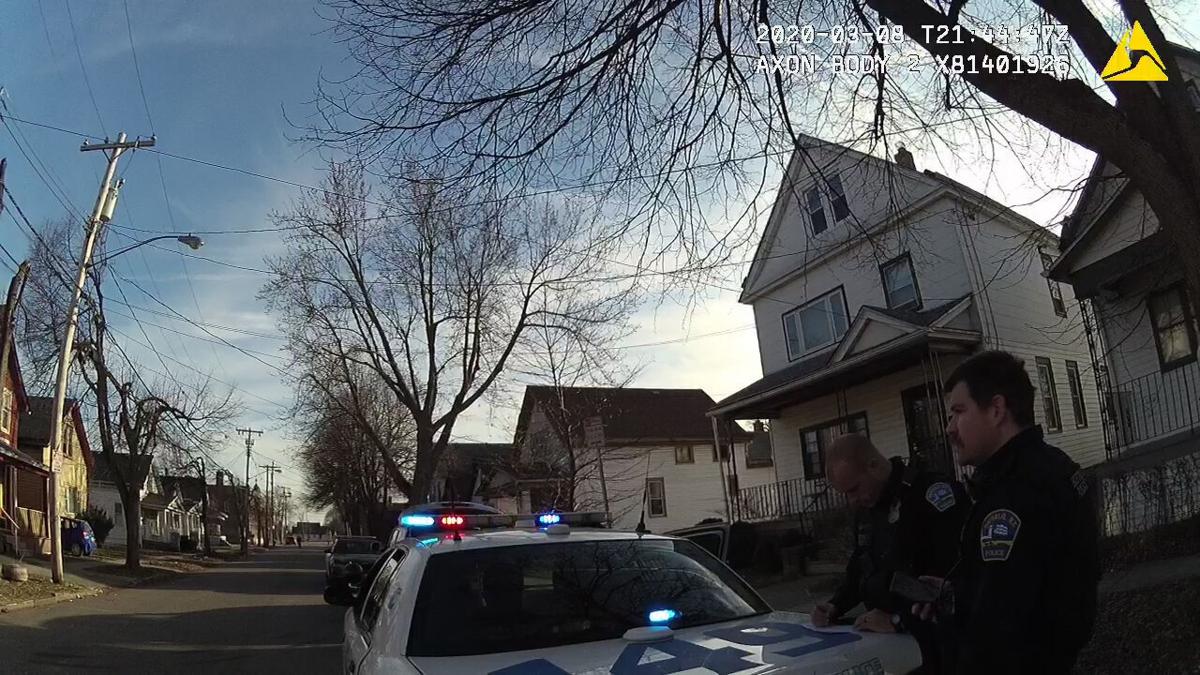
Officers Moffett and Davidson debate whether the capsules contain cocaine and turn to their phones to research other possibilities.
To Flynn, “there’s clearly a question of fact about what happened.” He said he cannot prove beyond a reasonable doubt Moffett knowingly lied. “I’d get killed at trial.”
Flynn said Moffett was giving his assistant prosecutor a view into the arguments he and his union lawyer will present when they go before an arbitrator. John Evans, president of the Buffalo Police Benevolent Association, did not return a message seeking comment, nor did a union-hired attorney involved in his case.
The traffic stop
For months, the department-promised Internal Affairs inquiry remained hidden from the public because police officials were holding up a Buffalo News request for the records under New York’s Freedom of Information Law. The department disclosed the officers were suspended – the first 30 days were without pay – but said little more.
Now, hundreds of pages provided days ago reveal the officers, when formally questioned, did not admit to what their body cameras captured on the unusually warm Sunday afternoon of March 8, 2020.
The officers stopped Eaton on a side street because he did not signal when he pulled to a curb. Smelling marijuana – Eaton had a personal amount in the vehicle – they searched the passenger compartment and plucked a pill vial from a satchel his fiancée had left behind, next to a child safety seat. The officers immediately suspected the capsules contained cocaine.
Officer Andrew Moffett finds a vial of pills and shows them to Officer John Davidson. They immediately suspect cocaine.
Video from Moffett’s body camera showed him, on Strauss Street, tearing open a small envelope kept in his pocket. He removed a moist slip of fabric and emptied a capsule onto it. He rubbed the powder around, and in seconds the field test gave him his result.
“It’s not coke,” he told his partner.
Minutes later, they were filling out paperwork charging Eaton, who was sitting in their patrol car, with the cocaine-related felony. The officers assumed each pill contained a gram. And they alleged Eaton did not just possess cocaine but was dealing it as well.
“Dude,” Davidson said to Moffett as they calculated 30 grams of cocaine, “that’s actually a huge charge.”
Moffett's answers
On Aug. 19, Moffett sat for an interview with Internal Affairs Lt. Stacy E. Lewis. A police union attorney was at his side.
Moffett told the lieutenant that he had tested the powder with a kit given to officers by the department’s narcotics division, a NIK test. The powder, Moffett said, turned the paper blue.
“Blue indicates a positive result?" he was asked.
“Yes,” Moffett said.
“And it did turn blue?”
“Yes.”
“So based on your information, belief, past experience, you had every reason to believe that this was some form of cocaine?” Lewis asked.
“Correct,” Moffett said.
Davidson: 'I don't know'
When Davidson sat before Internal Affairs he remembered Eaton’s demeanor, smelling marijuana, problems with the car’s registration, the warrant from the Town of Tonawanda over an unpaid traffic ticket, and the rug under the child seat being spattered with crumbs, because, to Davidson, that conflicted with Eaton's insistence he just bought the vehicle.
As to whether the powder was tested, Davidson could not recall.
“I didn’t have a NIK,” Davidson said when the lieutenant raised the question of whether the officers were equipped with a test.
“To my recollection, I don’t remember NIK testing it.”
“So no testing at the scene, to the best of your recollection?”
“No,” Davidson said, “I think … ah … cuz we called narcotics to kind of confer with them so I … don’t think I would have called narcotics had we already been able to NIK test.”
With that answer, Davidson almost said there had been no test, which would have been clearly false.
“But honestly," he continued, "I don’t … I don’t know if we NIK tested.”
During the arrest, the negative cocaine test dominated the officers' conversation. At one point, Moffett showed Davidson the test swab to prove his point. Davidson peered at it from inches away. He agreed with his partner that the swab did not indicate cocaine.
They then guessed what the substance might be since it wasn’t coke. Was it fentanyl, PCP, meth or vitamins, they wondered.
Inspector Robert V. Rosenswie, the head of Internal Affairs, saw Davidson’s answer as a lie. Writing up the paperwork alleging perjury, he said Davidson reported no test was done when a test had been “conducted in front of the officer.”
Probe almost derailed
The Internal Affairs file shows the wheels of the investigation turned slowly. Before the matter reached Lewis, it was examined within the C District, where Moffett and Davidson are assigned. The district inquiry focused mainly on whether Moffett and Davidson were rude to Eaton. A captain concluded they hadn’t been.
“After watching the body camera footage, I am proud of the way these officers speak and treat the public," Capt. Jason R. Whitenight wrote in a memo. “I respectfully request that this case be deemed unfounded.”

Morgan Eaton on Strauss Street in Buffalo, where he was stopped in March by the police and charged with a felony of cocaine possession. Buffalo police body camera video shows the officers conducted a field test that determined the pills did not contain cocaine, but arrested him anyway. Eaton has since sued the city and the police officers.
Eaton and his fiancée, Dominique Calhoun, refused to accept any outcome that did not lead to serious discipline. Eaton and Calhoun are the parents of three children, and Eaton has a son from another relationship. The couple say they have been the victims of heavy-handed treatment by C District police in the past.
Eaton calls the traffic stop and the rush to judgement a classic case of Driving While Black.
“They tarnished my reputation,” he wrote in his complaint to the department, “charging me with cocaine and intent to distribute, which were blatant lies.”
The internal investigation moved downtown, landing before Lewis. After interviewing the police officers, she turned to Eaton, giving him a chance to “tell your story,” she said when they gathered on Sept. 11.
The session appeared to sour when Lewis said she understood the white powder tested positive for cocaine, as Moffett told her weeks earlier.
“The NIK test came back blue,” Lewis told Eaton, according to a transcript. “ … It indicates a controlled substance.”
Eaton was sitting with an attorney who intended to prepare a lawsuit, Matthew Albert. By then, both had seen the body camera video, and they challenged her.
Eaton had already told the lieutenant the video showed one officer tell his partner three times the substance wasn’t coke. Albert, who once worked as an assistant district attorney, said arrest papers almost always note a positive field test if there has been one.
Why didn’t the court papers filed against Eaton mention a field test? he asked.
“Yeah,” Lewis said, “we will take a look at the video again.”
Momentum builds
The file shows little action for the next 11 days, until The Buffalo News on Sept. 22 emailed the Buffalo police spokesman, Capt. Jeffrey D. Rinaldo, telling him the news organization had body camera video of Eaton’s arrest and was seeking comment for an article.
“Is it proper police work to charge someone with cocaine possession when the officer has serious doubts that he or she has seized cocaine?” The News asked.
The next day, Police Commissioner Byron Lockwood ordered Davidson and Moffett placed on administrative leave immediately. And the following day, Sept. 24, the head of Internal Affairs, Rosenswie, signed the papers formally accusing Moffett and Davidson of dishonesty in the arrest and their internal testimony.
The papers also alleged the officers had committed perjury under New York’s Penal Law, but there is no sign the department contacted county prosecutors to place criminal charges. In Davidson's case, the department produced a transcript he signed under penalty of perjury.
The Buffalo PBA quickly let the department know it would contest the matter.
Arbitrator's decision
Months later, in April of this year, the case went before arbitrator Jeffrey M. Selchick.
Selchick has decided other high-profile disciplinary cases involving local police. He ruled last year that the Town of Cheektowaga could not fire an officer who decked a supervisor because, the arbitrator said, the attacker had a clean disciplinary record up to that point. In 2013, Selchick ruled the City of Buffalo owed an officer about $200,000 in back pay because it fired him – without a hearing – when he was caught running a marijuana-growing operation. In 2014, Selchick ruled the city could fire a police officer who had threatened to kill a woman in a private-life dispute fueled by jealousy.
With Davidson, the arbitrator dismissed the charges, saying the city failed to prove its case. “There is insufficient evidence,” Selchick wrote. He provided no other explanation in his one-page report.
Selchick did not respond to a Buffalo News email and phone message seeking comment.
As for the statement Davidson signed charging Eaton with cocaine possession when no cocaine was found – which the Buffalo Police Department also considered perjury – Selchick and Flynn are in agreement there, too.
In October, after The Buffalo News published its article about the arrest, Flynn called a news conference to say he would not charge the officers with a crime.
Most of Flynn’s comments were about Davidson, who signed the accusatory documents. Flynn said that judging by the video, Davidson seemed to believe – despite the field test – that the substance was cocaine, so prosecutors could not say he knowingly made a false statement. Further, the officers submitted the pills to the crime lab for confirmation, meaning their word alone would not keep the cocaine possession charge alive, Flynn said.
Future testimony
But acknowledging the way the bogus felony disrupted Eaton’s life, Flynn said: “Bottom line, they should have never charged him. They should have waited.”
Last week, Flynn acknowledged the fodder that the Eaton matter will give defense lawyers as they challenge the credibility of the arresting officers – Moffett especially – whenever they testify against future defendants.
Said Flynn: “Moffett is just going to have to explain on the witness stand, ‘I did not commit perjury.’ ”