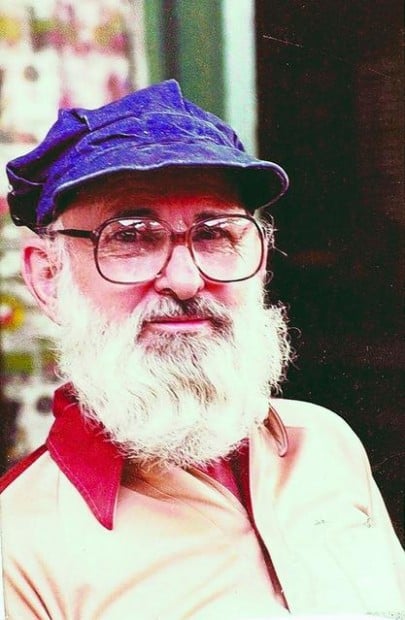
Critics compared his writing to that of Mark Twain, William Faulk-ner and Edgar Allan Poe.
Publishers called him brilliant. His first novel was adapted into an acclaimed play. And Kurt Vonnegut sent him a note praising his prose.
Yet Bisbee-based Donald Wetzel remained one of the best authors nobody has never heard of.
Friends, family and fans of the colorful writer will gather at 3 p.m. today at the Copper Queen Hotel and Saloon in Bisbee to remember Wetzel, who died June 21 at 86.
Wetzel was born in upstate New York, one of three brothers. Though his life was marked by tragic and tumultuous events, Wetzel clung to the small joys of life.
"My father was basically an atheist, but probably the most spiritual person I've ever met," Joseph Wetzel said.
People are also reading…
When the future author was 13, his mother was fatally hit by a car as she crossed a street. His father, an architect, "felt it would be too much for him to care for three boys," Joseph Wetzel said. The boys were split up and sent to live with relatives. Donald stayed with his father's family in Alabama.
"The family there treated him like an indentured servant," said Wetzel's daughter, Naomi Wetzel McCoy. "That's where he really read a lot, kind of escaping that world and questioning the larger world and trying to take himself out of that one small place."
The events following the death of his mother led Wetzel to take an interest in literature as an intellectual oasis, but the next major event in his life — World War II — stirred his need to write down his own thoughts.
"He decided he was absolutely against it. Everything in his being was against going to war," Joseph Wetzel said.
His father, influenced by writer and naturalist Henry David Thoreau, spiritual and political leader Mahatma Gandhi and radical poet Walt Whitman, registered as a conscientious objector. With Hitler's Nazis cutting a swath through Europe, it wasn't a popular time to take that stand.
Though his objections were based on moral, not religious grounds, Wetzel was given the option of staying with Quakers in a conscientious-objector camp instead of going to prison.
"He took a hard stand on that and he said, 'If it's wrong, it's wrong,' " his son said.
Wetzel, then in his early 20s, was sentenced to more than a year in an Ohio federal prison.
"They put him in solitary confinement until he cracked up," his son said. "They put him in solitary to break him."
After his breakdown, Wetzel spent time in a psychiatric ward before being shipped to a federal prison in Kentucky. That's where the pacifist met Louis "Lepke" Buchalter.
Buchalter, who eventually died in the electric chair, was a member of "Murder Incorporated," the name given by the press to an organized crime group that carried out hundreds of murders on behalf of the mob.
Wetzel was a small man and no match for bigger, tougher convicts, so when the mobster mistook him for a fellow Jew, Wetzel didn't correct him.
"The two men had nothing in common, (but) he thought my dad was Jewish so he decided to take him under his wing. Louie Lepke was larger than life, and he protected my dad from other people in the prison," Joseph Wetzel said.
It was from his prison experience that Wetzel eventually wrote "Pacifist: Or, My War and Louis Lepke," in 1986.
Before the publication of "Pacifist," though, he penned six novels. The first, a story about love, "A Wreath and a Curse" in 1950, was turned into a Broadway play. Wetzel was living in New Mexico when the play opened to critical acclaim in 1954. He was working as a janitor and couldn't afford to travel to New York.
Wetzel's writing was lauded by critics, but it didn't generate a steady income for the author, who would wed four times — twice to the same woman — and have four children.
His first wife, Britta, the mother of his two oldest children, Mia Manifold and David Wetzel, both of Alabama, started out as his sister-in-law.
"He actually stole her away from his brother," Joseph Wetzel said. "My dad was ashamed of it later, but my dad felt his brother wasn't taking care of her like he should be."
Britta had emotional problems, and after divorcing and remarrying Wetzel she committed suicide.
"It affected the way he connected to people," his son said. First his mother's death, then his wife's made Wetzel "terrified" to become close to people.
Wetzel wed Joseph's mother, Mary, a writer, but eventually he left her to marry Nancy, a 19-year-old almost 30 years his junior. The couple eventually landed in Bisbee, where they raised their daughter, Naomi.
The family shake-up found its way onto the pages of Wetzel's 1973 book, "A Bird in the Hand."
"It was probably his best-written book, but the family all hates it for obvious reasons," Joseph Wetzel said.
Donald and Nancy were happy for a while, his son said, but the age difference took its toll and they, too, divorced.
Wetzel received a Guggenheim Memorial Foundation fellowship in 1956 while he lived in Flagstaff, and he accrued writing awards throughout his career. But he didn't make money at his craft until the early 1980s, when a small New York press took an interest in his book, "The Complete Joel's Journal and Fact-Filled Fart Book."
The book is a fictional account of an 11-year-old boy and his relationship with his father.
"Joel's Journal" had such an authentically youthful tone that the publisher thought it was written by a precocious boy.
The vagaries involved in book distribution prevented "Joel's Journal" from reaching major bookstores. But marketed to gift shops worldwide, the book sold more than 3 million copies and was translated into several languages.
"It was the 'fart' that helped sell the book and I think that's unfortunate, because the book is brilliant," publisher Charles Faraone said. "He was extremely witty. If you read just the diary, you'll get a sense of just how brilliant he really is. He's been compared to Mark Twain. I think it's a fair comparison."
Traveling around the country for decades, Wetzel encountered other writers.
Author Mark Harris, best known for the 1956 novel "Bang the Drum Slowly" and his wife shared a house in Denver with Wetzel. Harris wrote the foreword to the reprint of Wetzel's 1969 novel "The Lost Skiff."
Author and environmentalist Edward Abbey wrote the foreword to Wetzel's 1957 novel "The Rain and the Fire and the Will of God" when it was reprinted.
And counterculture satirist Kurt Vonnegut sent Wetzel a note of praise after he received copies of "Pacifist" and the Bisbee author's final novel, "As I Walked Out One Evening."
In that last novel, published in 1997, Wetzel confronted his fears about Alzheimer's disease.
"That was a very bold book because he was already worried about losing his mind," publisher Martin Shepard said. "It's really a gem, a fascinating story. He was an extraordinarily gifted man."
It was the caprice of the publishing industry, not a lack of talent that prevented Wetzel from becoming well-known, Faraone said.
"I think he was a brilliant writer," he said. "Just one right book that would have caught one right person would have changed Donald's life."
Though he didn't achieve popular success, his children said their father wasn't bitter.
"He led this amazing life where all these tragic events happened to him, yet he thought he had a wonderful life," daughter Naomi McCoy said. "He didn't look at these events as something that would pull him down. Instead he looked at all the little things in between."
Life Stories
This feature chronicles the lives of recently deceased Tucsonans. Some were well-known across the community. Others had an impact on a smaller sphere of friends, family and acquaintances. Many of these people led interesting — and sometimes extraordinary — lives with little or no fanfare. Now you'll hear their stories. Past "Life Stories" are online at http://go.azstarnet.com /lifestories