

Like most other local residents, Tricia Torrez didn't know that the Sahuarita area had a German prisoner of war camp during World War II.
Until a couple of years ago, that is, when she overheard her grandfather, Joe Martinez, talking about it as they were driving along a stretch of Nogales Highway south of Sahuarita, near the community of Continental.
"He said something to grandma like, 'Remember the POW camp here?' " Torrez said.
"I couldn't believe it, because he wouldn't ever talk about it, his time in the military," she said.
Torrez said that every time she asked him about it, her grandfather would say his combat experiences were just too painful to talk about.
But during the few months after he mentioned the POW camp, Torrez said he talked more about his service as a guard at Camp Continental, just west of the Nogales Highway-Quail Crossing Boulevard intersection.
People are also reading…
It's a good thing he did, because there's no trace of the camp now and only a few, hard-to-find documents attesting to its existence.
Camp at Florence
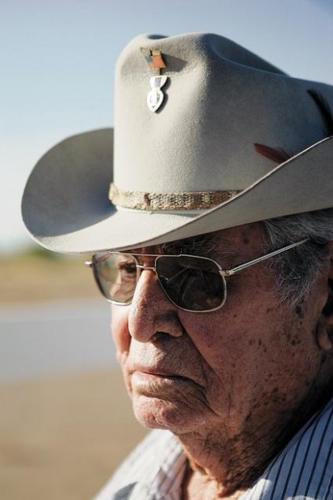
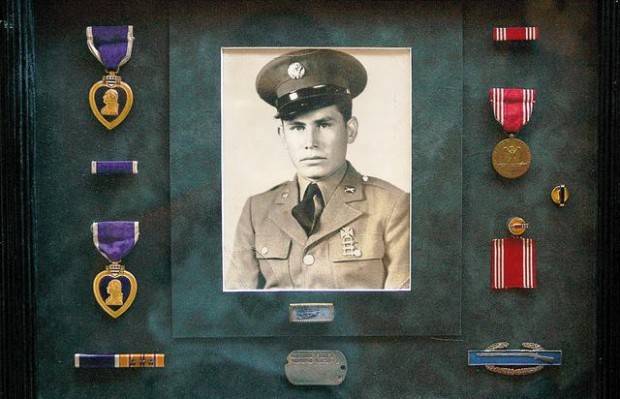
Martinez, now 86, was 22 when he enlisted in the Army on Jan. 8, 1942. Two months later, he shipped out to Australia, then to New Guinea, where he fought in several campaigns to retake the island from the Japanese.
He was awarded two Purple Hearts for suffering leg and head wounds during ferocious fighting.
Because he also contracted malaria, Martinez said he was sent back to the States in June 1944 for treatment at hospitals in New Mexico and California before being offered an assignment at Camp Florence, a POW camp in the Central Arizona town of the same name. It was one of two major POW camps in the state, along with Camp Papago Park, in Phoenix.
In November 1944, Martinez, then a staff sergeant, was assigned to a convoy of trucks that transported German prisoners to a site between Sahuarita and Continental, where a new POW camp was to be established.
Martinez, who was born in Nogales, Ariz., said he was glad to be assigned to the convoy, because it gave him a chance to return to the area where he grew up, between Elephant Head and Madera Canyon.
21 state "branch camps"
Camp Continental was the southernmost of at least 21 smaller "branch camps" built around Arizona during World War II, according to "PW: First-Person Accounts of German Prisoners of War in Arizona," by Tempe author and Arizona Historical Society member Steve Hoza.
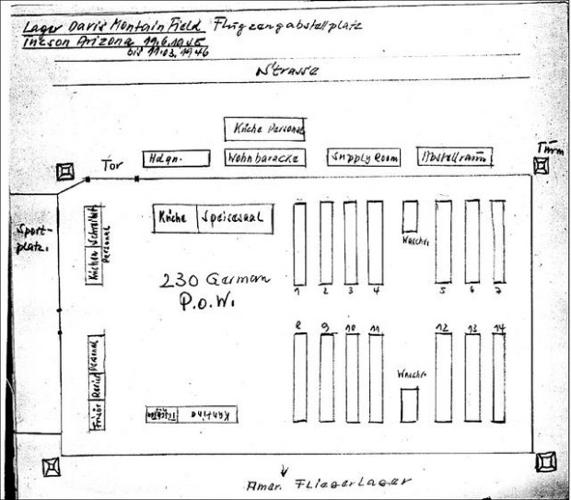
Other Tucson-area POW camps were located at Davis-Monthan, then an Army Air Forces base, Marana and nearby Cortaro Farms.
The POWs provided badly needed labor, mainly for farming but also for other tasks, while most of the country's work force was involved with the war, Donnelly said.
They were paid 80 cents a day in scrip that could be exchanged for items at a small post exchange set up at each camp, he said.
Gladys Bull Klingenberg, 91, who now lives in Green Valley, said the prisoners tended to cotton crops that were growing on the Bull Farm, owned by her father, James.
The prisoners also worked on vegetable crops around the area, Martinez said.
Some of the German POWs sent to Camp Continental were good workers, he said — but not the first group, composed mainly of U-boat crew members.
"They were fanatics," he said. "There were a lot of Hitler youth.
"They'd be fighting all the time," said Martinez, who was in charge of 40 soldiers who worked as guards for the 250-prisoner camp. "Every night, at about 3 or 4 in the morning, they'd be carrying on, fighting. We had to go in and knock some heads to settle them down."
The guards, who always carried weapons while on duty, sometimes had to use clubs to quell disorderly prisoners.
Because they were so unruly, the submariners spent a lot of their time at Camp Continental on bread-and-water rations, Martinez said.
Lloyd Clark, a historian with the Arizona Historical Society, said "that was very typical behavior" for U-boat crew members.
"They were determined to bring the war back to us in the states," he said.
Twenty-five U-boat crewmen pulled off what some say was the biggest POW escape in the United States when they tunneled out of Camp Papago Park on Dec. 23, 1944. The last was captured on Jan. 28, 1945.
Martinez said the next group of POWs sent to Camp Continental, mainly infantry soldiers, were much more cooperative.
"They were good workers," he said.
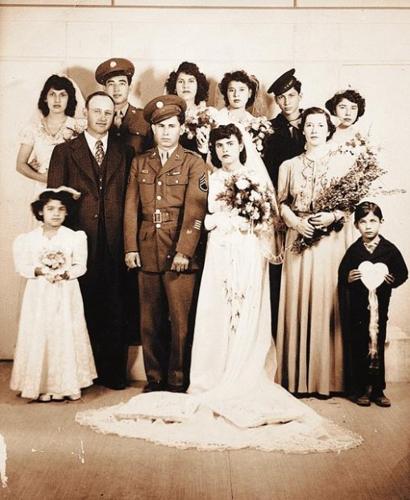
Several of the prisoners became acquainted with Martinez, and some even made him a cake baked from ingredients they'd collected as a wedding present when he married Cora Gastelum Martinez in December 1944.
Joe Martinez said some of the prisoners tried to befriend him. But, he said, "They weren't our friends. They were the enemy.
"I fought against the Japanese, and I saw a lot of my buddies get killed," he said.
"These soldiers were their allies. They were our enemy."
There's no trace of the camp today on the site, in the southern portion of Sahuarita.
A few tangled wads of rusty barbed-wire fencing can be found here and there between the scrub and mesquites, but there's no way to discern whether they're from the fence that encircled the camp.
"Not too many people know"
Martinez said he decided to talk about the POW camp because his granddaughter, Tricia, told him that people wouldn't believe her when she talked about it.
"Not too many people know about this," he said.
Clark says veterans who have seen combat often don't want to talk about it. But they should, because if they don't the history they've seen and lived through may never be recorded, he said.
"It's important to talk about it," said Clark, a retired Army Reserve colonel and World War II vet who now lives in the Phoenix area. "Anyone who's had an experience that is significant, like Mr. Martinez's, should relay that information, record it for posterity."
William Donnelly, a historian at the Center for Military History at Fort McNair in Washington, D.C., said Army officials "are certainly very interested in collecting the experiences of veterans of the 20th century.
"Their accounts provide a treasure trove of history," he said.
Jean Fuer Davis, a retired teacher and local historian who lives in Green Valley, was glad to learn that Martinez is sharing his firsthand account of what she calls "an obscure bit of local history."
"I've never run across anybody who's known about it," said Davis, who collected some information about the camp while interviewing longtime area residents in 1985. "Anybody that I've ever talked to about it always says, 'Really? I didn't know that!' "


