

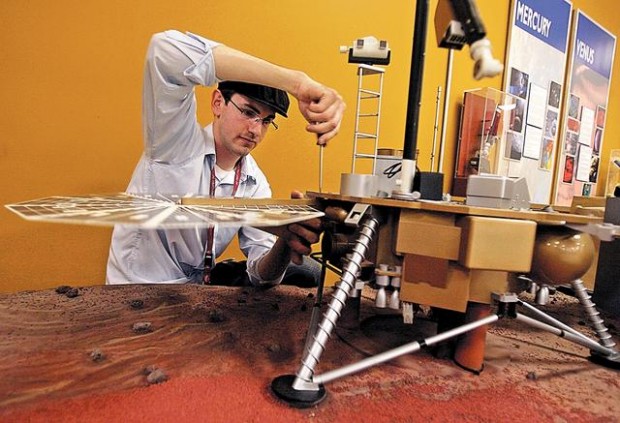
There are no humans on the Phoenix Mars Lander, but UA scientists' careers, hearts and souls are riding on the spacecraft as it nears its final descent.
The team has spent the past five years consumed with the mission, whose climactic moments are now just one week away.
Next Sunday afternoon, the 800-pound spacecraft must slow from 12,500 miles per hour to 5.4 mph in just seven minutes before touching down.
"It will definitely land. The big question is how hard," says Michael J. Drake, director of the UA's Lunar and Planetary Laboratory, which is leading the mission's science and built some of the instruments.
"An awful lot of people have spent an awful lot of time building instruments and designing a mission that has enormous potential to change the way humanity thinks about itself," Drake said.
People are also reading…
"All those hopes will be dashed in that frightening moment if the spacecraft crashes."
Several of the mission's UA scientists, like principal investigator Peter H. Smith, have focused their careers on Mars exploration for more than a decade.
They're excited by this mission's chance to prove definitively what the others didn't: that Mars has water and a habitable zone that could support life.
With a successful mission, Drake said, the UA will become highly competitive in terms of bringing in hundreds of millions of dollars worth of research contracts. It will also be at the forefront of Mars exploration for the foreseeable future.
The first signal confirming a landing in Mars' arctic circle is expected at 4:53 p.m. Tucson time next Sunday.
After the spacecraft's health is verified, NASA will hand mission control over to the UA — the first academic institution ever to operate a spacecraft on the surface of another planet.
The mission could pave the way to answering an age-old question: Are we alone in the universe?
If primitive life got started on Mars, it could be abundant throughout the universe.
But the mission is working against a Mars curse of sorts: More than half of the world's attempts to land on the red planet have failed.
Also, the landing technology Phoenix is using — three landing legs rather than airbags — has not been used to successfully touch down on Mars since 1976. The legs are designed to absorb shock and bounce off rocks. The last time landing legs were used on a Mars mission was in 1999, and that spacecraft crashed.
Space exploration is risky business. If any single part on the spacecraft malfunctions the mission is in peril, said Smith, the principal investigator.
"We have 26 pyros — those are little explosive bolts that fire in the last seven minutes. Each one of those has, you know, some 0.00-something chance of failure, so if you take that 0.999 to the 26th power, which is how you do these things, it's like an 80 percent chance of success," Smith said, showing the kinds of calculations the team has to deal with.
Many of the local scientists on the mission note the irony that the mission named "Phoenix" is operating out of Tucson. But the lander's name is not a reference to the city.
Rather, it is is a reminder of two past Mars missions that failed, symbolizing a rising from the ashes. It uses instruments from the Mars Polar Lander, which failed to return data from Mars' antarctic region in December 1999; and the Mars Surveyor 2001 Lander, which was canceled.
On the upside, Smith said, everything has been done to ensure a successful landing this time around.
"If it doesn't succeed, it isn't because we didn't do all the right things," he said. "It's because some unknown thing jumped out and bit us, or we had a bad day for some reason. It's very unlikely to be the UA's fault there. Although we are involved in the mission, we aren't actually designing the landing. Our operations center is still viable."
And if the mission's promise is fulfilled, the scientific payoff will be very large.
"There is a lot of prestige on the line," noted William V. Boynton, a UA professor and a co-investigator on the mission's science team. "It should be great for public relations and getting people from all over the world to realize that the UA is a leader in this field of science. It should cause lots of people to take a close look at us."
Boynton has a gamma-ray spectrometer on the Mars Odyssey spacecraft, which launched in 2001 and has detected ice sheets from the poles stretching down to about 60 degrees of latitude in both of Mars' hemispheres. That would be like having a layer of ice stretching from the North Pole across much of Canada.
Those ice sheets could be what became of the water that scientists believe once flowed on a more dynamic, Earth-like Mars.
The mission is important for other reasons, too:
● NASA's two Viking landers, which landed on the red planet in 1976, characterized Mars as a dead planet, which Smith said was a blow to Mars exploration.
He said the Phoenix mission gives scientists a chance to do a more thorough investigation in the search for life.
● Scientists can study the hydrologic cycle on Mars, which could yield lessons about climate change and how geological processes differ between Mars and Earth.
● The scientific instruments on the lander ideally will allow scientists to determine if the ice on Mars is water ice or carbon dioxide ice, or something else. It will also allow them to look for high molecular-weight organic material, such as proteins. If it definitely formed on Mars, then that's a smoking gun to either past or present life on Mars.
● Verifying the presence of water and a habitable zone could provide some answers about whether future human exploration on Mars is possible.
"The university has been very supportive in this mission, and naturally it's not done out of altruism," Smith said. "It's done out of the idea of building a facility here that could be used for future missions to other planets, to other asteroids, to the moon, whatever."
Inside the entrance of the Science Operations Center — the UA's mission control for the lander — is a sign that says "alien crossing." It's a joke. The scientists stress they are not going to find any Martians.
"The question is, is there something lurking in these northern plains that is going to give us a clue to life on Mars? And if there is, we want to know about it," Smith said.
"We don't have life-detection equipment. We're not saying we're going to detect life. We're just looking for those conditions. Maybe it's not there. That's fine. If that's what Mars is about, we'd like to know the truth."
Smith has been working on the Phoenix mission since 2002 when he first submitted the proposal for the $420 million project. His proposal was selected in 2003 out of a competition.
Since that time, 400 to 500 people have had a part in the project.
It's a passion for many.
"These things are very long in duration. A significant fraction of somebody's professional lifetime is put into these missions," Drake said. "The adrenaline rush — the feeling of release you get — is just extraordinary.
"Watch what happens when we land. If we have a successful landing, people are going to be going nuts in mission control. They're going to be going nuts on campus."
COMING UP
• Countdown news coverage all this week. Tucson & Region
• Classic Martian movies, Mars-inspired drinks and more. Thursday in Caliente
"There is a lot of prestige on the line."
William V. Boynton, UA professor and a co-investigator on the mission's science team


