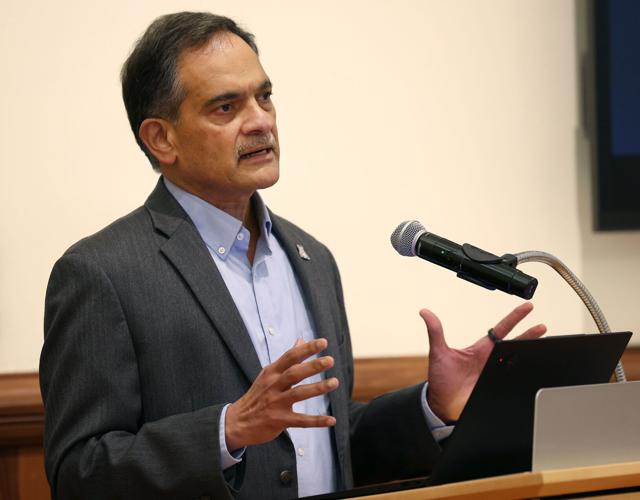
The combined student enrollments at Arizona’s three public universities declined this fall for the first time in a decade, state data show, but university officials have yet to release numbers on how this affects net tuition revenue.
In fall 2026, the cumulative enrollment decline at all three universities was recorded at 3.2%.
Adding up the numbers from the University of Arizona, Arizona State University and Northern Arizona University, total student enrollment dropped from 241,493 in academic year 2025-26 to 233,775 in academic year 2026-27.

Kendrex
Even so, Bradley Kendrex, the Arizona Board of Regents vice president for finance, strategy and governance, told the board at a meeting Thursday that Arizona’s enrollment growth over the last decade has “far outpaced anything else that we see in any other level of university, public university, all universities in the country.”
People are also reading…
He said he didn’t have current-year information on enrollment at peer universities nationwide, however.
According to board documents, enrollment growth in the future will face demographic and recruitment challenges.
The number of high school students graduating in Arizona is expected to decline 5% by 2041, compared to a 13% national drop, the board was told.
UA’s decline ‘quite intentional’

Garimella
UA President Suresh Garimella told the regents that the university’s 18.5% drop from fall 2025 in first-year undergraduate enrollment, and other enrollment trends this fall, were “quite intentional” and “as planned,” but that the UA “will stabilize the numbers.”
“We’re not looking at growing numbers necessarily, but growing quality, growing retention, growing graduation rates, making sure our students are ready for careers, etc.,” Garimella said.
“In particular, this fall we had the most academically prepared class we’ve ever had, which was intentional,” he said. “The GPA, for example, as one metric for our incoming students, jumped significantly from last year to this year. About a third of our students are first-generation students, about a third of our students are Pell-eligible, and for Arizona residents, our Pell-eligible class was around 39% of our incoming class.”
UA reported in September that the average grade point average of the freshman class this fall was 3.55. More than 40% of the students had a high school GPA higher than 3.75, and nearly 36% were in the top 10% of their graduating class.
Garimella told the regents that UA will continue to build partnerships with community colleges, including Pima, to bring in in-state students.
The enrollment of transfer students to the UA from Pima Community College has increased by 5.7% and is now at its highest level since 2020, UA’s official numbers show.
Big drop in UA international students
Garimella also said he hopes the situation for international students will stabilize as well.
UA’s international student enrollment plunged by 13% and NAU's by 15%, while ASU's dropped by 1%, since 2021, Kendrex said.
Nationally, there are 111,000 fewer international students at U.S. colleges and universities this fall, according to a preliminary analysis by NAFSA: Association of International Educators and JB International. That will lead to up to $3.4 billion in lost revenue and nearly 40,000 fewer jobs, NAFSA says.
More graduate students
Kendrex said while the general enrollment trend is “turning down,” there was still a significant increase over the last five years in undergraduate students at all three universities, increasing from 169,021 students in 2022 to 184,499 in 2027.
The recent growth has been in graduate students, whose numbers increased from 43,693 in 2026 to 49,276 in 2027.
In the last five years:
ASU’s undergraduate enrollment rose by 15% and graduate enrollment by 21%.
UA’s undergraduate enrollment grew by 1.7% and graduate enrollment dropped by 0.25%.
And NAU’s undergraduate enrollment decreased by 11% and graduate enrollment decreased by 9%.
40% online jump over 5 years
Kendrex also said online enrollment in the state is “a consistent source of growth.”
While the number of total on-campus students at the three universities has decreased by 5% in the last five years, the total number of online students has increased by 40%, the numbers show.
“If we look at each of the universities again, we have ASU Online up 49% since 2021 and that represents 86% of the online students in the system,” Kendrex said.
Garimella
“This is somewhat excluding the University of Arizona Global Campus, which still tends to report on a different basis, but UA’s traditional online is up 29% since 2021,” he said.
He also said students are increasingly studying part-time at the universities, and this fits into the online model well. Since fall 2021, the full-time population is up 8.5%, while the part-time population is up 13.1%, he said.
Fewer out-of-state students at UA
In the last five years, the total number of in-state students at all three universities has increased by 6% and out-of-state students have increased by 13%.
But that growth is fueled by ASU, while UA and NAU both have fewer out-of-state students than before.
ASU’s in-state students increased by 5% and out-of-state students by 26%; UA’s in-state students increased by 8% and out-of-state students decreased by 7%; and NAU’s in-state students increased by 3% and out-of-state students decreased by 39%.
More students who qualify for aid
The total number of Arizona students eligible for Pell grants, a form of federal need-based financial aid given to undergraduate students, has increased by 28% in the last five years, going from 51,698 students in 2022 to 66,330 in academic year 2026-2027.
Since 2021, the number of Pell-eligible students at ASU increased by 39%, those at UA rose by 7%, and those at NAU by 2%.
“We have a growing number of students at the schools who are Pell-eligible students, which means we continue to make great progress as a system in attracting students who are relatively lower in income and (we) are giving them the opportunity to access the universities and what we have to offer,” Kendrex said.
More non-traditional students
Kendrex also said the numbers of non-traditional students and older students have increased over the last few years; there are more women than men enrolled, and the students are more racially and ethnically diverse.
“We have a 25% increase in underrepresented minorities, which both reflects broader demographics as well as the university success in broadening the appeal and access for our students,” he said.
“The student body continues to grow in the female side — more female than males. We have 7.4% growth over the course of the five years in the male population, with 11.6% in female. So, the female student population continues to outpace males meaningfully, but again, both populations see a little bit of a downturn over the course of this last year.”
Reporter Prerana Sannappanavar covers higher education for the Arizona Daily Star and Tucson.com. Contact her at psannappa1@tucson.com or DM her on Twitter.

Prerana Sannappanavar
Higher Education Reporter