A University of Arizona administrator said the 18.5% drop in first-year undergraduate enrollment for the fall 2026 semester doesn’t mean the UA is dropping in enrollment overall, but is just returning to its pre-COVID class sizes.
But a faculty senator questioned the accuracy of that statement, saying pre-COVID class sizes of freshman students were nearly 650 students larger than this fall's.
The administrator, Kristina Wong Davis, UA’s vice president for enrollment management and dean of admissions, told faculty senators at a meeting Monday: “When you look at our enrollment size, it is very much in line with where it was pre-COVID."

Kristina Wong Davis
“So, we’re not really dropping in enrollment overall; we’re really returning to where we were pre-COVID in terms of size of the first year of class,” Davis told the faculty leaders. “That’s just specific to the first-year class," Davis continued. "We increase transfer enrollment and all other enrollments vary depending on the platform and the program. And so, it’s a very large enrollment perspective and we’re only talking about one very small slice of that when we talk about this particular first-year enrollment slice.”
People are also reading…
In response, Faculty Senator Joellen Russell, a university distinguished professor of biogeochemical dynamics, said “those numbers aren’t quite right.” Looking at years' worth of official fall enrollment numbers, Russell said there was a gap of nearly 650 students in the first-year classes between fall 2017 and 2026.

Joellen Russell
“Forget like pre-COVID — we’re down," Russell said. "We’re definitely down. We’re not down just for a couple years. We’re down.”
The numbers of new undergraduate students in the UA's fall semesters, including transfer students, have fluctuated over the years — 9,144 in 2017, decreasing to about 8,929 in 2021, increasing to 10,272 in 2023, and then decreasing to 8,498 in 2026.
UA announced its official enrollment numbers for fall 2026 on Sept. 24, saying that of the first-year undergraduate class of about 6,000 students, 69% are Arizona residents, nearly 29% are out-of-state students, and 1.8% are international students.
More than 30% of first-year students are first-generation college students as well, the UA reported. In terms of students who are eligible for Pell Grants, a need-based form of federal financial aid that’s given to undergraduates and doesn’t need to be repaid, more than 33% of first-year students are Pell-eligible, as are more than 39% of in-state students.
Including Arizona Online and the online school UA Global Campus, UA’s total enrollment this fall is recorded at 67,714. Removing the university’s Global Campus numbers, UA’s total enrollment rests at 49,104.
Additionally, the university also brought in 2,387 transfer students in its new undergraduate class, which is also a decrease from previous years’ transfer student numbers.
Combination of factors
Faculty Senator Anna Cooper asked Davis if the 18.5% enrollment drop in first-year undergraduates was intentional or was “some kind of error.”
Davis said the enrollment drop this fall was due to a combination of numerous factors, one of which was the fact that the UA did a “comprehensive review to ensure that our students who came in had the ability to succeed and retain.”
A few other factors she mentioned were the decline in international students nationally, a competitive market for domestic out-of-state students, as well as the "demographic cliff," which is the decline nationally in traditional, college-age students due to falling birth rates during and after the Great Recession.
“We were looking very diligently at the students for the indicators that they have the ability to succeed,” Davis said. “And then we do know our international enrollment is down. It’s been down nationally for a lot of institutions. And domestic non-resident enrollment has really softened nationally as well. So, there are a number of compounding factors, and we’re facing the demographic cliff for the very first year in a very significant way nationally.”
Since the spring, UA officials, including Provost Patricia Prelock and President Suresh Garimella, have publicly discussed their intentional strategy to bring in a smaller class of students this fall and to be more selective in deciding which students they accept to come here.
Financial impact data still to come
Faculty senators also questioned UA officials about the financial impact of the decrease in enrollment. To this, UA Chief Financial Officer John Arnold, who was present at the meeting briefly, said it’s still a bit early, and they’re gathering the data on tuition revenue. Arnold said they’ll have more information in the next month or so, but that “revenues are in line with budget expectations.”
Faculty Senator Lucy Ziurys, a Regents professor of chemistry, biochemistry and astronomy, said she’d heard from a department head that their department is already feeling financial stress due to the enrollment drop because a few laboratories weren’t filled to capacity of students. This has led to the number of teaching assistants going down, and everyone has been “scrambling” to support the department's graduate students, she said.
At Monday’s meeting, Davis and Prelock, who was attending online, also discussed the UA’s decision to retire its “Schedule for Success” program, which had been around since 2011. This program enrolled students who needed additional academic preparation and time to adjust to the rigors of an Association of American Universities course schedule.
Faculty Chair Leila Hudson questioned why this program was retired “so abruptly in the course of a single year.” She also asked what data and evidence this decision was based on, who on the academic side was consulted, and how this went forward without cooperation of the deans or faculty governance bodies.
Prelock said she wasn’t sure who was consulted, since the decision was made before she got to the UA in May 2025, but that there were two elements involved.
“One is we were not retaining the students, and they did not bring in the financial component that was expected,” she said. “So, we brought in more students and we did not bring in more net tuition revenue. And then the students retained at a much poorer rate compared to our students who were not on ‘Schedule for Success.’”
“Although I realize people have strong, passionate feelings about ‘Schedule for Success,’ the goal is not full, open access without the supports or the reality of them being successful, but to make sure that they can be successful and we give them pathways to get that success,” Prelock said. “Even if it doesn’t mean immediately coming to the U of A, but maybe another pathway, if that is their desire. So, it was really about student success and financial sustainability, and we didn’t achieve either of those.”

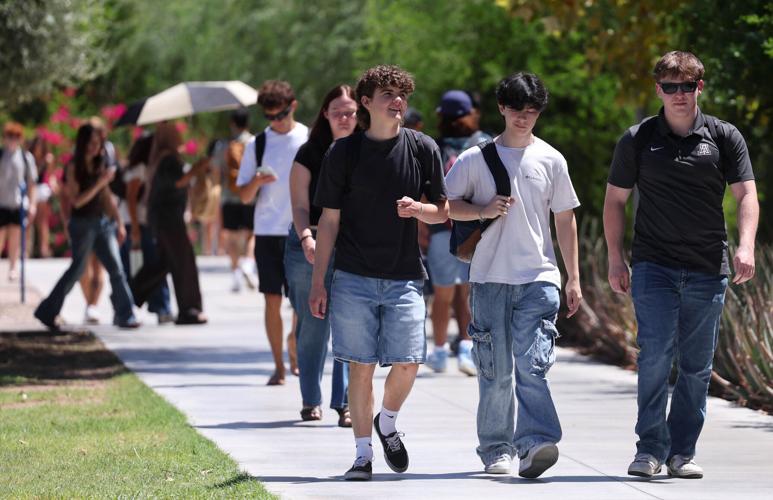
Students shown at the University of Arizona on the first day of fall semester classes in August this year.
In response, Hudson said she hopes Prelock and Davis will provide the data behind the decision.
"Of course, all of us are opposed to luring students in simply to extract revenue from them and then kick them out as failures,” Hudson said. “But it is our job to do this in a rational, data, evidence-based way that preserves the pathway to research university excellence for students, especially underprivileged rural students who might have been ill-served by the sucking of value out of our K-12 system,” she continued. “So, it’s really stunning to me that a decision like this, that eliminates an entire class of potential graduates, would be conducted without any kind of governance, consultation with the elected representatives of the faculty, or even with the colleges. So, we would really like to see the demographic data.”
Prelock said the UA does have cumulative data on retention. She also said this year’s class is “just as strong” in terms of eligible students and in terms of percentage of students who are first-generation, even without “Schedule for Success.”
Davis said recruitment for fall 2027 is already underway, and admissions teams are in high schools throughout Arizona and other areas of the country, as well as working to strengthen pathways with the state's community colleges, including Pima Community College.
Reporter Prerana Sannappanavar covers higher education for the Arizona Daily Star and Tucson.com. Contact her at psannappa1@tucson.com or DM her on Twitter.

Prerana Sannappanavar
Higher Education Reporter