

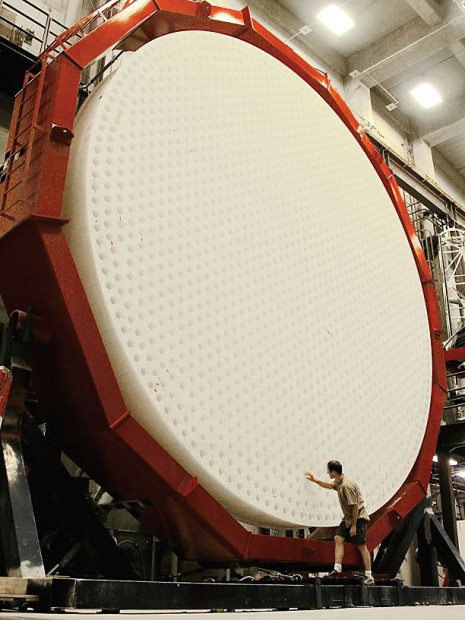
The University of Arizona is renaming the lab where it makes its giant astronomical mirrors to honor an Arizona businessman whose company supplies some of its components, and who recently gave a $20 million gift to the UA.
The gift from Richard F. Caris, founder and chairman of Interface, Inc., goes to the UA Department of Astronomy and Steward Observatory toward its involvement in the Giant Magellan Telescope project.
The UA announced the gift Monday.
Eight mirrors for that giant telescope will be cast and polished in the Steward Observatory Mirror Lab beneath the bleachers of Arizona Stadium — a facility that will be renamed the Richard F. Caris Mirror Lab.
The UA is part of an international consortium building the Giant Magellan Telescope, set to begin operating from Las Campanas Observatory in Chile's Atacama Desert sometime in the next decade.
People are also reading…
Its completion target is 2021.
The Giant Magellan Telescope will combine the light of seven 8.4-meter (27.6 feet) mirrors being spun-cast and polished at the Mirror Lab, using a unique process developed under astronomer Roger Angel, the lab’s founder.
“It means a lot to us that someone who has capacity to help us out values what we’re doing enough to make a gift like this,” said Buell Jannuzi, head of UA Astronomy and director of Steward Observatory.
“It is hard for any institution to undertake these projects without people like Richard,” he said.
Caris has previously given multi-million-dollar gifts to the UA Astronomy Department for the Large Synoptic Survey Telescope and for public-outreach facilities in astronomy atop Mount Lemmon.
Daniel Petrocelli, director of development for Steward, said Caris first visited the Mirror Lab out of curiosity. His company, which specialized in load-force measurement devices, sold most of its products to the oil industry and he wanted to understand their application to astronomy.
“As he discovered what we were doing, he fell in love with it,” said Petrocelli.
Petrocelli said Caris became a regular visitor to the lab after he underwrote the casting of the LSST mirror. “He called it ‘my mirror,’ ” Petrocelli said.
The UA has committed to a $60 million share of the Giant Magellan Telescope and hopes to double its share of the project with additional philanthropy, said Jannuzi.
The UA's partners in the project are the Brazilian state of São Paulo, institutional partners from Australia and South Korea, the Australian National University, the Carnegie Institution for Science, Harvard University, the Smithsonian Institution, Texas A&M University, the University of Chicago and the University of Texas at Austin.
The UA has completed polishing one of the seven off-axis mirrors that will be arrayed around a center mirror to create a segmented mirror with a combined diameter of 24.5 meters (83.5 feet).
Two additional off-axis mirrors are cast. Molds for the center mirror are currently being assembled.
The GMT is one of three next-generation, giant, segmented telescopes that promise a tenfold increase in resolution over the best space telescopes now in operation.
The Thirty Meter Telescope, headed by California universities with involvement from China, India and other countries, is under construction on Mauna Kea, an astronomical enclave on the island of Hawaii.
The 14-member nations of the European Southern Observatory are building a 39-meter telescope in Chile, called the European Extremely Large Telescope.
The E-ELT and the TMT will use hundreds of small mirrors.
All three telescopes promise to usher in a new era of ground-based astronomy, producing images at least 10 times clearer than the best space telescopes.
They will be capable of capturing images of planets orbiting distant stars and light from the early universe.


