
He had to leap from the window to save his life. Literally.
So began the Bosnian War for Ali Insanic, a Muslim living in the city of Banja Luka. It was the fall of '92, and the city was about to suffer "ethnic cleansing" in the newly declared country of Bosnia and Herzegovina.
"A janitor came into the classroom where I was teaching and said, 'You have to get out now,' " says Ali. "She was Serbian. She said five soldiers were looking for me."
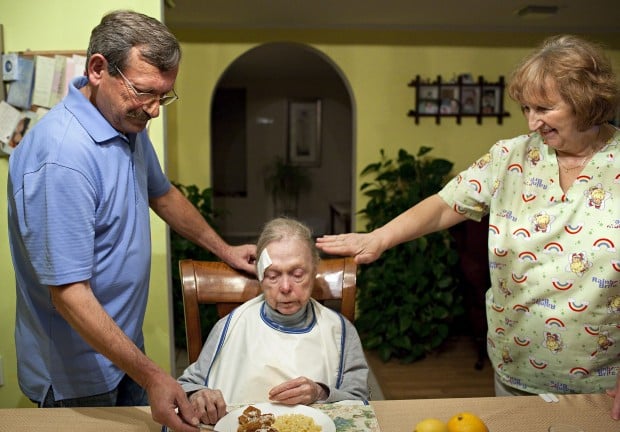
Today, Ali; his wife, Emi; and son, Damir, all live in Tucson, where Ali and Emi run an adult-care home.
All adapted readily to their new country, learning English and becoming U.S. citizens.
"We have achieved so much here. It could have never happened somewhere else," says Damir, 32, who works as an emergency medical technician.
People are also reading…
He was 14 the last time he saw his native land before packing a small duffel bag in May of 1992 and leaving with his sister, Dzenana, to join friends in Slovenia. "I did not know I would never come back," he says.
How could he? After all, the country where he lived, the former Yugoslavia, had been relatively peaceful.
"It was communism, but very liberal communism," says Ali, a nonpracticing Muslim. "You lived the good life. It didn't matter if you were Serbian, Croatian or Muslim. You could be whatever you wanted to be. We didn't talk about religion."
He and Emi, both 60, have known each other since childhood, growing up in Banja Luka, about 90 miles from Sarajevo.
"Our parents were friends," says Emi, who often frequented the bakery that Ali's father owned. They married in 1970. By then, both had graduated from teachers college, and Ali had served a short stint in the army.
After teaching elementary school for eight years in the small town of Ravne, they moved back to Banja Luka, where both again got teaching jobs.
It was here that the troubles began in the early '90s, after the Republic of the Serb People of Bosnia and Herzegovina was formed and later broke away from Yugoslavia, sparking the Bosnian War.
"Banja Luka became part of the new Republic of Serbia," says Emi. Sensing trouble, she and Ali sent Damir and Dzenana to stay with friends in Slovenia.
"We thought it would blow over," says Damir. Instead, both his parents lost their jobs on the first day of school that fall - Ali by jumping through the window, Emi after her day was done. "All the Muslim and Croatian teachers were fired," she says.
Meanwhile, Ali had made it back home, avoiding the main roads. For weeks, he stayed sequestered in his house, afraid of the knock on the door.
"Muslim and Croatian people were being dragged outside and beaten," he says.
Finally, he and Emi made plans to join their children in the Czech Republic, where they had relocated, again staying with friends.
First, they had to sign papers, giving everything away and promising never to return.
"You had to pay to join a convoy," says Emi. "There were hundreds of cars."
"I was lucky - I had a car nobody wanted," says Ali.
"It was a car from driving school," says Emi. "It had two steering wheels, two sets of pedals."
In December of 1992, they crossed the border and were reunited with their children, settling into an apartment with more than a dozen other people.
They quickly got permits and began working in an outdoor bazaar, selling new clothes and items bought by others in Turkey.
For eight years they toiled at their jobs, listening to the radio in those early years for any news of the war, which was settled in 1995.
Still, they knew they could never return to their homeland. In 2000, Ali, Emi and Damir immigrated to Tucson, where Emi's sister had moved a year earlier. Dzenana, now 38, decided to stay in the Czech Republic.
In Tucson, the three quickly got jobs in hotels. All three signed up for English classes.
Ali also bought a used car. "When the salesman found out we were from Bosnia, he said, 'You give me $500 and pay as much as you can each month.' I still use that car."
Damir, and later, Emi, both took classes and became certified nursing attendants. Damir then went on to earn his emergency medical technician certification.
Meanwhile, Ali and Emi in 2003 bought a spacious home on the city's east side and converted it into an adult-care home, where they both now live.
Here, all the holidays are celebrated - Muslim, Jewish, Christian.
The home has been a godsend to Jackie Newlove, whose mother, Sidy Rayfeld, 96, has lived here since 2005.
"I walked in here, and it was so homey. I knew this was the place for my mother," says Newlove, adding that her mother was allowed to bring both her cat and her piano, which she still plays from time to time.
Sandy Qureshi, who lost her husband, Mohsin, last October, also sings the praises of the Insanics, who cared for Mohsin for 10 months until his death.
"Ali taught him a song about Tito, and they would go down the sidewalk singing," says Qureshi. "At the end, he had hospice right there. They would not leave him alone for one minute."
Says Ali about those he and Emi now care for: "Before, we were teachers of children. They are like children. It's not too different."
Bonnie Henry's column appears Sundays and Mondays. Reach her at 573-4179 or at bhenry@azstarnet.com, or write to P.O. Box 26807, Tucson, AZ 85726.
 101 homes to be built on NW Tucson corner