

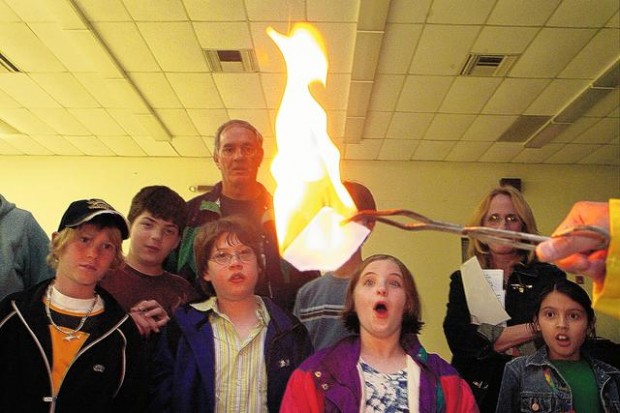
Erika Cook stood among a dozen of her classmates and marveled at the sight of nonfat dairy creamer bursting into flames.
Like others around her, including the adults, she couldn't quite describe watching a University of Arizona chemistry student pour the creamer directly into the flame of a blowtorch and feeling the instantaneous heat of the fire.
And just a few feet away, she found a quick but expensive way to make ice cream: liquid nitrogen.
"I didn't know that chemical could make ice cream," 9-year-old Erika said through a mouthful of freshly made ice cream.
Reactions like Erika's were what teachers and parents were looking for at Manzanita Elementary School's Science Night on March 29.
The event used the expertise of students and professors with the University of Arizona's Bio5 Science Education Outreach Program to teach elementary students about science and give them a chance to do hands-on experiments.
People are also reading…
With the federal government pressing schools to improve science proficiency in the next seven years, and Arizona piloting a science standardized test this month, getting kids interested in the diverse fields of science became more important this year.
"Any time that we can present science content with a hands-on focus, it becomes real to students," said Principal Colleen Nichols. "It's more theoretical when they read it out of a book."
Nichols said the school's site council wanted to present an educational event for students revolving around science. Parent Norine Houtz, who works with the Bio5 Institute, helped set up the event, which used the outreach group's experience with kids to create a walking tour of various aspects of science.
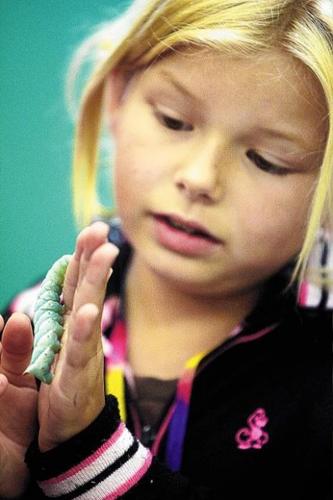
Throughout the evening, parents escorted their kids to each of the four stations set up in different rooms — Biotech Project, Insect Discovery, Chemistry Club and Physics Factory — where college students and professors demonstrated various aspects of science and assisted with experiments.
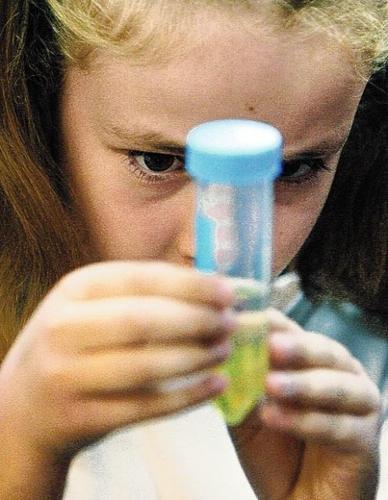
At the Biotech station, kids learned about the complex science behind their DNA by swishing salt water in their mouths, transferring the liquid to a beaker and watching a milky string form. That milky goop — their DNA — was transferred to a vial that kids could wear around their necks.
"It looks creepy," said Arlene Lanz, 11, a sixth-grader at Orange Grove Middle School who went to the event with her sister, Victoria, a third-grader at Manzanita. "It looks like boogers from your nose."
Quinn Marell, also a third-grader, said she wasn't aware that DNA could be found on any part of the body.
"I didn't know it could come from your mouth," said the 9-year-old. "I thought it would come from here," motioning to her stomach.
The most popular place seemed to be the multipurpose room, where three college students showed kids how combining certain chemicals can make liquids change color, instantly freeze a banana and turn coffee creamer into fire.
Erika Cook said it was her favorite station of the four because she is a big fan of chemistry. "I like mixing stuff," she said. "I like not knowing what's going to happen when you start an experiment." Erika mentioned the chemistry set she uses in class, where one of her favorite experiments turned water into snowflakes.
Her friend, second-grader Justine Griego, said observing the qualities of liquid nitrogen, which was used to freeze bananas and make ice cream, was the best part of the night.
"I think liquid nitrogen is my new favorite word," said Justine, 8.
Justine and Erika are too young to take part this year in the state's science standardized test, which will be administered to students in fourth, eighth and 10th grades. But Nichols said the enthusiasm they and other students showed last week meant it's likely teachers won't have to work as hard to drum up interest in science in the coming years.
"That's the whole purpose, to get them interested in pursuing a career in science or even math," Nichols said.
Science at your school
• To learn more about the Bio5 Science Education Outreach Program, go online to bio5.org/education/education_home.php.


