In Tucson, traffic rarely looks like a problem.
There are no sprawling freeway backups or daily scenes of gridlock.
By the numbers, the city performs well. The average commute time sits at about 24 minutes, below the national average, according to data from the U.S. Census Bureau.
Compared with major metropolitan areas, that makes Tucson relatively uncongested. But that data point misses what drivers here actually experience.
“It’s not that you’re stuck,” said Daniel Ortega, a medical assistant who commutes across town each day. “It’s that you’re constantly being slowed down. It never feels smooth.”
That gap between statistical reality and lived experience is at the center of Tucson’s traffic problem. The issue is not severe congestion. It is inefficient.
People are also reading…
Transportation data supports that distinction. According to estimates from the Washington, D.C.-based traffic analytics firm INRIX, drivers in Tucson lose roughly 40 to 50 hours per year to traffic delays.
The city’s congestion level typically rises by about 25 to 30% during peak travel periods, particularly during the morning commute between roughly 7-9 a.m. and the evening rush between about 4-6 p.m, meaning trips take significantly longer than they would under free-flow conditions. While those figures are modest compared with larger cities, they point to a system that consistently underperforms relative to its size.

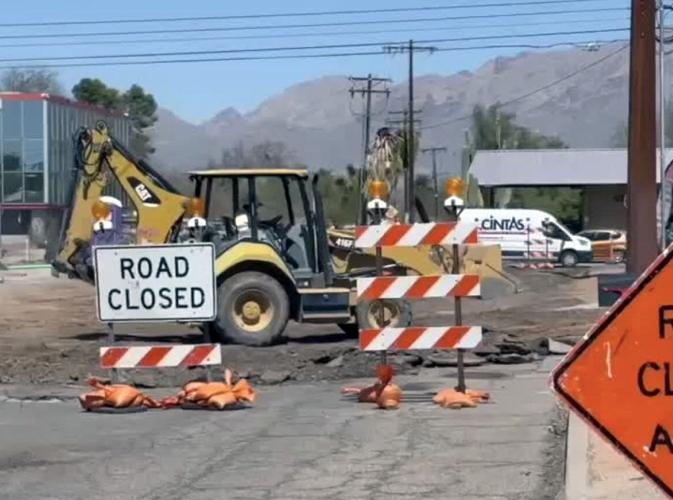
Road construction crews work near East Speedway and North Country Club Road. As infrastructure projects continue across major city corridors, lane restrictions have contributed to changing traffic patterns and temporary slowdowns for drivers.
On a recent afternoon along busy East Speedway, that underperformance played out in real time. Cars moved in short bursts, accelerating through one signal before braking at the next. A left-turn lane backed up into through traffic. Drivers missed lights by seconds and waited through multiple cycles.
“You can be moving fine, then suddenly you’re stopping every block,” said Luis Ramirez, a delivery driver who spends most of his day on Tucson roads. “It’s not traffic like L.A. It’s just inefficient.”
Urban planning experts often point to road design as a key factor. Tucson relies heavily on wide arterial streets rather than a dense freeway network. Corridors like Speedway, Broadway and Grant Road carry a large share of daily traffic, but they are interrupted by frequent signals, turning vehicles and cross-street flows.
That design limits throughput.
A 2025 report from the Pima Association of Governments notes that signalized intersections, not freeway bottlenecks, account for a significant portion of delay across the region. Even when traffic volumes are moderate, poorly synchronized lights and turning conflicts can reduce effective speeds and create stop-and-go patterns.
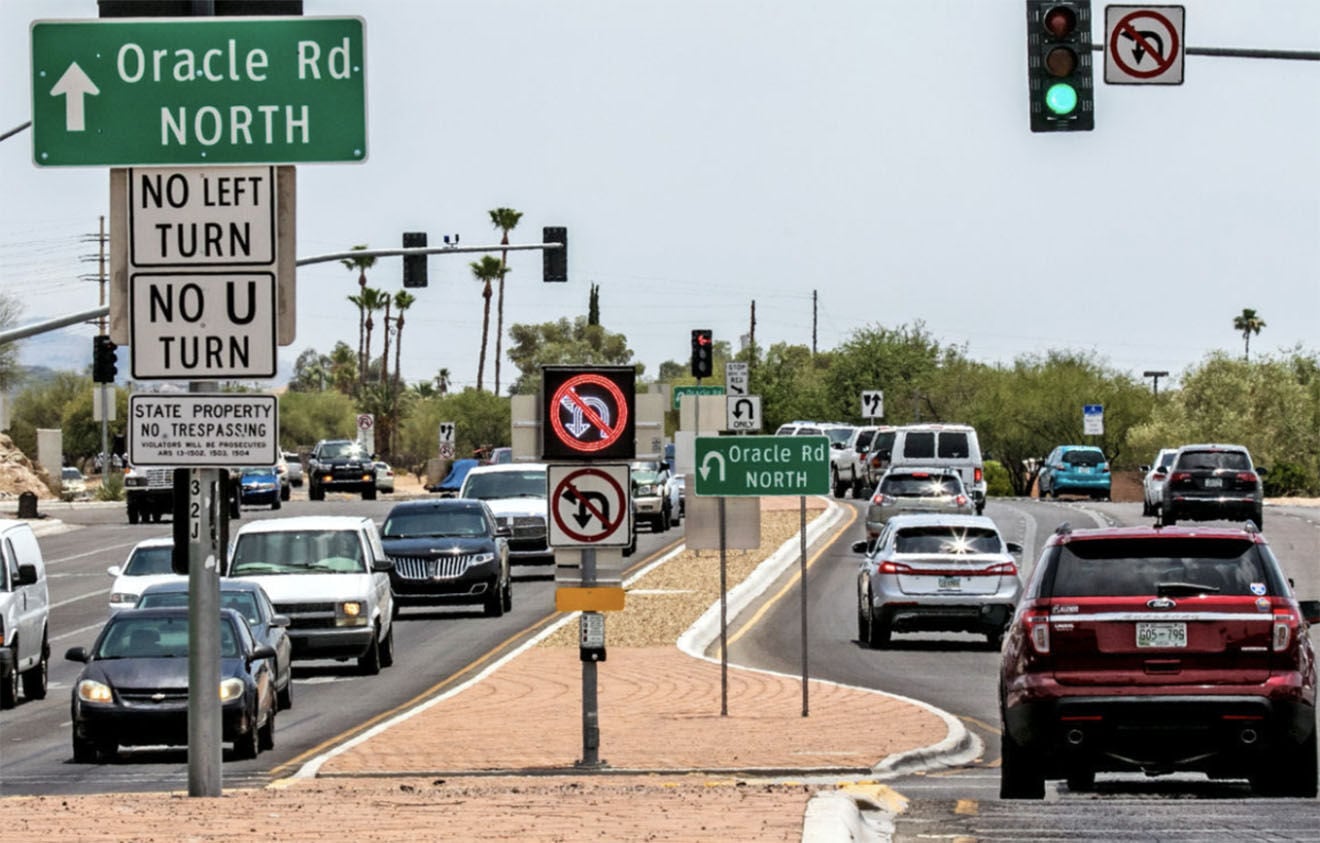
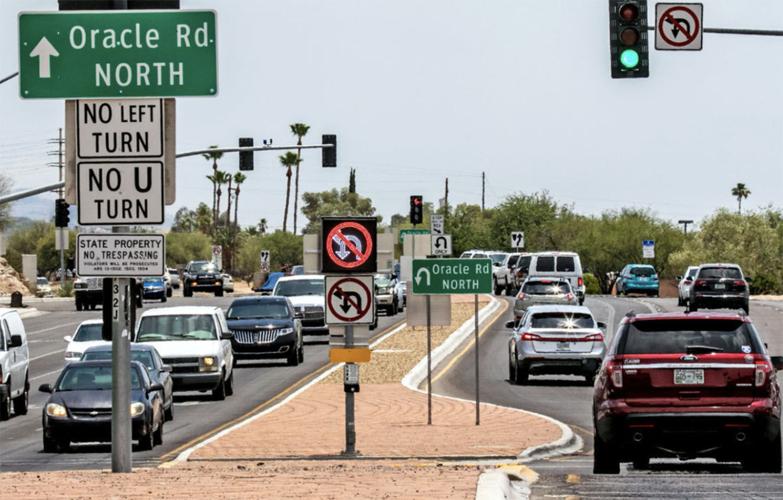
Traffic moves along North Oracle Road, where drivers navigate signal timing, restricted turns and heavy corridor traffic that many residents say contributes to Tucson's stop-and-go driving experience.
“You’re not dealing with one big choke point,” said Marcus Hill, who commutes downtown. “You’re dealing with 20 small ones.”
That fragmentation is what makes Tucson’s traffic feel worse than it looks on paper.
The city’s reliance on driving amplifies the issue. Census data shows that roughly 70% of commuters drive alone, a higher share than in many larger urban areas. Public transit accounts for only a small fraction of trips, and while cycling infrastructure has expanded, it remains limited in reach.
That means most movement is concentrated in the same corridors.
Unlike cities with centralized job hubs, Tucson’s travel patterns are dispersed. Residents move between neighborhoods, school campuses, retail areas and job sites spread across miles of low-density development. The average trip may be short, often five to 10 miles, but it involves navigating multiple intersections and signals.
“You look at the distance and think it should be quick,” said Alyssa Nguyen, a University of Arizona student who commutes daily from the east side of Tucson. “But it’s not the distance that slows you down. It’s everything in between.”
The nature of daily travel has also shifted. Post-pandemic patterns show less pronounced rush hours and more consistent traffic throughout the day. According to regional mobility reports from the Pima Association of Governments, midday traffic volumes have increased as flexible work schedules, delivery services and multi-stop trips become more common.
For drivers like Ramirez, that means there is no real break in demand.
“I’m driving all day, not just to and from work,” he said. “There’s always cars out.”
Construction and growth add further variability. Tucson has seen steady population increases in recent years, and infrastructure projects are ongoing across key corridors. While intended to improve long-term flow, lane closures and temporary restrictions often introduce short-term slowdowns.
“There’s always something changing,” said Ortega, the medical assistant. “Your normal route isn’t always reliable.”
City officials have started implementing adaptive traffic signal systems designed to respond to real-time conditions. According to updates from the City of Tucson Department of Transportation and Mobility, the technology has been deployed along corridors including Broadway from Aviation Parkway to Swan Road; Campbell Avenue from Limberlost Drive to Ajo Way; and Park Avenue near Irvington and Valencia roads.
Early pilot results showed reductions in delay and improved travel times. However, the systems are not yet widespread, and many intersections still operate on fixed timing.
In response to growing complaints about inconsistent traffic flow, Tucson has started modernizing some of its traffic infrastructure with AI-powered signal technology. Unlike traditional traffic lights that operate on fixed timing schedules, the newer systems continuously analyze traffic conditions in real time and adjust signals accordingly.
The technology is designed to respond dynamically to changing traffic patterns throughout the day, said Francisco Levya, a systems engineer for the city.
“These new systems are looking at the volume of data second by second, or at least every minute, and they’re deciding if there’s a change in the traffic pattern,” Levya said.
However, for many Tucson drivers, adjusting to the constantly changing traffic flow has not been easy. Some commuters say the unpredictability of stop-and-go patterns and shifting signal timing has made everyday driving more frustrating and mentally exhausting.
“It’s unpredictable,” said Hill, the downtown commuter. “Not bad enough to plan your whole life around, but enough to throw you off every day.”
“It’s tiring,” said Nguyen, the UA student. “You’re always stopping, starting, watching lights. It’s not a relaxed drive.”
Back on Speedway, traffic continues its pattern. Cars advance in short intervals, then pause again as another signal changes.
No one is stuck for long, but no one moves freely either.
Arizona Sonoran News is a news service of the University of Arizona School of Journalism


 BioBlitzers catalog wildlife in U.S., Mexico as walls go up along border