Tucson's long-term water supply "is in significant danger" if PFAS contamination of the city's central wellfield isn't addressed, City Manager Tim Thomure says.
He made the statement Tuesday in a pitch to the City Council to approve what he said is a first step toward launching a cleanup: the proposed agreement between the city and a private, nonprofit group of Air Force veterans, which sources previously told the Star would result in the Air Force helping to pay to start PFAS cleanup.
Thomure noted that the city has taken 24 of its wells out of service due to PFAS contamination and has set 8 more city wells aside for emergency use only.
Many or most of those wells lie in the central wellfield, occupying parts of the city's urban core, midtown and the east side, which was the city's biggest source of drinking water until the Central Arizona Project came online. In the past 20 years, the city has stopped using most of those wells in favor of the renewable CAP water delivered from the Colorado River. But with CAP supplies jeopardized for the long-term due to river flow declines, city officials may need to rely on city groundwater supplies to some extent instead.
People are also reading…
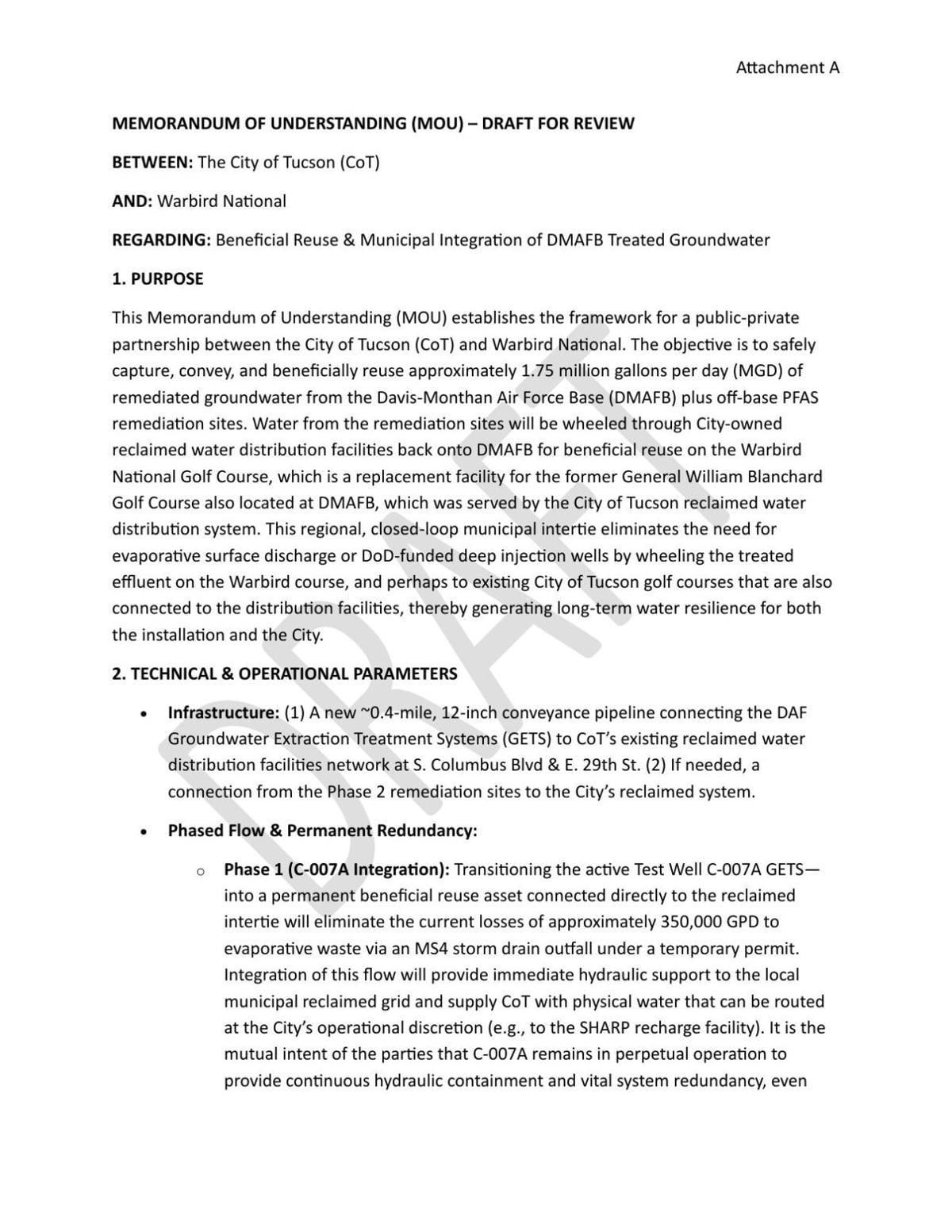
Thomure was asking the council to approve a memorandum of understanding between the city and the group of Air Force veterans called Warbird National. The memorandum wouldn't actually launch work on PFAS groundwater cleanup but would be used as a framework for future negotiations between the city, the nonprofit group and the Air Force over how a cleanup will be carried out.
While the memorandum didn't lay out a timetable, Thomure told the Star a cleanup system could be designed and built in 18 to 24 months.
The cleanup cost hasn't been determined, but it would all be paid by federal funding or private money raised by the Warbird group, Thomure told the Star.
The memorandum, posted online late Tuesday afternoon, is aimed at speeding removal of PFAS compounds known as "forever chemicals" underneath Davis-Monthan Air Force Base — compounds that have already moved well north into the city's central wellfield.
The memo would also start a process for the nonprofit Warbird National to construct and operate an 18-hole golf course on leased, city-owned land on or near the base. The course would use reclaimed water that would be made available by the pollution cleanup.

Thomure
Would boost DOD priority of Tucson cleanup
One of the goals of the proposed memorandum of understanding is to accelerate cleanup of the area's groundwater. It has lagged since the existence of the PFAS contamination became publicly known in the late 2010s.
Besides shutting down city wells in midtown Tucson, the city has also since 2021 stopped serving its customers once-contaminated groundwater from another 10 wells that had previously been run through the city's big south-side treatment plant. Those wells, too, have been found tainted by PFAS compounds.
"PFAS compounds are present in groundwater (downhill) from the Davis-Monthan Air Force Base. This PFAS plume has already impacted a number of Tucson Water’s production wells in the central wellfield, and if it is left unaddressed, the city’s long-term water supply is in significant danger," Thomure wrote to the City Council.
Thomure noted in his memo that in a September 2024 memorandum, an assistant defense secretary told all military service branches, including the Air Force, that the Department of Defense remains committed to fulfilling its PFAS-related cleanup responsibilities, in accordance with the federal Superfund toxic waste cleanup law.
While Thomure wrote that this is notable, he told the council it leaves Tucson’s central wellfield in peril due to two main factors.

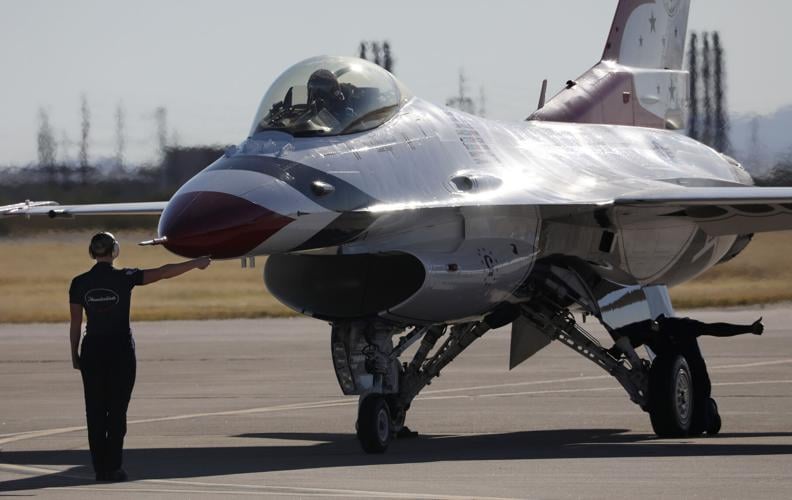
Davis-Monthan Air Force Base.
First, the formal Superfund cleanup process can take many years before actual cleanup actions are taken. Second, since Tucson Water does not serve PFAS compounds in city drinking water, the Davis-Monthan cleanup site has not received high priority from Defense Department officials, he wrote.
Despite several other efforts of the city and the Arizona Department of Environmental Quality toward getting a cleanup going, "a large gap remains in the overall strategy to address PFAS contamination downhill of the Air Force base.
"This item presents the opportunity to leverage private and Federal funding to address this gap in the very near term," Thomure wrote of the proposed memorandum of understanding.
New golf course part of proposal
The proposal also spells out a goal for much of the treated groundwater to be kept on the base to be used by a new golf course built and operated by Warbird National.
A city news release Tuesday painted an elaborate picture of Warbird's proposed operation. Besides a golf course, the nonprofit group also plans outdoor aviation exhibits, public amenities, and a Center for Learning and Winning. The latter effort would provide science, technology, engineering and mathematics education for young people and programming for veterans and the military community in general.
But as the proposed memo's language makes clear, its approval will not trigger an immediate cleanup of the contaminated groundwater or immediate construction of the golf course.
Instead, the principles laid out in the memo represent "a mutual statement of intent and conceptual alignment. It will serve as the basis for negotiating a subsequent, legally binding Intergovernmental Agreement and/or Definitive Agreement" involving the Air Force, the city and Warbird National, the memo said.
The memorandum would set the stage for a public-private partnership between the city and Warbird to get the cleanup started and to plan and build infrastructure to get the treated water to the golf course. Since a cleanup would likely produce more treated water than the golf course could use, what's left over could be used on other city facilities.
"The objective is to safely capture, convey, and beneficially reuse approximately 1.75 million gallons per day of remediated groundwater from the Davis-Monthan Air Force Base," plus an additional amount of cleaned-up groundwater from sites off the base, the proposed memorandum said.
The city's news release said this proposed project would allow for installation of a PFAS treatment system at the base "several years faster than what is currently under evaluation by the U.S. Air Force, while supporting the creation of a national military veterans golf, aviation, and education destination."
But financing of the proposed cleanup and the golf course project isn't spelled out in either the memorandum of understanding, Thomure's message to the council or the city's news release.
The proposed public-private partnership would rely on both philanthropic funding alongside federal funding to treat PFAS-tainted groundwater through a federally supported cleanup effort, the city's news release said.
Also unanswered by the proposed city-Warbird memorandum and the city's statements is where would the golf course development be located, and how large would the overall development site be.
Also unclear is how committed the Air Force is to carrying out the memorandum of understanding and conducting a cleanup, or how thorough a cleanup is contemplated by the document.
At no cost to water customers
The city's announcement came four days after Thomure, Tucson Mayor Regina Romero and other city officials laid out some of the memo's details and their hopes for speeding up the cleanup at a Water Roundtable at City Hall.
City staff told the 25 to 30 people who attended the roundtable not to disclose what was said until this week, several attendees told the Star earlier this week. Those sources said the city hopes or expects to get $20 million in federal money for a PFAS cleanup in return for allowing the new golf course.
If the memorandum leads to a cleanup effort, the work could be accelerated by several years "at no cost to Tucson Water ratepayers," Thomure wrote.
In the news release, several top city officials endorsed the effort to develop a memorandum of understanding to get the cleanup started.
“Keeping Tucson’s water supply safe and secure remains one of my top priorities,” said Romero. “We have taken significant steps to prevent PFAS in our city’s drinking water system, and to address PFAS contamination in our local groundwater. This public-private partnership has the potential to allow us to cleanup a PFAS plume and keep our aquifer safe."
Tucson Water Director John Kmiec said in the news release, “This partnership presents an opportunity to move groundwater cleanup forward while putting treated water to productive use. It supports an innovative public amenity without reducing the water available to Tucson customers.”
South-siders have "lived with the impacts of groundwater contamination for a long time, and people want to see something done about it,” said Roberto “Bobby” Jaramillo, a retired military veteran and member of the city's Citizens Water Advisory Council and the Unified Community Advisory Board, which oversees south-side groundwater cleanups.
“As a veteran, I’m glad to see the military stepping up and taking responsibility for its part in the cleanup. If we can clean up this groundwater, put that water to good use, and do it without putting the cost on Tucson Water customers, I think that’s a good thing for our community," he was quoted in the news release.
'Just do it, without a golf course'
But former City Councilman Steve Kozachik sharply criticized the groundwater-cleanup-for-golf-course arrangement in comments to the Star. In 2018, he was the first to reveal the existence of PFAS groundwater contamination to the Star.
"This should have been done 10 years ago," said Kozachik, now director of the Pima County Animal Care Center. "Now they (military officials) want something in return for it. I think the city should say no to this deal. Now you finally admitted that this is your mess," he said of the Air Force. "You got some money to clean it up. Just do it, without a golf course being a part of the conversation."
Contact Tony Davis at 520-349-0350 or tdavis@tucson.com. Follow Davis on Twitter@tonydavis987.

Tony Davis
Reporter





 Tucson official: Air Force won't pay for D-M groundwater cleanup now