A new $27 million layer of technology at the city's 32-year-old southside water treatment plant will bring more efficient and effective cleanup of PFAS compounds known as "forever chemicals" from that area's long-polluted aquifer, Tucson Water officials said.
The newly installed "ion exchange" treatment method will allow more contaminated water to be treated every day, perhaps twice as much, Tucson Water Director John Kmiec said. It will allow the plant to treat water tainted with heavier concentrations of PFAS compounds than are currently being treated, he said.
If this treatment process works as planned for a few years, it's even possible the city could someday return to delivering the treated water directly to customers as it did from 1994 until June 2021, if the mayor, City Council and community want that to happen, Kmiec said.
Over the years, as contaminants were discovered at various times in the aquifer, that water has been treated first to remove trichloroethylene (TCE), then 1,4-dioxane, and eventually PFAS as well. TCE and 1,4-dioxane are industrial solvents known to be present in the southside groundwater since 1981 and 2001, respectively. PFAS was discovered there in the 2010s.
People are also reading…

Tucson officials held a ribbon-cutting ceremony Tuesday to commemorate the completion of the expansion of a water treatment plant that includes new technology to more quickly remove PFAS contamination from groundwater. The plant is at 1110 W. Irvington Road.
The city shut down the treatment plant in June 2021, after PFAS levels in groundwater were discovered to be rising rapidly. It reopened the plant in November 2021 but has since discharged the treated water into the neighboring Santa Cruz River and into the city's reclaimed water system that serves golf courses and parks, rather than serving it to customers.
The utility hopes to bring the new ion exchange technology online by the end of September at its Tucson Airport Remediation Project plant, commonly known as TARP, which has been removing various contaminants from groundwater there since 1994, Kmiec said.
'We are serious about our water'
The treatment plant lies near Irvington Road and Interstate 19, very near where PFAS compounds and the two other pollutants have been found.
Kmiec and other city, state and federal officials, including Gov. Katie Hobbs and Tucson Mayor Regina Romero, spoke at a news briefing Tuesday at the TARP site, heralding the introduction of the project's new, beefed-up technology.
Their talks were loaded with references to the south side's long history of contamination and health problems, including excessive cancers that were linked to the TCE pollution, which dated back to the 1950s but wasn't discovered until 1981. The city shut down the wells over the TCE plume in the groundwater in the early 1980s.
TCE, 1,4-dioxane and PFAS are either known to likely cause or be suspected of causing various kinds of cancer.
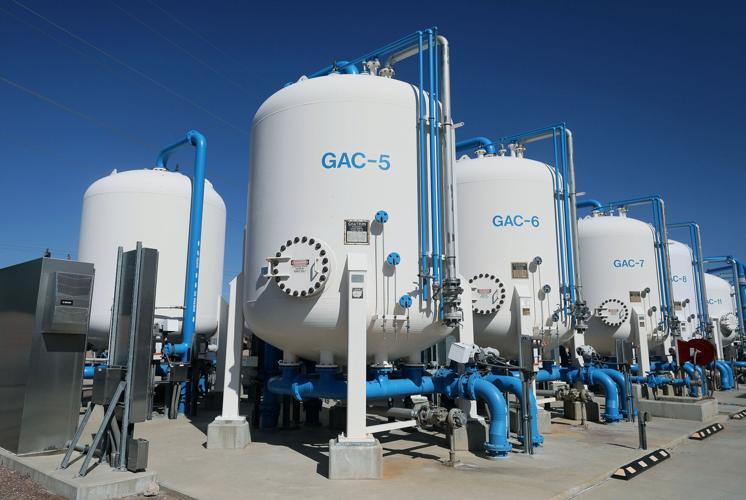
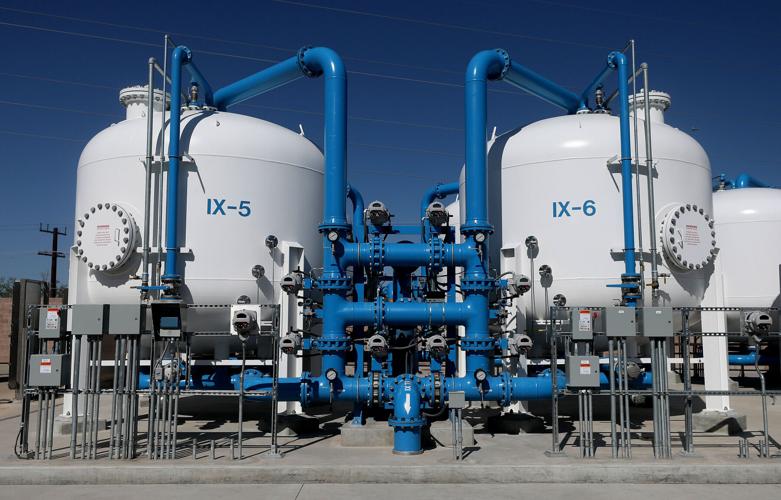
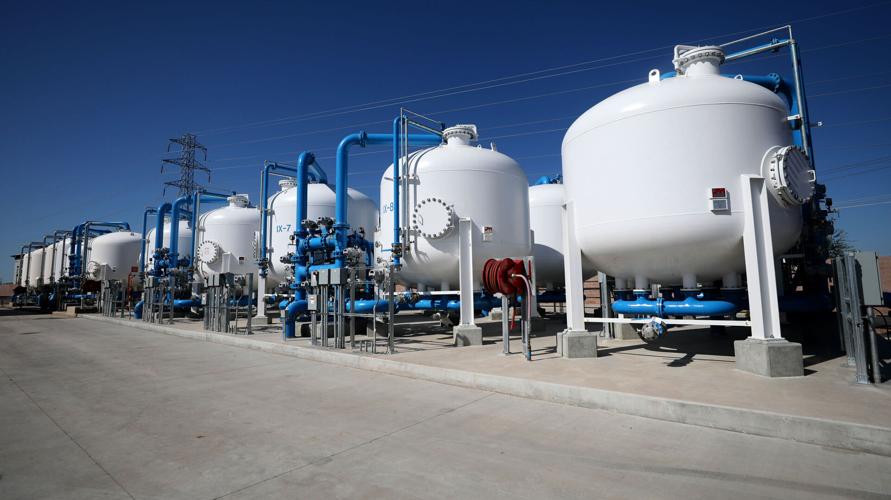
The treatment will be done in a series of nearly two dozen large, white steel tanks known as vessels, each capable of holding 20,000 gallons of liquids.

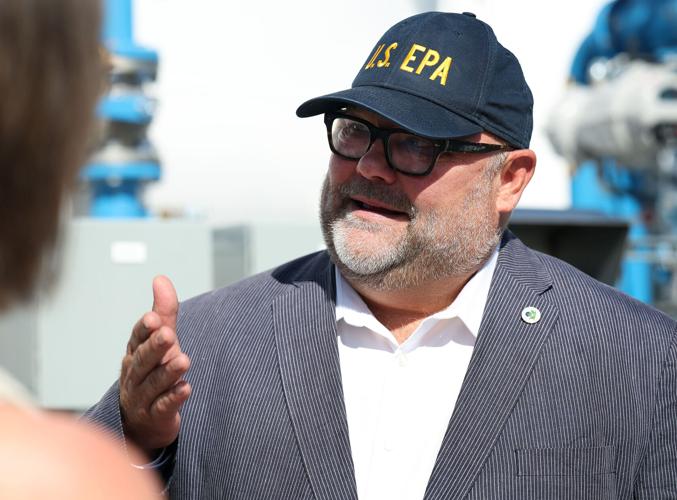
Mike Montgomery, director of the Superfund & Emergency Management Division of the U.S. Environmental Protection Agency's Region 9, was among those attending a ribbon-cutting ceremony Tuesday for expansion of a Tucson water treatment plant financed partly by a federal grant.
The construction was paid for mainly from a $25 million federal grant, distributed by the Arizona Department of Environmental Quality, plus another $2 million from the city, Kmiec said. The federal grant came from congressional appropriations made during the 2020-21 COVID-19 outbreak to help cities and states that suffered economic hits from the prolonged pandemic.
Hobbs said the completion of the new treatment process makes her proud and shows "we are serious about our water. We understand that we live in a desert. The water is the lifeblood of our state. We stretch every drop we can to make sure our families and businesses have the water we need to thrive."
Hobbs and several other speakers acknowledged the south side's deep history of groundwater contamination and its devastating effects on human health. "For many decades families on the south side have been living with the consequences of unsafe drinking water that will never be forgotten," and that reality is "interwoven with today’s celebration," Hobbs said.
Robert Jaramillo is a member of the United Community Advisory Board of citizens who have watchdogged the groundwater cleanup for decades. He thanked city, state and federal officials for their efforts to make this treatment plant expansion possible.
"It does take a team effort to get this done properly and correctly," Jaramillo said. "Our community has been suffering for decades, for generations."
Yolanda Herrera, a co-chair of the advisory board, noted that her late father and the late Lorraine Lee, longtime head of Chicanos por la Causa, both went to Washington, D.C. back in the early 1980s to seek help from federal officials and Congress to get the pollution cleaned up.
"It's a fight we're never going to quit," said Herrera.
The mayor told the gathering that TARP has become an essential part of Tucson's commitment to pollution cleanup and drinking water protection.
"As new contaminants emerged, when it affected our ability to provide drinking water, we took wells out of service and worked with federal and state partners to develop lasting solutions," Romero said.
How the technology works
Here's how the new PFAS treatment method will work, Kmiec told the Star:
The groundwater will first pass through "ion exchange resins," which Kmiec said look like little plastic balls, designed for PFAS molecules to be absorbed onto them.

Tanks at the the newly expanded Tucson Airport Remediation Project or TARP plant, where contaminants are removed from city groundwater.
In a "constant process of chemical absorption, the PFAS will be filtered out, and stick to the resin balls inside those vessels," Kmiec said.
The resin materials have an attractive property that causes PFAS molecules to stick to it, said Kmiec, adding, "Think of a magnet that is a chemical and sticks to a filter. The PFAS comes out of the water and sticks to the filter media."
Until now, the PFAS compounds have been treated by granular activated carbon compounds at the tail end of the treatment plant's groundwater cleanup process. The groundwater first passes through an advanced oxidation plant that removes TCE and 1,4-dioxane.

The tanks at the expanded Tucson Airport Remediation Project or TARP plant that include new PFAS treatment technologies, at 1110 W. Irvington Road.
Now, the PFAS will be removed strictly by the ion exchange method at the beginning of the treatment process. The granulated carbon will be used solely to remove hydrogen peroxide after it's been used to remove the 1,4-dioxane from the groundwater, said Kmiec. That means the granular activated carbon compounds will last much longer, requiring much less frequent replacement, he said.
"The carbon will last for years," he said.
The granular activated carbon can efficiently remove PFAS from the water only when it's at low levels, Kmiec said.
Knowing higher concentrations are coming off the Tucson International Airport property to the south of that area makes it important to put in a filter that can handle much higher levels of PFAS, he said. PFAS has been found under the airport property and was linked to former use of firefighting foam containing the chemicals at area operations, including the Air National Guard.
"The net benefit to the system is that we will gain greater confidence we're treating everything more efficiently. Our long-term costs should go down," Kmiec said.
Contact Tony Davis at 520-349-0350 or tdavis@tucson.com. Follow Davis on Twitter@tonydavis987.

Tony Davis
Reporter


 City to receive $25M to improve water cleanup in Tucson