

If cows could talk, Brad Cowan wouldn't need the Internet.
The state livestock officer spends more time than he would like rounding up wayward livestock. And once he does, helping the animals find their way home can be tougher than riding the range tracking them down in the first place — not to mention more time consuming.
It certainly doesn't help matters that for years the state relied solely on wanted posters — foundation of mass communication in the Old West that they are — to get the word out.
"We posted them in a saloon or a fence post," said Ed Hermes, spokesman for the Department of Agriculture.
Then the officers would wait for phone calls that wouldn't always come.
But the state — at Cowan's urging — is now using 21st century technology to help remedy the problem. While the posters will remain, the Department of Agriculture recently launched a lost-and-found Web site.
People are also reading…
The site greets users with a rooster's crow, the ring of cowbells and the snort of a pig.
"At this point, the general public is not going to see the fence posts," Cowan said. "This will give more exposure to the animals that are lost."
How the Web site works is pretty simple.
When a livestock officer or a member of the public finds a lost animal, a description and location are posted. Photos are in the works, but a few technical glitches need to be worked out.
Still, people can then search for cattle, sheep, swine, goats, horses, emus and ostriches, llamas and alpacas, bison, deer and elk.
Pets and poultry — despite a rooster being featured on the Web site — are not welcome. Just livestock.
While there is a certain amount of novelty about using the Internet to help find a lost cow, Hermes said the site is much-needed.
Last year alone, state livestock officers handled 1,621 strays, Hermes said. No small feat considering there are roughly 15 livestock officers and inspectors statewide.
And while the primary intention is to get animals home quicker, there is also a hope that it will free up livestock officers to do more investigative work.
"I'd rather spend my time working on cruelty cases," said Cowan, who covers Pima County.
Originally from Southeastern Arizona, Cowan is something of an old cowboy.
He can rope, tell a good story and is always quick with a good quote.
Friday morning, there was only one stray in his care: a small, docile gray horse with sad eyes Cowan picked up a few weeks ago west of the Tucson Mountains.
The horse has no obvious owner. Cowan said he hoped the Web site would help link the horse with an owner or, at the very least, a family interested in adoption if it goes unclaimed and gets put up for auction — an outcome for all unclaimed livestock in the state's care for at least two weeks.
The horse is to be auctioned Thursday in Willcox.
Perhaps because the Web site is so new, or perhaps because the Department of Agriculture is relatively small, the lost-and-found site has been slow to take off.
There are only a handful of animals posted on it, and at times it goes down because of technical problems.
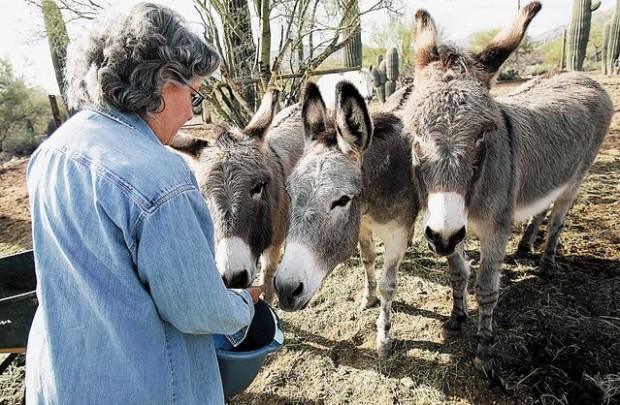
But Kathy Thureson used it last week after three burros wandered to the edge of her Northwest Side home.
"Everything seems to turn up here," she said.
She and her husband keep two horses on their property, and so they were able to corral the burros and care for them.
After a few days, she found the owner, albeit not because of the Web site. A delivery driver noticed a sign she had posted about the burros and then later saw a second sign for three lost burros. So, it seems, the old method still has some traction.
Still, to Cowan, the story demonstrated the need for not just the site, but also a public awareness about it.
If the burros' owner knew about the Web site, "We could have had them back together that day," he said.
Did you know ...
The secret to catching an ostrich starts with a sock.
To catch an ostrich you have to corner it, which is often done with a section of fencing. Then you grab the beak with one hand, and with the other you place a sock over its head.
"Corner them, grab the beak, put a sock over the head and blindfold them," said Brad Cowan, livestock officer for Arizona Department of Agriculture. "An ostrich beak is kind of leathery."


