
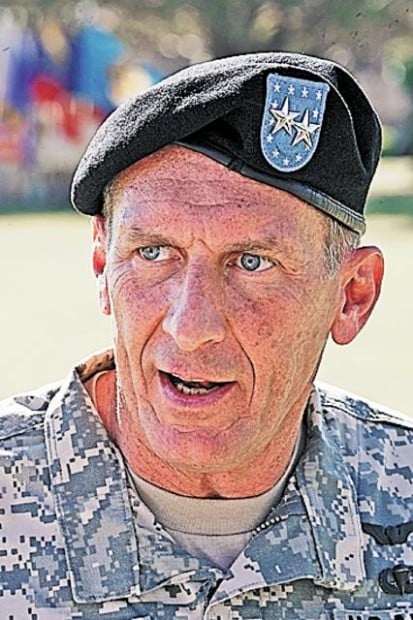
SIERRA VISTA — Fresh from the frays in Iraq and Afghanistan, a new two-star general took command of Arizona's largest military installation on Friday.
Maj. Gen. John M. Custer III assumed the top job at Fort Huachuca and its intelligence school in a swirl of pageantry and bravado.
"Bring your courage, baby!" Custer urged hundreds of troops assembled for the change-of-command ceremony at the Army post 75 miles southeast of Tucson.
Cannons boomed, flags fluttered — and several soldiers fainted in the heat — as Custer took the reins from Maj. General Barbara G. Fast.
Fast, who shook off the pall of the Abu Ghraib prison scandal and went on to oversee innovations in military intelligence training, was praised as a leader "who serves her nation steadfastly and loyally."
People are also reading…
"You can look back with pride on a job well done," Lt. Gen. Thomas Metz told Fast.
Metz is deputy commander of the Army's Training and Doctrine Command at Fort Monroe, Va., where Fast is headed for her next Army assignment.
Fast, one of the few female soldiers ever to reach the rank of two-star general, was head of military intelligence in Iraq in 2004 when the prisoner abuse saga erupted.
She was criticized in one investigation for not giving better advice on the right way to run interrogation and intelligence operations overseas. But several other probes cleared her of wrongdoing at Abu Ghraib, and one praised her for improving intelligence-gathering efforts.
During her tenure at Fort Huachuca, Fast was involved with efforts to upgrade interrogator training, improve soldiers' cultural awareness of the Middle East and counteract the deadly threat posed by makeshift bombs, the top cause of troop deaths in Iraq.
Custer has spent the past four years as intelligence director for U.S. Central Command headquarters in Florida. In that role, Custer said he spent "about 95 percent" of his time in Afghanistan and Iraq.
Custer said in an interview that the experience gave him a keen appreciation for the hardships soldiers face overseas.
He said one of his top priorities is to quickly transfer new knowledge from the battlefield into classrooms at Fort Huachuca where interrogators and counterintelligence soldiers are trained.
Those efforts are indispensable to accurately target the enemy, he said.
"We can't just go out and bomb houses. We have to know that it's the seventh house down, in the back bedroom. That's something you only get from good intelligence."
Friday's ceremony included the most lavish display of pomp the Army could muster, a spectacle seen only once every few years at Fort Huachuca when a new commanding general arrives.
Sousa marches filled the air as ceremonial steeds charged across historic Brown Parade Field under a hail of pistol fire. Soldiers had practiced their marching strut for days in advance, but in the end, it was too much for some of them.
A half-dozen or so troops, assembled in formation for an hour or longer in the ovenlike morning sunshine, collapsed and were carried off on stretchers during the dignitaries' speeches.
Military retiree Mike Dennis, of Sierra Vista, and his wife, Jackie, were among the throng of civilian spectators who witnessed Friday's ceremony.
They predicted Custer, who once served as the fort's deputy commander, will do the Army proud in the top job.
"He's a people person," Jackie Dennis said.
"He's a charismatic leader," her husband agreed. "He leads with style, humor and authority."
Did You Know ...
Camp Huachuca faced a serious environmental threat the year after it was established.
The first commander, Capt. Samuel Marmaduke Whitside, wrote in 1878 that the rainy season had started and the adobe buildings were not faring well against the 35 to 40 inches of rain that had fallen.
"Roofs are now saturated ... perishable supplies damaged ... every possible means have been adopted to protect government property ... we have labored constantly getting out materials and erecting buildings, all of which are now washed away" or rendered uninhabitable.
The camp did survive that monsoon, and by 1882, it had become a permanent post named Fort Huachuca.
Source: The Bisbee Daily Review, July 31, 1951