

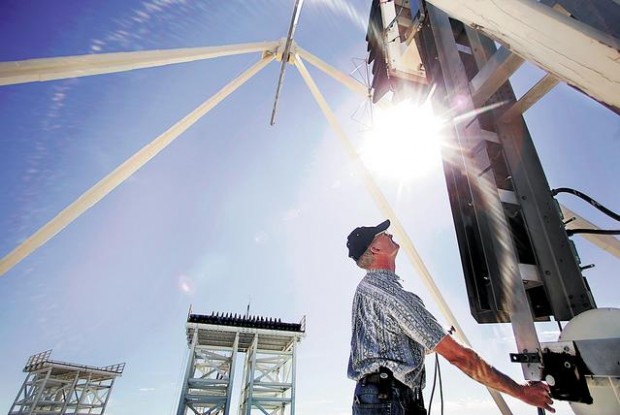
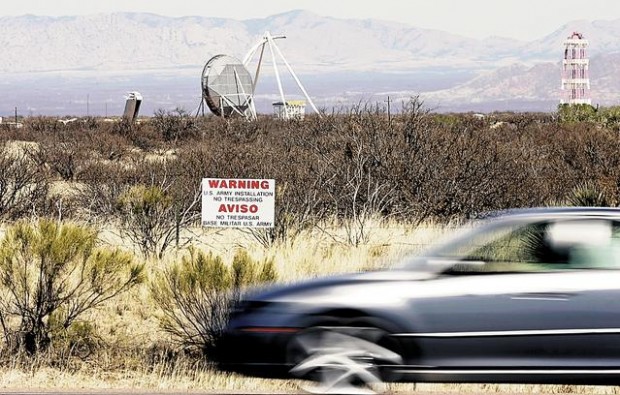
Civic and Army leaders are hoping to stop an unforeseen force from limiting future operations at Fort Huachuca, the military's sole outpost for sensitive electronic testing.
Sitting in a bowl surrounded by mountains roughly 75 miles southeast of Tucson, the Sierra Vista post is home to the Army's Electronic Proving Ground, where military equipment undergoes extensive radio-frequency testing.
The terrain, shielded from radio waves by the metal-rich mountains, is the only place in the United States where such testing can occur, officials say.
Yet as more people move into the surrounding area — bringing with them cell phones, ham radios and other electronic devices — the radio frequencies used by fort officials are seeing an increasing amount of interference.
While officials say there's no immediate danger to the proving ground — a key mission that led to the post reopening in 1954 — they worry that the radio-frequency encroachment, while mostly unnoticed by the public, one day could become a tangible problem similar to aircraft noise around Davis-Monthan Air Force Base.
People are also reading…
To protect the proving ground, fort officials and legislators have crafted a bill that would require developers talk to post leaders and work out ways to avoid impinging on the testing.
While the bill is limited in its requirements — it asks only that developers meet with Fort Huachuca leaders, who have no veto power over specific projects — post officials said it's a good starting point that can help preserve the proving ground and the fort.
"There's only one other place in the world like this, and it's in Australia," said Col. Jasey B. Briley, chief of staff for the U.S. Army Intelligence Center. "That's why this post is so valuable."
New systems tested
Whenever the military prepares to deploy a new radio or other communication device for troops on the battlefield, the technology must be put through a battery of tests at Fort Huachuca.
Post officials bombard the equipment with radio waves, try to jam signals and make sure it works in simulated field conditions.
But as nearby Sierra Vista has grown, the radio spectrum has seen an increasing amount of civilian interference.
Officials liken the encroachment to a house next to a busy street versus a home in a rural area: There's a lot of traffic and noise near the city house but almost none near the home in the country.
But unlike cars driving down the street, the increased radio frequency traffic can't be seen or felt.
"The primary issue is not direct interference but a recurring level of background noise," said Larry Portouw, president of Fort Huachuca's civilian booster group.
The extra radio noise hasn't posed a serious problem — Fort Huachuca's ambient radio traffic is still four or five times lower than Tucson's — but officials know the increase is linked to growth in the region, said Frank Davis, director of operations at the proving ground.
The legislation, sponsored by Senate President Tim Bee, R-Tucson, isn't designed to limit growth but to allow the fort to have some say in future projects.
It also puts the proving ground on the map, giving it definitive boundaries. Those boundaries would be published for new homeowners so they're aware of the nearby testing.
A major focus of the legislation is to raise awareness about the proving ground so people realize how vital it is to the fort and the region, which relies on the post for thousands of jobs and a multimillion-dollar economic boost, Bee said.
The measure, Senate Bill 1387, has passed through the Senate and is awaiting hearings in two House committees.
Developers in the region already work closely with Fort Huachuca when planning future developments, though the legislation sets it in stone, said Matt Walsh, the chief of the fort's strategic planning office.
"We want to get a handle on how we're going to grow in the future and have that smart dialogue upfront before it becomes problematic," he said.
Bee agreed. "What we're trying to establish there is an opportunity for there to be cooperation between city leaders and the fort so there can be an awareness of the electronic issues as developers are building around it," he said.
Possible starting point
Post officials hope the legislation, if passed, will become a starting point for future initiatives to protect the proving ground.
Eventually, Briley said, he'd like to see more protection of specific frequencies in the region that the proving ground needs to perform its mission.
One area that officials would like to see protected is high-frequency radio waves, as it's virtually impossible to find another location to conduct testing in that area of the spectrum, Walsh said.
But part of the problem is that even fort officials don't know the best way to address the increasing radio interference.
While officials can point to specific sources of interference, such as radio towers, garage-door openers and large electronic transformers, they don't have any idea on how all the elements combine to produce the ambient noise seen in the region, Davis said.
"It's difficult to discern what exactly is causing it," he said. "It's a real pot of stew."
The proving ground is seeking funding to perform a comprehensive survey of the area around Fort Huachuca to learn how the various elements combine to create interference.
Once researchers develop that understanding, proving- ground officials can look at ways to block or limit future interference in specific frequencies, Davis said.
At the least, fort officials would be able to show developers that a construction project, such as an industrial park, might cause a specific disruption to testing.
"That's what we'd like to happen," Davis said. "To be able to sit down someday and show them how it could adversely impact us."
DID YOU KNOW
Fort Huachuca was reopened in the 1950s because it proved to be the perfect place for conducting electronic testing.
The former Apache Wars outpost, originally established in 1877, was closed after World War II, but later flourished because of its electronic proving ground and military intelligence school.
Source: Fort Huachuca


