

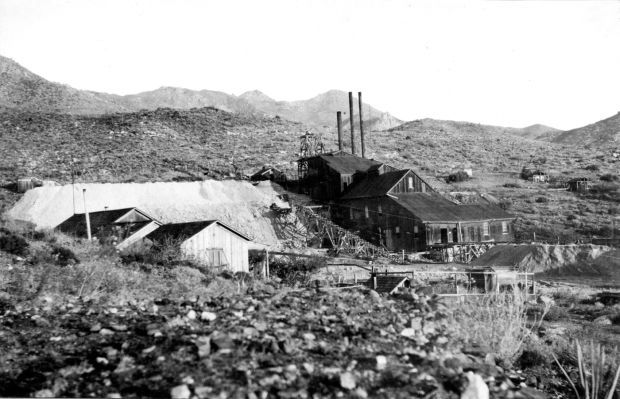
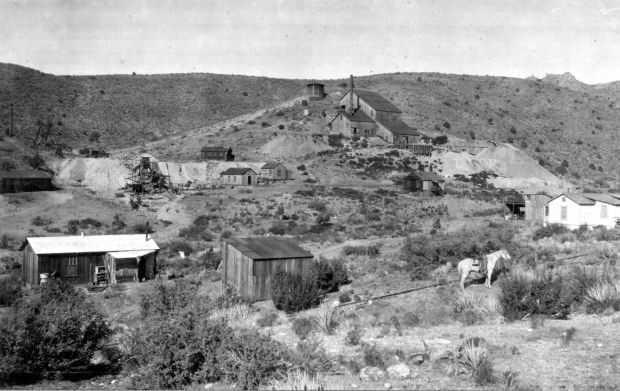
Over the past 150 years, significant gold and turquoise mining in Mohave County have yielded more than 1,100 recorded mining claims.
Located in the northwestern Arizona portion of the Basin and Range Province, 20 miles west of the edge of the Colorado Plateau, the Kingman Turquoise Mine near Kingman was mined by the Hohokam and the Navajo, as evidenced by the hammers, water skins, charcoal and polishing material discovered at the mine site in the Cerbat Mountains.
Charcoal was used to heat rocks containing veins of turquoise. Miners would apply water, which would fracture the rocks and reveal exceptional turquoise specimens renowned for use in the jewelry trade.
Aztec Peak and Ithaca Peak in the Cerbat Mountains are world-famous turquoise localities.
Named after the Hualapai Indians, the Wallapai mining district includes smaller districts and camps, including Cerbat, Chloride and Mineral Park. The Wallapai district is in the central part of the 23-mile long Cerbat Mountain range 15 miles northwest of Kingman.
People are also reading…
Silver, lead and to some degree gold were extensively mined in the area beginning in 1863. “Cerbat,” derived from the Yuman word meaning “bighorn sheep,” once prevalent in the area was the name given the mining camp. Developed in the 1860s, the camp included an arrastra — a grinding wheel — and the Golden Gem Mine, which produced over $400,000 in metals between 1871 and 1907.
The town of Chloride 20 miles north of Kingman claims to be the oldest Anglo-American mining town in Arizona. Named for exposed ore laced with silver chloride, mining activity there exploded following a rich gold strike in the Cerbat Mountains in 1900. Two thousand hardrock miners made their home in the area.
The most productive mine recorded in the Wallapai district was the Tennessee mine and mill, connected to the town of Chloride by the Arizona and Utah Railroad. The Tennessee mine was worked by the American Smelting and Refining Co. in 1910 with a 1,400-foot shaft and flotation plant.
Operating between 1890 and 1947, the Tennessee, Elkart and Schuylkill mines were the largest producers of lead and zinc in the district while producing $7.5 million in copper, lead, silver and gold. Between the years 1904 and 1948, the Wallapai district produced $23 million in metals.
The town of Kingman, founded in 1882, was the nearest access to a railroad station from Chloride, located 20 miles northwest. The arrival of the Atlantic and Pacific Railroad to Kingman brought about increased activity and growth to the district.
Formerly known as the McGuire Mine, the Bi-Metal Mine consists of an open pit and underground workings 3 miles south of Kingman. Early owners included Major Pickerell and Mrs. Mcguire, and Arizona Gold Mines Co. The property, valued at $70,000 in 1909, included a 10-stamp mill operation, along with rockers, jackhammers and diamond drilling. Advertised as a deposit comparable to the Homestake in South Dakota with gold ore averaging $5 a ton, passengers riding the Santa Fe Railroad that crossed the mine property could see the mine and mill in operation.
The Frisco Land and Mining Co. undertook an open-pit mining operation at the Bi-Metal Mine in the early 1980s. Ore was trucked to the Frisco Mine for leaching. Operations were suspended in 1986 because of the unprofitability of low-grade ore, running less than .1 ounce per ton of gold. Open-pit gold reserves reported at the Bi-Metal Mine in 1984 remained unobtainable because of their location beneath Interstate 40 and the Santa Fe Railroad.
Located 19 miles northwest of Kingman is the Mineral Park Mine, which started out as a five-stamp quartz mill and townsite operation in 1871. An open pit mine operated by the Duval Corp. a century later included a 12,000-ton per-day mill and concentrate operation. Acquired by the Cyprus Mining Co. in 1986, the mine was converted to an SX-EW (solvent-extration/electowinning) operation in 1994.
Today the Mineral Park copper and molybdenum mine includes 6,500 acres, with an estimated mine life of 25 years.
In December 2014, active mining at Mineral Park ceased as Mineral Park Inc., a subsidiary of Mercator Minerals Ltd., declared bankruptcy. The subsidiary is currently for sale.
William Ascarza is an archivist, historian and author of six books, including “Southeastern Arizona Mining Towns,” “Arizona-Sonora Desert Museum” and “Tucson Mountains,” available at Antigone Books, Cat Mountain Emporium, the Arizona-Sonora Desert Museum and the Arizona Geologic Survey’s Arizona Experience Store. Email him at mining@tucson.com
Sources: Arizona Department of Mines and Mineral Resources File Data (Bi-Metal Mine) July 27, 1988; McClelland G. Dings. The Wallapai Mining District Cerbat Mountains, Mohave County Arizona. Geological Survey Bulletin 978-E. U.S. Government Printing Office, Washington: 1951; Mineral Park Mine files $10M sale offer. News- Herald havasunews.com January 2015; Mines, Mining and Prospects in Great Southwest Region. Los Angeles Herald. Monday, Oct. 12, 1908; F.C. Schrader. 1909; Mineral Deposits of the Cerbat Range, Black Mountains and Grand Wash Cliffs. Mohave County, Arizona. U.S. Geological Survey Bulletin 397. Washington. Government Printing Office.


