

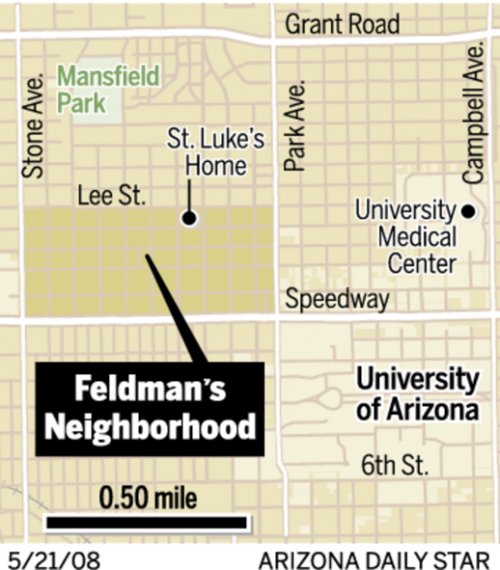
Nearly $600,000 in sidewalks and other pedestrian-safety improvements have made it much easier to take a stroll through the historic Feldman's Neighborhood.
"Feldman is a longtime Tucson neighborhood that, when it was built, lacked a lot of the amenities that we now expect to have in urban neighborhoods. One of those is sidewalks," said Pima County Board of Supervisors Chairman Richard Elías. He is the county supervisor for District 5, where the neighborhood is located.
The neighborhood dates to the turn of the 20th century, when people with tuberculosis who could not afford a sanitarium lived there in tents. People gave the area the derogatory nicknames Tent City and Lunger (Lung) Hill, according to a written neighborhood history submitted to the county by a resident. Later, permanent sanitariums opened in the area.
The neighborhood is home to about 2,100 people. It is bordered by East Lee Street to the north, East Speedway to the south, North Park Avenue to the east and North Stone Avenue to the west.
People are also reading…
The neighborhood is named for subdivision founder and Tucson entrepreneur A.M. Feldman, said Phyllis Webster, historian for the Feldman's Neighborhood Association.
Though several former tuberculosis sanitariums — now used for other things — still exist there, times have changed.
A combination of 2004 county bond money and city funding helped bring the neighborhood's walking paths up to 21st century standards.
A $500,000 grant from the county's Neighborhood Reinvestment Program and $96,000 in Tucson Ward 6 Back to Basics funding paid for improvements geared toward making it safer and more comfortable to walk in the national historic district.
Feldman's now has about 6,700 linear feet of new sidewalks and 94 Americans with Disabilities Act-compliant ramps. Existing sidewalks were modified or repaired.
Previously, the neighborhood had disconnected, deteriorating, 70-year-old sidewalks and dirt easements, which residents said made it difficult to get around on foot.
"It was a huge problem. There were a lot of residents that would walk in the streets or in the dirt and (were) falling," said Monika Ashe, the neighborhood association's president.
William Rose, 57, had a hard time walking to the supermarket before the new sidewalks were put in.
"I'm tired of walking in the dirt, tripping over the rocks," he said. "Now I can walk to Fry's without tripping."
Rose is a resident of St. Luke's Home, 615 E. Adams St. The home was founded in 1917 as a tuberculosis sanitarium.
Though no longer associated with tuberculosis, St. Luke's continues to help people in need. It is now a supervised home for low-income men, women and couples 55 and older.
"It's nice for them to be able to feel safe while they are walking, and that's something they didn't have before," said Lizette Lopez, St. Luke's volunteer coordinator.
Families with children also said the pedestrian safety improvements helped them.
Jessica Coltrin said it is now much easier for her 7-year-old daughter, Star, to walk to school.
Another benefit: The rest of the family has become less reliant on going everywhere by car.
"We walk, and it's easier to take the bus, too. It's a cleaner shot to the bus stop, so we find ourselves driving a lot less — plus gas prices have something to do with that," said Coltrin, 33. "It's much more of a joy to walk around the neighborhood now."
DID YOU KNOW
In 1989, the Speedway-Drachman District was entered on the National Register of Historic Places. The name was later changed to Feldman's Historic District and the area is included in the Feldman's Neighborhood Association. It was home to several sanatoriums, including St. Luke's, which was founded in 1917. It was also home to Whitwell, built in 1908. Whitwell is the castlelike structure on East Adams Street near North Euclid Avenue.


 U of A’s fall enrollment down more than 20%, sources say


