For homeowner Hazard Hawk, it was a case of three strikes and his well was out.
He and his wife, Deborah, had to abandon their well in Cochise County's Dragoon Mountains foothills last February, after sediment built up in it and browned its water so heavily that they felt it was unfit for them and their four horses to drink.
Three years earlier, they had a well company install a new set of pipes for the well after it had also filled with sediment. Fifteen years ago, the previous owner of the home where they live in the Cochise County subdivision of Richland had drilled the well 200 feet deeper after it dried up.
This time around, their well driller, Brian Allen, came over and said, '‘Your well is dead,’” Hawk recalls.
“He came in, and tried to pull out the pump. The ground was moving, and he said 'once we get a 50,000-pound pump moving, no telling where it will go.’”
People are also reading…
So now they’re paying a water-hauling company $200 every three weeks to truck 2,500 gallons to their home, lying 3 miles east of the Dragoon Mountains in the Willcox Basin.

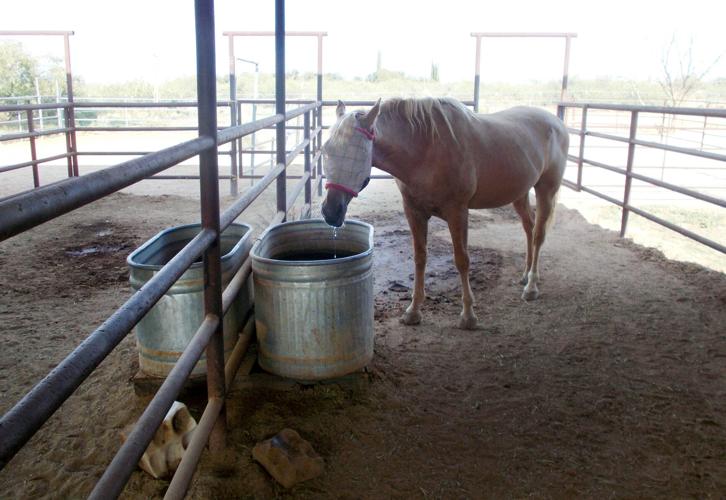
Hazard Hawk’s horse, BC, drinks water from a trough. The water was hauled to Hawk's house in the Richland area near southeast Arizona's Dragoon Mountains by a private supplier. That's because his drinking well was rendered useless when its pump was plugged up with sediment.
Hawk’s dead well had company. Not long after Allen told the Hawks their well was useless, he gave similar bad news to two other households nearby, all within a mile of each other, Allen told the Star. Around the entire Willcox Basin, estimates are that more than 100 drinking wells have dried up in recent years.
Regulators from the Arizona Department of Water Resources have proposed cutting water use by farms — by far the basin's largest water user — by 10% to reduce the pressure on the area's long-depleted aquifer.
But activists working on this issue say it will take a bigger cut than that to keep more wells from drying up.
One of the other Richland residents who lost a well, Randy Redhawk, today drives five miles to Sunsites regularly to fill his truck with water served at a station run by a private company that has its own well. That water tastes “terrible” because it contains excessive chlorine and fluoride, he said, so he uses it only for washing and for giving water to his animals.
To get his drinking water, Redhawk drives four miles every six weeks to a friend’s house that has a good well, and fills six five-gallon plastic bottles with water.
He recalled that back in the spring, the ground collapsed on his and some neighboring wells. Prior to that, his well delivered 26 gallons a minute, but then it slowed to a trickle of maybe 1 gallon an hour, Redhawk said. A month later, the well “totally went out,” he said.
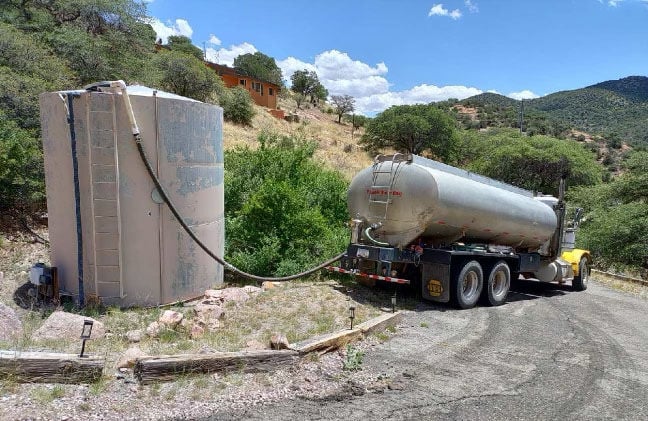
A tanker run by Desert Water Delivery, a private water hauler in the Willcox Basin, connects to a large water tank owned by a Cochise County homeowner. The water is being hauled to the homeowner because the family's well dried up.
“We lost all of our wells,” he said of those belonging to him and his Richland neighbors. “The pumps got covered” due to subsidence, he said, in which the ground sinks after over-pumping removes water from the soil’s pores.
Sinking ground breaks well casings
Well driller Allen said that at all three wells he saw stop working, “The ground is moving down here. For all three of them, the well casing broke.”
He was referring to a tubular structure, typically made of steel or PVC materials, that lines the inside of the well. It serves as a water-tight protective lining, offers structural support and prevents the well from being contaminated by sediments and bacteria. “People keep moving into our valley, sucking water out. When the ground sinks, it moves. It’s breaking the casings," Allen said.
Lou Manuta, president of a group that tries to help Willcox-area owners of dried-up wells get new wells, said he talked to owners of 12 Richland wells — including Hawk and Redhawk — that stopped working over a six-week period earlier this year due to excessive sedimentation of pumps. The well owners live within a two-mile radius of one another, he said.
All those cases occurred in Richland, a sparsely populated area. It lies 7 miles north of Sunsites, an unincorporated community of 600 to 800 residents, 27 miles southwest of the city of Willcox.
Those well casings were probably being damaged from crunching and twisting caused by compaction of the ground from subsidence, in which over-pumping of groundwater causes the ground to sink, said Brian Conway, an Arizona Department of Water Resources hydrogeologist. He regularly tracks subsidence patterns in the Willcox Basin.
In the Richland-Sunsites area, the ground sinks from subsidence by about two inches a year, he said.
“Subsidence in the subsurface, that leads to the sediment being able to get into the well casing. That’s one of the telltale signs that the casings are damaged. The casing is a critical part, that allows water in but keeps sediment out,” Conway said.
Well replacement program
Manuta is president of People for the Playa Water Resources, a nonprofit group that’s trying to help basin residents with failed wells get new ones through an $11 million well replacement program established by the Willcox Basin’s megadairy company, Riverview LLP. The program was set up following a legal settlement reached in early 2026 between Minnesota-based Riverview, which owns two large dairies in the basin, and Arizona Attorney General Kris Mayes.
And while the well owners await responses to their applications for new wells, which can take 3 months to process, Manuta’s group pays a Sunsites-based water company to haul water to their houses.
“In each instance, there was still some water in their well,” Manuta said of the 12 Richland well owners. “The problem was the pumps got clogged.”
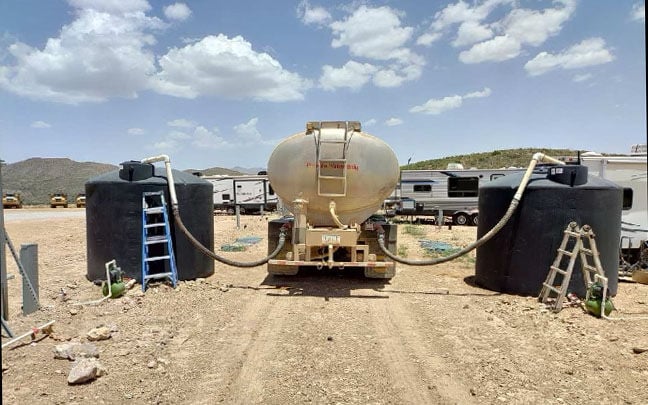
Desert Water Delivery, a private water hauler, connects its water truck to two water storage tanks serving a Cochise County household. The company's business is growing as wells continue to dry up in rural areas of the county including the Willcox Basin.
State officials took the first step this month towards curbing the Willcox Basin’s chronic groundwater overdraft. Following more than a decade of building anger and anguished debate over water use and drying wells in the basin, ADWR has proposed to require most farmers in the 1,911-square-mile basin covering parts of Cochise and Graham counties to cut their water use by 10% starting in 2029.
But already, Steve Kisiel, leader of an activist group in the basin called Cochise Groundwater Stewards, said he’s received anecdotal accounts of “easily more than 100” wells in the basin that had to be deepened after they’d gone dry.
And he warns that if agricultural pumping isn’t cut significantly fairly soon, and well levels keep falling at their current pace, he believes virtually every residential well in the Willcox Basin will go dry in 25 to 40 years.
“The reason is the huge overdraft — almost exclusively attributed to agricultural irrigation — will continue to deplete the aquifer and lower water levels,” said Kisiel, whose group works to “assure the preservation of our precious groundwater.”
“The drought only makes things worse,” he said. “Everyone here knows or should know it’s just a matter of when, not if, their well will run out of water.”
Kisiel cited figures from maps in ADWR's 313-page proposed management plan that show large concentrations of monitored wells saw major declines from 1990 through 2021. In various parts of the basin and over various periods, wells have dropped 3 to 13 feet a year.
Noting these declines, Kisiel said, "Most domestic wells (in the basin) are drilled 150 to 200 feet below where they first hit good water. Even if a well is drilled with that cushion today, the well would likely run out of water in less than 40 years."
Kristine Uhlman, a retired University of Arizona hydrologist who has done water studies in the Willcox Basin, agreed with Kisiel's projections, adding, "My experience with Kisiel is that he digs deep and does the math. His numbers are good."
ADWR didn't respond to the Star's request to comment on Kisiel's projection.
Manuta said, ”It’s only getting worse. So many wells have gone dry in the last few months. Most people can’t afford new wells. Without a really strong, enforceable management plan, it’s only going to accelerate.”
More business for water haulers
People who run the companies that tried to service Hawk’s well and that now haul water to his home say they, too, are seeing plenty of residential wells go dry in the basin.
ADWR reported two years ago it has records of 71 wells that have dried up there since the department formed in 1980, and 29 of them have gone dry since 2014. But the department and people living in the basin have never conducted an official basinwide survey of dried-out wells, leaving the actual total uncertain.
Desert Water Delivery, which hauls water to the Hawks, delivers water to a total of “50 to 75 households” in Cochise County, said the company’s owner, Ben Hipps.
“We get more customers all the time. We also set up pumps for people as well. We’re setting up water systems for people who can be served by us,” Hipps said. “I’m not the only dog in town. I know for sure of two other companies here that haul water, but my understanding is I cover more of a customer base than they do.
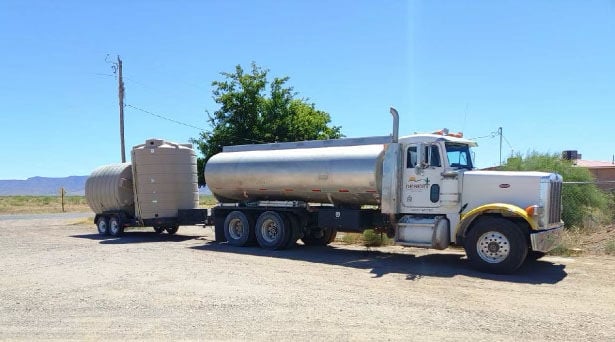
Desert Water Delivery's water truck hauls water to a Cochise County customer.
“There’s also a lot of people who haul for themselves; I represent people who don’t have equipment to haul for themselves,” he said.
Brian Allen, whose family has run a well drilling service in Cochise County for half a century, said he’s either drilling new wells or deepening existing wells in the basin twice a week and that 70% of his company’s drilling is for new wells.
“We’ve been drilling wells forever. It is what it is. It doesn’t rain. It doesn’t snow. If people want to bitch that it’s farmers and ranchers sucking up water, they need to go back where they came from,” said Allen, whose family owns Allen’s Well Drilling Service in Elfrida, just south of the Willcox Basin near the city of Douglas. "My family has been here since the ‘30s. There’s been water issues here for 40 years."
Hawk, however, said he’s in the Willcox Basin to stay.
“We’re too old to pack up and move again.” said Hawk, who is 77 and whose wife is 75.
He said a previous owner of his property had drilled the well 200 feet deep in 1993. The owners deepened it another 200 feet in 2011 after it went dry, Hawk said. The Hawks bought their house with its well in February 2020, after moving down from Paulden north of Prescott because they were getting tired of that area’s continued growth and increasing traffic, he said.
They had no problems with it until April 2023 when the pump filled with sediment the first time, he said. Today, life with the hauled water is more difficult than with their now-abandoned well. But they have no plans to seek help from the Riverview fund to drill a new well, Hawk said.
“We’re both retired, both on Social Security, we’re doing very good,” and other families need the outside help more than they do, Hawk said.
Redhawk, however, says he’s still waiting to hear back on his application for money from Riverview to drill a new well, three months after he requested it.
Delays setting up program
To date, Riverview has financed new wells for 17 families, at a cost of $389,483, the Attorney General's Office said. But that money all came from a fund that set aside half of the $11 million to help families living within 1.5 miles of either of those dairies. Redhawk and Hawk live much farther away, well to the west of the dairies.
They would be eligible to receive money from a separate Riverview fund, managed by the Arizona Community Foundation. But Redhawk said he’s heard nothing from the foundation since submitting his application.
Arizona Community Foundation was selected as a Third-Party Charitable Administrator for a settlement agreement between State of Arizona and Riverview LLP. The Settlement created the $5.5M Sulphur Springs Water Fund, supporting qualifying residents and schools in the Sulphur Springs Valley in southeastern Arizona who have been impacted by declining groundwater levels.
On Sunday, the foundation issued a statement saying a company with which it has contracted is conducting "on-site assessments" of wells of people who have applied to the foundation for funding of new wells. Starting this month, applicants meeting initial eligibility standards for receiving funds will be contacted by the foundation or or the contractor to schedule their assessment, or contacted with a request for further information pertaining to their application, the foundation said.
Anyone wanting to learn more about the program or submit an application should visit The Sulphur Springs Water Fund website. Applicants seeking status updates on their submitted application should write SSWF@azfoundation.org.
Manuta said foundation officials have told him they’ve had some delays setting up their part of the well funding program. That's in part because the foundation decided to hire a hydrogeologist to review estimates from well drillers of the costs of drilling the residents’ new wells.
Today, the foundation has “40 to 50 applications that have just been sitting there,” Manuta said.
While awaiting results on his application, Redhawk said he uses an outhouse instead of his toilet to save water at the trailer where he lives on his 10-acre property. He rents a house on his property to longtime friends, and they have saved water by getting rid of some of their animals and taking their clothes to the laundromat instead of using their washing machine, he said.
He had fed himself for years with crops he grew at a community garden on his property, he said. But this year, his well gave out just after he dug seeds for his summer crops — “I just let everything die."
“That’s hard for me," Redhawk said. "I’ve always grown my own food. I haven’t been able to grow anything for six months now."
Contact Tony Davis at 520-349-0350 or tdavis@tucson.com. Follow Davis on Twitter@tonydavis987.

Tony Davis
Reporter


 State pushes 10% water use cut for farmers in Willcox Basin