

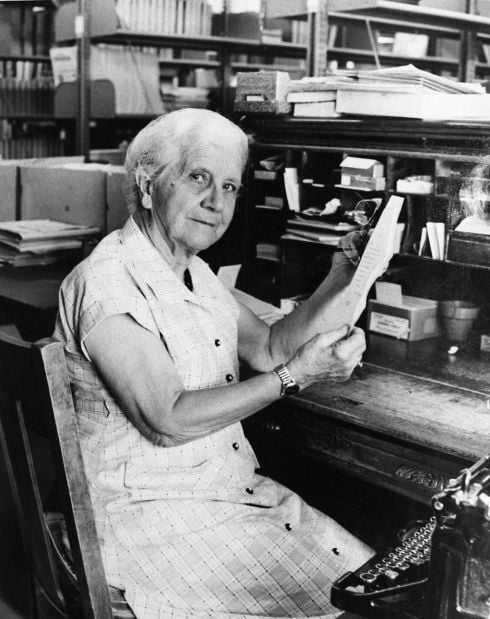
The woman responsible for making the Arizona Historical Society what it is today grew up in the late 1800s on the far side of the Santa Catalina Mountains, about 40 miles north of Tucson.
Edith Olive Stratton remembered her family’s first ranch house as “a dugout — a dwelling actually dug out of the side of a hill. It had three walls of ‘mountain,’ a dirt floor and roof.” Her father, Emerson Stratton, called their cattle ranch the Pandora after the Greek myth about a box that spilled out all the ills of the world, leaving only hope. At the time, the family had little left but hope.
Born in Florence in 1878, Edith was 18 months old when her father relocated his family. She thrived in the rocky, rough backwoods country of the Catalinas.
She became an expert rider and sharpshooter, bringing home wild game for supper by the time she was 10. She survived raging floodwaters roaring down the San Pedro River and once sailed off in her mother’s washtub across a creek. Cowboys taught her to make rope from cowhide and how to twist horsehair using a notched stick called a tarabilla. She trapped skunks and sold the fur for spending money.
People are also reading…
Her New England-bred mother, Carrie Stratton, disapproved of her daughter’s rambunctious activities and discouraged her association with local ranch hands. Edith often said she regretted “not being a cowboy among cowboys.”
The Stratton family consisted of four children — Mabel, Edith, Johnny, and Elmer. “We had a tutor on the ranch when we could get one,” Edith wrote, “but usually we attended the public school in Tucson ... . Mother would rent a house in town and we all would spend the winter there.”
By 1895, drought and overgrazed range grass had exhausted and depleted the Pandora cattle, forcing Emerson to move his family back to Florence. Edith completed her schooling there before attending Los Angeles Normal School, graduating in 1900.
She returned to Tucson to enter the University of Arizona but after one semester she was offered a teaching job in the mining community of Liberty near Arivaca. Teachers were still scarce in Arizona and Edith continued to receive offers to teach while attending classes at the university. She finally graduated in 1920.
“I had been taking courses on and off for 20 years,” she said. “I thought I was in school longer than anyone in the history of university.”
In 1903, while still teaching and attending college, Edith married George Farwell Kitt, who at the time ran a dry-goods business with his father and brothers on the corner of Congress and Scott Streets. The couple had two children: Edith, born in 1904, and Roskruge in 1906.
She was an active member of the Tucson Woman’s Club, the Arizona Federation of Women’s Clubs, the American Legion Auxiliary, and the Business and Professional Women’s Club. She was one of three organizers and a director of the Tucson Fine Arts Association. It was her interest in Arizona’s past, however, that led her to serve as secretary of the Arizona Pioneers Historical Society in 1925.
The territory’s first legislature incorporated the Arizona Historical Society in 1864 “to preserve the relics and paint the wonders of the past.” Four years later the Arizona Society of Pioneers became a reality, although membership was restricted to men only. By 1913, a few women were allowed to join but it was not until Edith took over as secretary that women became in integral part of the organization.
“That title ‘secretary’ was erroneous,” Edith said, “for I had to be not only the corresponding secretary but also librarian, researcher, entertainer, welfare worker, and father confessor all in one.”
The small, somewhat disorganized Historical Society that was then housed in a storeroom at the Tucsonia Hotel on the corner of Main Avenue and Congress Street blossomed under Edith’s guidance. She was instrumental in cultivating the society from a minor social organization into one of the finest archival facilities in the Southwest. For over 20 years she traveled the state, seeking forgotten relics and organized a vast array of historic artifacts and materials so others could enjoy the vestiges of Arizona’s past.
“I tried to make the office a kind of clubhouse for the old-timers,” she said, “and there I took down their reminiscences. Some of these were detailed and highly factual; others had to taken with a grain of salt.”
She visited libraries and museums around the country to study collecting and cataloging methods. She initiated membership dues and solicited donations to keep the society afloat.
When she took over as secretary, the society had a grand total of three members. The next year, under her leadership, membership rose to 29. Edith saved the society money by doing the janitorial work herself.
“As for our collection,” she said, “I guess I became a pretty good beggar. ... I asked authors for their new books, organizations for their published reports, and the newspaper editors of the state for free subscriptions to their dailies and weeklies. My argument was that Arizona was still making history.”
Donations began to pour in. She recorded receiving 1,000 donated items in 1928 and by 1931, the list had increased to over six pages of contributions.
The year she became secretary, Edith recorded her father’s early memories of Arizona just before he died. She incorporated his recollections with her own history in a book published in 1964, “Pioneering in Arizona: The Reminiscences of Emerson Oliver Stratton & Edith Stratton Kitt.”
In 1928, the Historical Society was moved under the stadium on the campus of the University of Arizona. It was relocated to its present site, 949 East Second St., in 1955.
Edith retired in 1947, although she continued to involve herself in historic research for many years. She was named “First Lady of Arizona’s Territorial Centennial” in 1963 for her historic contributions. She died in 1968 at the age of 89.
“She was the Historical Society,” Mrs. Emery C. Johnson, president of the Arizona Pioneers’ Historical Society, said in a Jan. 21, 1968, article about Edith’s death. “She did more than any other single Arizonan to preserve, collect and restore Arizoniana.”
Jan Cleere is an award-winning author, historian, and lecturer. Her latest book, Levi’s & Lace: Arizona Women Who Made History (Rio Nuevo Publishers), is available in bookstores and online. Email her at Jan@JanCleere.com
Sources:
John Alexander Carroll, "Pioneering in Arizona: The Reminiscences of Emerson Oliver Stratton and Edith Stratton Kitt," Arizona Pioneers’ Historical Society, 1964
Tucson Citizen, “Mrs. G.F. Kitt Knew Arizona Way Back When,” April 25, 1964
Arizona Daily Star, “New Pioneer Secretary is Woman, First in 42 Years of Organization,” January 5, 1926
C.L. Sonnichsen, "Pioneer Heritage: The First Century of the Arizona Historical Society," Arizona Historical Society, 1984


 U of A’s fall enrollment down more than 20%, sources say


