JERUSALEM — Israeli Prime Minister Benjamin Netanyahu on Friday said he ordered the military to prepare a plan to "evacuate" civilians from Rafah ahead of an expected Israeli invasion of the densely populated southern Gaza city.
The announcement came after heavy international criticism, including from the U.S., of Israeli intentions to move ground forces into the city that borders Egypt.
Rafah had a prewar population of roughly 280,000, and according to the United Nations is now home to some 1.4 million additional people living with relatives, in shelters or in sprawling tent camps after fleeing fighting elsewhere in Gaza.
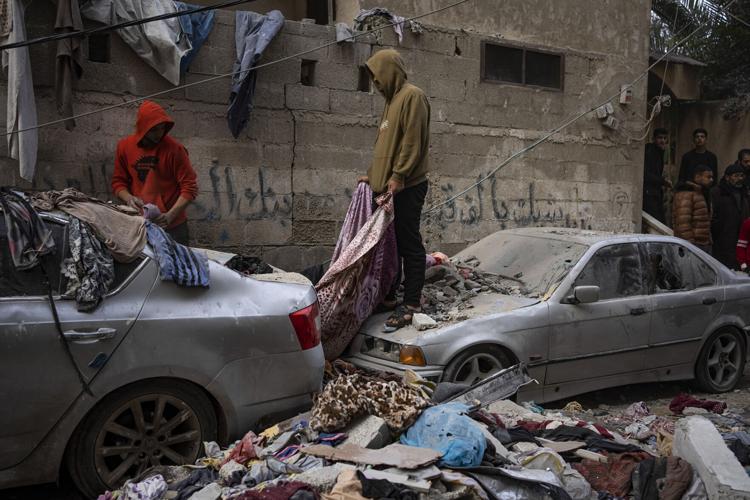
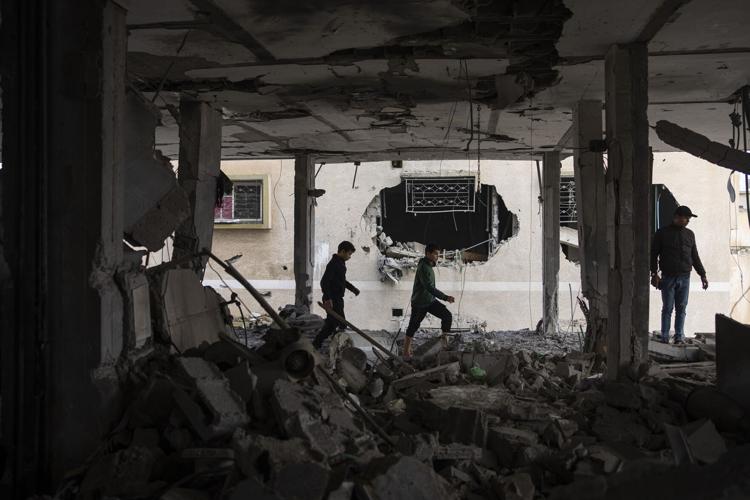
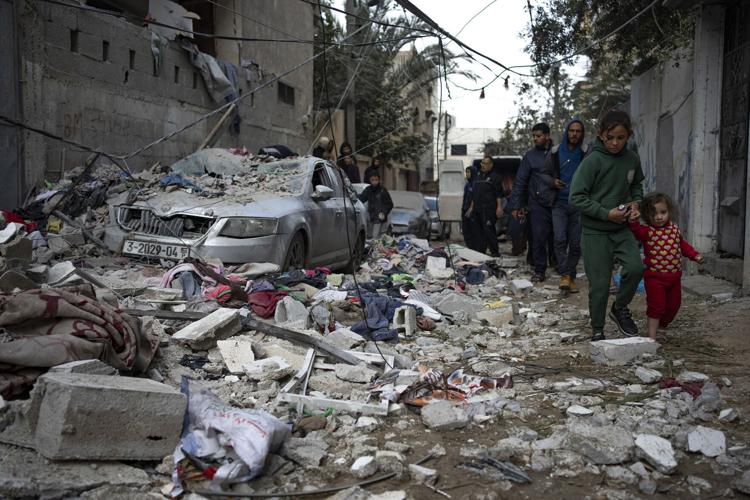
Israel already has begun to strike Rafah from the air. Airstrikes overnight and into Friday hit two residential buildings in Rafah, while two other sites were bombed in central Gaza, including one that damaged a kindergarten-turned-shelter for displaced Palestinians.
People are also reading…
AP journalists who saw the bodies arriving at hospitals confirmed at least 22 people were killed.

Palestinians look at the destruction Friday after an Israeli airstrike in Rafah, Gaza Strip.
Israel claims Rafah is the last remaining Hamas stronghold in Gaza after more than four months of war.
"It is impossible to achieve the goal of the war of eliminating Hamas by leaving four Hamas battalions in Rafah," Netanyahu's office said. "On the contrary, it is clear that intense activity in Rafah requires that civilians evacuate the areas of combat."
It said he ordered the military and security officials to come up with a "combined plan" that includes both a mass evacuation of civilians and the destruction of Hamas' forces in the town.
Israel declared war after Hamas militants took about 250 hostages during the Oct. 7 attack in which fighting also left about 1,200 people dead.
Since then, an Israeli air and ground offensive has killed about 28,000 Palestinians, most of them women and children, according to local health officials. About 80% of Gaza’s 2.3 million people have been displaced, and the territory plunged into a humanitarian crisis.

Palestinians look at the destruction Friday after an Israeli airstrike in Rafah, Gaza Strip.
Netanyahu has largely rebuffed international criticism of the civilian death toll, but that criticism grew in recent days as Netanyahu and other leaders vow to move into Rafah.
U.S. President Joe Biden said Thursday that Israel's conduct in the war is "over the top," the harshest U.S. criticism yet of its close ally. The State Department said an invasion of Rafah in the current circumstances "would be a disaster."
It remains unclear where civilians can go. The Israeli offensive caused widespread destruction, especially in northern Gaza, and hundreds of thousands of people do not have homes to return to.
In addition, Egypt has warned that any movement of Palestinians across the border into Egypt would threaten the four-decade-old peace treaty between Israel and Egypt. The border crossing between Gaza and Egypt, which is mostly closed, serves as the main entry point for humanitarian aid.
Israel imposed financial restrictions on the main U.N. agency providing aid in the Gaza Strip, a measure which prevented a shipment of food for 1.1 million Palestinians from reaching the war-battered enclave, the agency's director said Friday.
The restrictions deepened a crisis between Israel and UNRWA, whose operations have been threatened following Israeli accusations that some of its workers participated in the Oct. 7 attack. Those accusations led major donor nations, including the U.S., to suspend funding to the U.N. organization and left its future in question.
UNRWA's director, Philippe Lazzarini, said Friday that that a convoy of food donated by Turkey has been sitting for weeks in the Israeli port city of Ashdod. The agency said that the Israeli contractor they work with received a call from Israeli customs authorities “ordering them not to process any UNRWA goods.”
That stoppage means 1,049 shipping containers of rice, flour, chickpeas, sugar and cooking oil — enough to feed 1.1 million people for one month — are stuck, even as an estimated 25% of families in Gaza face catastrophic hunger.
The World Food Program warned Friday that Gaza could be plunged into famine as early as May.

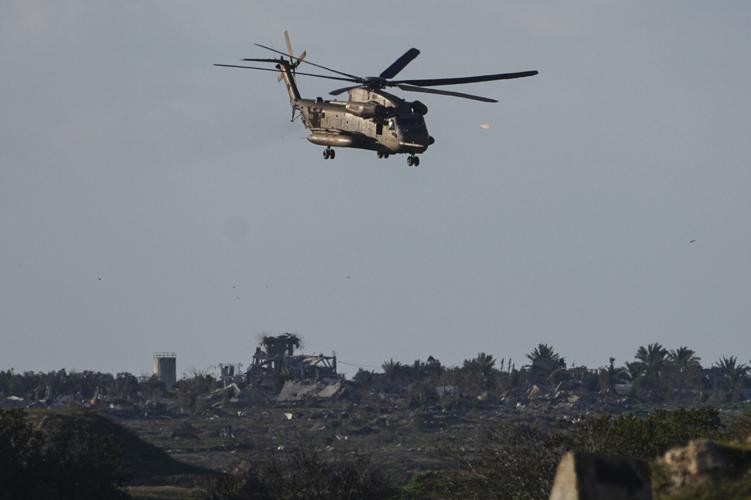
An Israeli military helicopter operates Friday on the edge of the Gaza Strip.
Growing friction
Comments from top U.S. officials about Rafah suggest growing friction with Netanyahu after a visit to the region by U.S. Secretary of State Antony Blinken.
Blinken, who has been working with Egypt and Qatar on trying to mediate a cease-fire between Israel and Hamas, left the region Thursday without an agreement. He said he believed it was still possible to strike a deal that would include an extended pause in fighting in exchange for the release of many of the more than 100 hostages held by Hamas.
Netanyahu appeared to snub Blinken, saying he will settle for nothing short of "total victory." The Israeli leader has said the war seeks to destroy Hamas' military and governing capabilities and return all hostages home. With Blinken still in town, Netanyahu said achieving those goals would require an operation in Rafah.
Vedant Patel, a State Department spokesman, said Thursday that going ahead with such an offensive "with no planning and little thought in an area where there is sheltering of a million people would be a disaster."
John Kirby, the White House's national security spokesman, said an Israel ground offensive in Rafah is "not something we would support."
With the war now in its fifth month, Israeli ground forces are still focusing on the city of Khan Younis, just north of Rafah, but Netanyahu repeatedly said Rafah will be next, creating panic among hundreds of thousands of displaced people.

Palestinians walk past destruction Friday after an Israeli airstrike in Rafah.
Overnight strikes
Shortly after midnight Friday, a residential building was struck near Rafah's Kuwaiti Hospital, killing five people from the al-Sayed family, including three children and a woman. A second Rafah strike killed three more people.
Another overnight strike, in the central town of Deir al-Balah, claimed nine lives. In central Gaza, a strike hit near a kindergarten-turned-shelter, damaging the building. It killed five and wounded several more people. Witnesses said shelter residents were asleep at the time.
Today in history: Feb. 9
1942: Joint Chiefs of Staff

In 1942, the U.S. Joint Chiefs of Staff held its first formal meeting to coordinate military strategy during World War II.
1943: Battle of Guadalcanal

In 1943, the World War II battle of Guadalcanal in the southwest Pacific ended with an Allied victory over Japanese forces.
1950: Joseph McCarthy

In 1950, in a speech in Wheeling, West Virginia, Republican Sen. Joseph McCarthy of Wisconsin charged that the State Department was riddled with Communists.
1962: Jamaica

In 1962, an agreement was signed to make Jamaica an independent nation within the British Commonwealth later in the year.
1964: The Beatles

In 1964, the Beatles made their first live American television appearance on “The Ed Sullivan Show,” broadcast from New York on CBS.
1971: Earthquake

In 1971, a magnitude 6.6 earthquake in California’s San Fernando Valley claimed 65 lives.
1984: Yuri V. Andropov

In 1984, Soviet leader Yuri V. Andropov, 69, died 15 months after succeeding Leonid Brezhnev; he was followed by Konstantin U. Chernenko.
1986: Halley's Comet

In 1986, Halley’s Comet visited the solar system for the first time since 1910. (Its next return will be in 2061).
2002: Princess Margaret

In 2002, Britain’s Princess Margaret, sister of Queen Elizabeth II, died in London at age 71.
2009: Alex Rodriguez

In 2009, New York Yankees third baseman Alex Rodriguez admitted to taking performance-enhancing drugs, telling ESPN he’d used banned substances while with the Texas Rangers for three years.
2020: Parasite

In 2020, “Parasite,” from South Korea, won the best picture Oscar, becoming the first foreign-language film to take home the biggest honor in film.
2021: Impeachment

In 2021, the Senate moved ahead with a second impeachment trial of former President Donald Trump, rejecting arguments that the chamber could not proceed because Trump was no longer in office.
2022: Kamila Valieva

In 2022, it was revealed that Kamila Valieva, the 15-year-old Russian figure skating superstar who had just led her team to an Olympic gold medal, tested positive for a banned heart medication before the Beijing Games.