A red carpet unfurled on the tarmac. Musicians with brass instruments performed “God Save the King.” Along Pennsylvania Avenue, British flags flapped in the wind.
King Charles and Queen Camilla traveled to the United States for a four-day journey commemorating 250 years of American independence from the British monarchy.

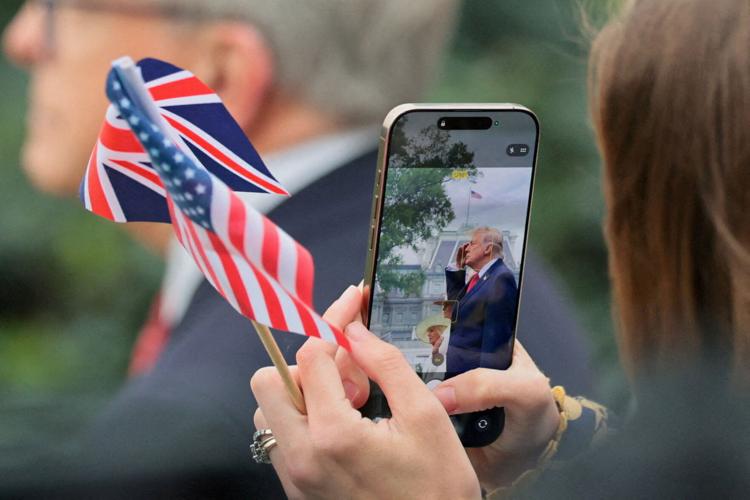
A person takes a picture of U.S. President Donald Trump saluting on Tuesday during an arrival ceremony for Britain's King Charles and Queen Camilla on the South Lawn of the White House in Washington, D.C.
The visit came at one of the most fraught times in recent history between the two nations, amid conflict between President Donald Trump and Prime Minister Keir Starmer over the war in Iran and the future of NATO.
Through periods of international political tensions, the British royals have served as a symbol of the cultural connection between the two nations. This visit, however, has prompted fresh questions about whether they still play that unifying role.
As Trump’s relationship with the U.K. has grown complicated, so too have Americans' attitudes toward the British royals. Prince Harry and Meghan Markle’s split from the family and the arrest of the king’s brother, Andrew Mountbatten-Windsor, over his ties to Jeffrey Epstein have polarized the public.
People are also reading…

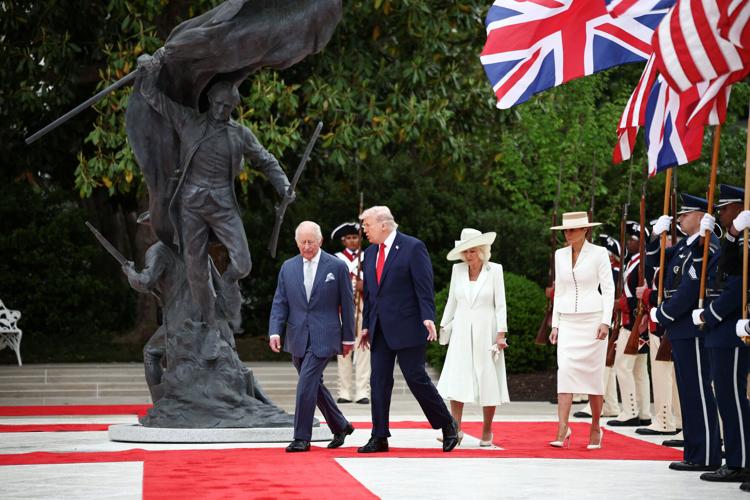
U.S. President Donald Trump, First Lady Melania Trump, Britain's King Charles III and Queen Camilla walk through the Rose Garden to the Oval Office of the White House on Tuesday.
The king’s visit with a deeply divisive American president, who himself has been compared to a monarch, threatens to further divide Americans concerning the British royals.
Sara Hammel, a former journalist who covered the royal family, said Americans' perceptions of the monarchy are in "the middle of another shift," and Charles' visit could shape where they land.
“The Trump thing, I think, is just bringing it all into focus," she said.
The president’s feud with the British government marks the most significant rift between the two countries in decades. But it’s far from the first time an American president has railed against a ruler of the British Isles.

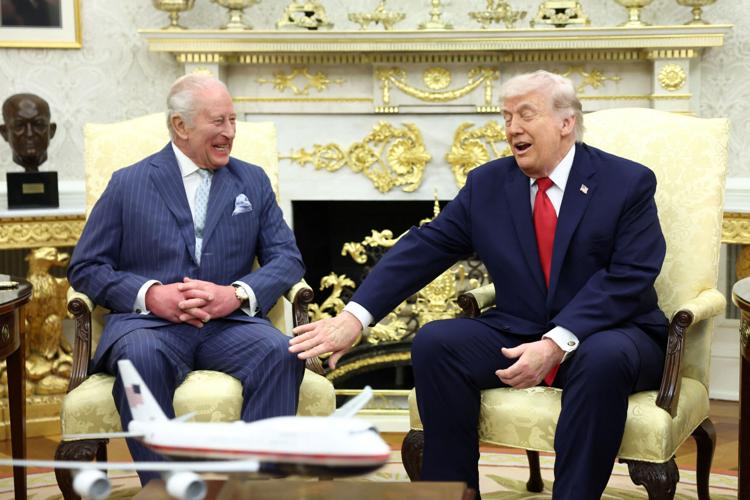
U.S. President Donald Trump and Britain's King Charles react as they meet in the Oval Office at the White House on Tuesday.
On July 9, 1776, days after listening to a reading of the Declaration of Independence in Lower Manhattan, George Washington’s troops toppled a lead statue of King George III. They melted it down so they could cast 42,000 bullets for use against the king’s army.
The small act of rebellion represented a symbolic tipping point in the battle for independence.
For years leading up to the Revolutionary War, colonists raged against what they viewed as unfair policies implemented by the British Parliament, but many didn’t extend their anger toward the king.
That view began to rupture as the first shots of the Revolutionary War rang out in Lexington and Concord in 1775, and a year later Americans resolved to topple the king — metaphorically and literally.
Once America became an independent nation, its hatred for the crown turned into intrigue.

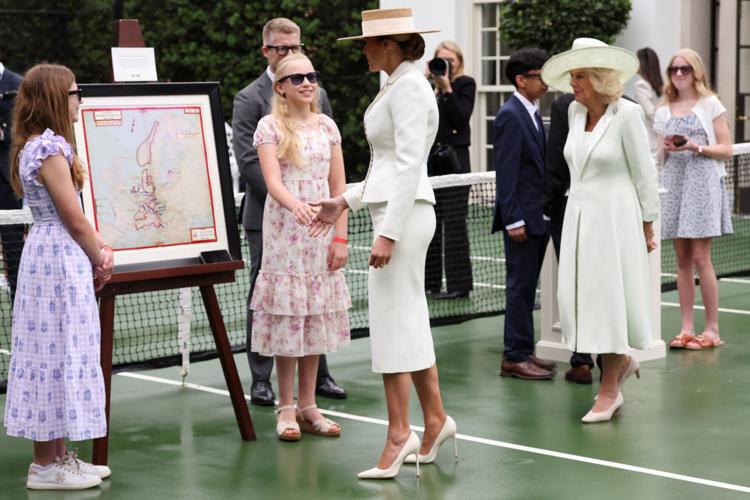
First lady Melania Trump and Britain's Queen Camilla watch students using AI-enabled glasses as they take part in a cultural educational event at the White House Tennis Pavilion on Tuesday.
Thousands gathered on shipping docks and downtown streets across Chicago, Detroit and Washington in 1860 for a chance to catch a glimpse of Albert Edward, the prince of Wales. He was the first British royal to visit the United States since its founding.
Excitement about the prince’s visit transcended social class and political viewpoints.
“The whole populace seemed to have gathered into this thoroughfare to greet the illustrious visitor,” the Detroit Free Press wrote of his arrival to the city.
Then-President James Buchanan even viewed the visit as a rare chance to bring the nation together as it teetered closer to civil war, according to the White House Historical Association.

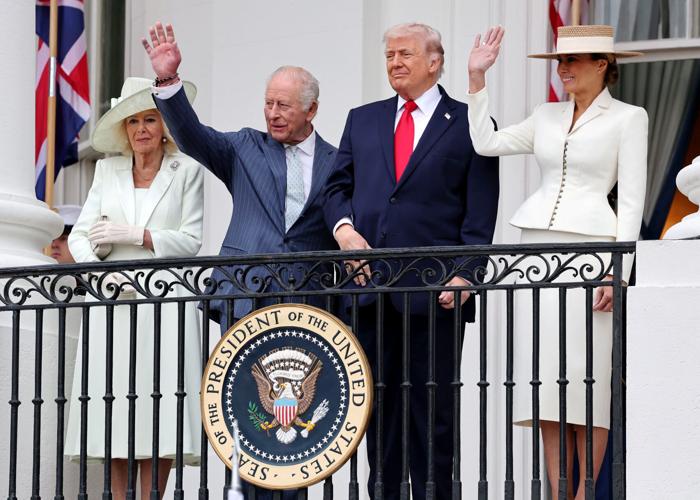
Queen Camilla, King Charles III, U.S. President Donald Trump and First Lady Melania Trump watch from the balcony of the South Portico of the White House on Tuesday during the State Arrival Ceremony of King Charles III and Queen Camilla to the United States.
Years later, during a four-day jaunt to the United States in 1939, King George VI and his wife, Queen Elizabeth, devoured hot dogs and strawberry shortcake at the Hyde Park home of then-President Franklin Delano Roosevelt. The meal helped forge America’s “special relationship” with Great Britain that has endured since World War II.
News articles and photos of the casual picnic enamored Americans, transforming their view of the royals as rigid and aristocratic to more down-to-earth.
Then-Prince Charles' marriage to Princess Diana in 1981 pushed the British monarchy to the center of pop culture. Called the "people's princess," Diana promoted the more human image of the royals.
Dancing with John Travolta at a state dinner hosted by President Ronald Reagan at the White House in 1985, Diana merged the worlds of royalty and celebrity.
For many Americans, the pomp and circumstance of the royals still holds allure.
Elizabeth Alcora, 30, of Pennsylvania said she regularly follows news about the royal family and was excited to watch the king’s “flashy” visit.
“It's such a crazy thing that this family has just been born into this role,” Alcora said. “I think they're doing a really interesting job at blending it to make it fit and relevant in 2026.”
But a flurry of scandals and family drama in the decades since Diana and Charles’ divorce has cracked the storybook image of the monarchy for many Americans.
April Stanley, 51, said she once liked the idea of the monarchy acting as a “moral guidepost” for Britain. But in recent years, the Oklahoma City resident said, she has begun believing it is “out of touch” and has been tarnished by sexual misconduct allegations against the king’s brother.
“My view is wholly negative. I see Trump and King Charles as being two peas in a pod,” Stanley said, adding she doesn’t believe Charles has appropriately addressed allegations against Mountbatten-Windsor.
That disdain, however, doesn’t extend toward her feelings about the United States’ “special relationship” with the British people.
“That's probably going to outlive this particular moment,” she said. “It is cool that we still get along and they want to congratulate us, the little kid that ran away from home and became successful.”