PHILADELPHIA — The Free Quaker Meeting House felt like it was stuck in an 18th-century time warp, except for the video crew and the street noise outside.
Men wore tri-corner hats, white stockings and long coats. Women wore their hair in bonnets, with long skirts and aprons. The wooden benches in the 1783 brick building at the corner of 6th and Arch streets in the heart of Philadelphia's Old City looked like they might have when congregants gathered, the open space illuminated by natural light entering from its large windows.
Actors in period costumes looked over scripts and chatted with one another. Most carried some sort of prop — a cane, a book, satchels like those carried by people in the 1700s.
But this was not a Quaker meeting. It was a rehearsal for the Benstitute, a training program for historic interpreters and storytellers through Historic Philadelphia's Once Upon a Nation.
People are also reading…

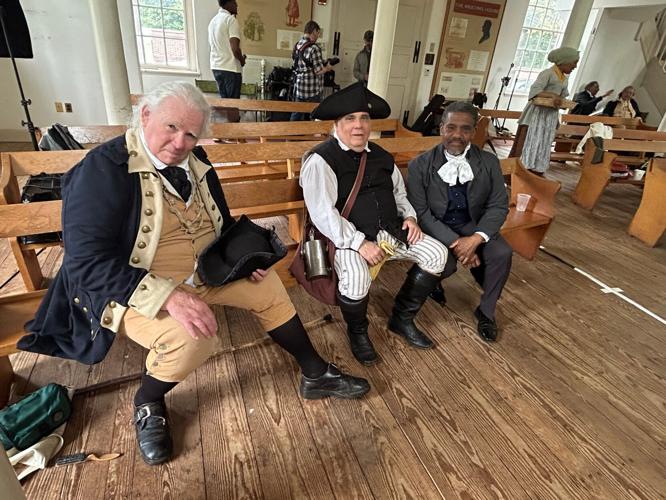
From left to right, David Scott Taylor, Coe Kummer and Keith Henley talk about the Revolutionary-era people whose stories they tell in Philadelphia's historic district.
For re-enactors (hobbyists who usually act out historic events) and interpreters (actors who inhabit the persona of a historic figure on an ongoing basis), bringing historic figures to life is more than dressing in period costumes. It requires preparation and research, a love of history and a dedication to accuracy.
It's also a way to connect modern audiences with the heroes and ordinary people of the past.
A 2024 Wall Street Journal story estimated there are about 240 Revolutionary War reenactment groups in the United States, with about 4,500 total members.
"From outside, it looks like we enjoy getting dressed in funny clothes and firing muskets," said Steve Cole, a Lexington, Massachusetts, re-enactor. "But we portray actual people."
The rewards for all that work? Teaching people about the risks and sacrifices made by people during wartime, challenging assumptions about history, and bringing to light the stories that aren't widely known.
"We know so much, but it's still ongoing work," said Jackson Pavlik, who portrays Benjamin Franklin in Philadelphia. "We're always preparing and always learning more."
'Who we are as a country'
Keith Henley sat on a bench with David Scott Taylor and Coe Kummer.
Taylor has played Walt Whitman, Franklin, and George Washington, as well as Gideon Olmsted, a Connecticut sea captain whose ship was seized by British forces in 1778, since 1998. Kummer was dressed on this day as Jacob Hiltzheimer, a German immigrant and silversmith who kept diaries of life in the Revolutionary period.
Henley was set to portray James Forten, a Black man born to free parents in Philadelphia in 1766. Forten was inspired to join the Revolutionary cause as a boy when he heard the Declaration of Independence read aloud in July 1776.

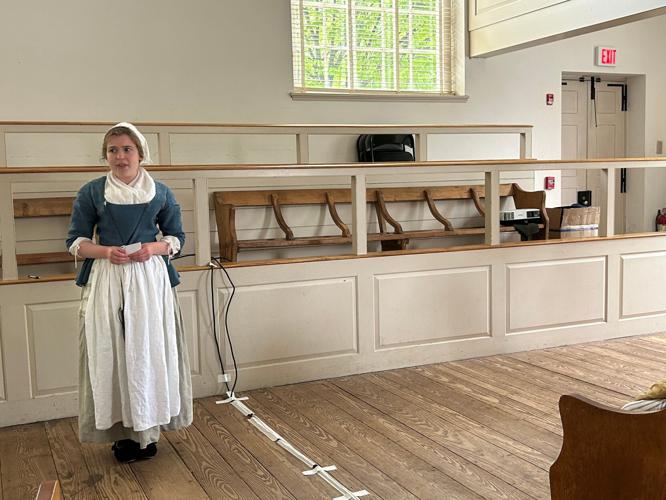
Anna Fiscarelli-Mintzer, as Betsy Ross, talks about the day George Washington, Robert Morris and her late husband's uncle George Ross visited to ask her to make a new American flag.
Forten would later become a sailor, be held by the British as a prisoner of war, and eventually build a career as a sailmaker and entrepreneur, becoming one of the nation's wealthiest men. He also became a vocal abolitionist.
A performer for over 30 years, Henley said the stories interpreters like him tell "are part of American history, and all the culture and people that make up who we are as a country."
"It's not just Anglo-Saxon men who built this country," he said. "You can't exclude Black people or women or Indigenous people. It's like reading a book in the beginning and the end, but not reading the middle. You miss too much."
Keeping memories alive
For Steve Cole of Lexington, Massachusetts, portraying William Diamond, the drummer who signaled the start of the Battle of Lexington, was a childhood dream come true.
Cole is the Lexington Minute Men's captain commanding. The nonprofit, all-volunteer group commemorates the battles of Lexington and Concord and the evacuation of Lexington. Cole said he's been to every reenactment since he was a baby, when his father would carry him in his arms to see his grandfather participate.

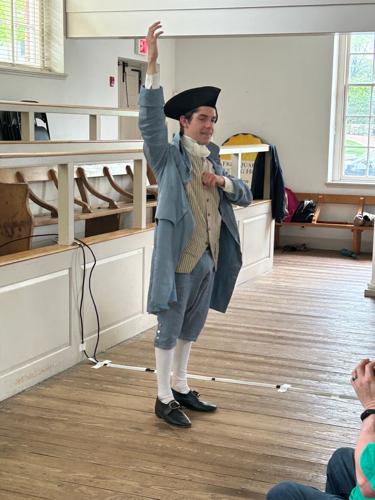
Lane Norris rehearses Patrick Henry's famous "Give me liberty or give me death!" speech at the Benstitute in Philadelphia, a training program for historic interpreters and storytellers.
Authenticity is vital to the Lexington Minute Men — thorough research to make sure they're accurately tracing the events; poring through all the available documentation; sourcing the wool for their uniforms through an 18th-century mill in England; monthly drills and extensive training on the use of muskets.
"We portray individual, real people, people who sacrificed," Cole said. "The men and women of Lexington ... made sacrifices none of us today can even begin to think about, so to tell the story in a way that keeps their memories alive, to make sure they're not forgotten, to teach it through living history, is really special."
Back at the 'Benstitute'
Jason Greenplate, program director for Once Upon a Time, said Historic Philadelphia issues casting calls for actors to be interpreters and storytellers. The nonprofit Historic Philadelphia offers interactive educational programs, walking tours, puppet shows and more.
Before they began their rehearsals — Pavlik channeling Franklin's charm and humor; Lane Norris taking on Patrick Henry's fiery passion as he exclaimed, "Give me liberty or give me death!"; and Courtney Mitchell selling her wares as Margaret Woodby, a free Black woman who owned a cake-baking business — the actors talked about why they chose this avenue for their art.

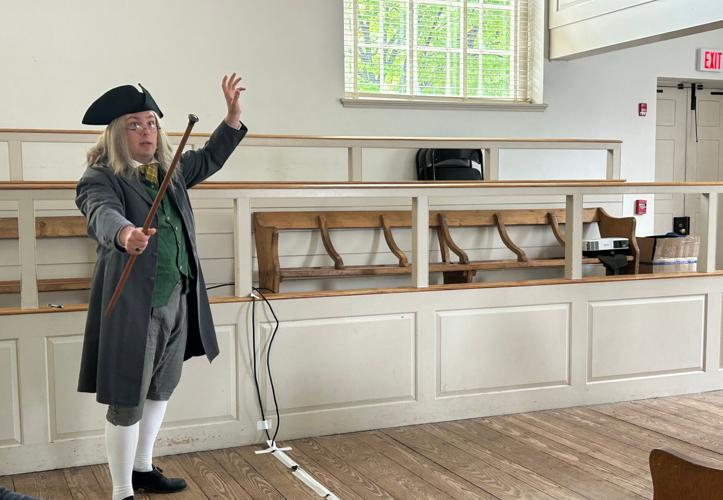
Jackson Pavlik inhabits the persona of Benjamin Franklin at the Benstitute in Philadelphia, where historic interpreters and re-enactors learn to tell stories about Revolutionary-era figures.
Mitchell said she's done this for 17 years, answering a casting call after college to "create a story" about an important moment in history. She wanted to let people know that women, including Black women, worked outside the home even in the 18th century.
"They were symbolic of what America was trying to become," she said. "A place that was only beginning to put liberty into practice."
Doing this work in Philadelphia, the birthplace of independence, is especially meaningful, said Taylor, who on this day was in character as Gideon Olmsted.
"Telling these stories here is so valuable," he said. "This is the heart of the matter here, and these stories are all about what America is and what it will be."