BISMARCK, N.D. — The first person to spot it was a shovel operator working the overnight shift, eyeing a glint of white as he scooped up a giant mound of dirt and dropped it into a dump truck.

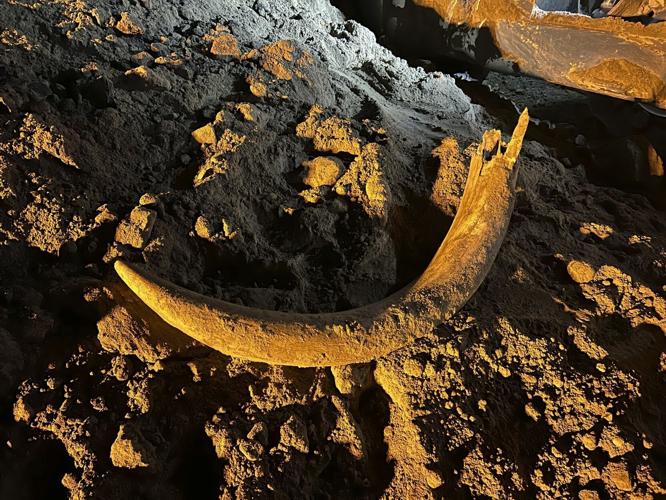
In this image provided by Coleman Fredricks, coal miners unearthed a mammoth tusk in May 2023 at the Freedom Mine near Beulah, N.D.
Later, after the truck driver dumped the load, a dozer driver was ready to flatten the dirt but stopped for a closer look when he, too, spotted that bit of white.
Only then did the miners realize they had unearthed something special: a 7-foot-long mammoth tusk that had been buried for thousands of years.
“We were very fortunate, lucky to find what we found,” said David Straley, an executive of North American Coal, which owns the mine.
The miners unearthed the tusk from an old streambed, about 40 feet deep, at the Freedom Mine near Beulah, North Dakota. The 45,000-acre surface mine produces up to 16 million tons of lignite coal per year.
People are also reading…
After spotting the tusk, the crews stopped digging in the area and called in experts, who estimated it to be 10,000 to 100,000 years old.

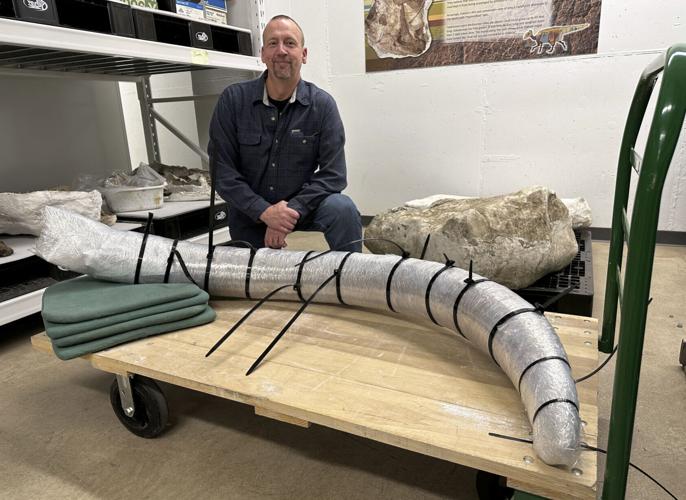
North Dakota Geologic Survey Paleontologist Jeff Person sits behind a 7-foot mammoth tusk Dec. 19 at the Geologic Survey office in Bismarck, N.D. Coal miners unearthed the tusk in May 2023 at the Freedom Mine near Beulah, North Dakota.
Jeff Person, a paleontologist with the North Dakota Geologic Survey, was among those to respond. He expressed surprise that the mammoth tusk hadn't suffered more damage, considering the massive equipment used at the site.
“It’s miraculous that it came out pretty much unscathed,” Person said.
A subsequent dig at the discovery site found more bones. Person described it as a “trickle of finds," totaling more than 20 bones, including a shoulder blade, ribs, a tooth and parts of hips, but it's likely to be the most complete mammoth found in North Dakota, where it's much more common to dig up an isolated mammoth bone, tooth or piece of a tusk.
“It's not a lot of bones compared to how many are in the skeleton, but it's enough that we know that this is all associated, and it's a lot more than we've ever found of one animal together, so that's really given us some significance," Person said.
Mammoths once roamed across parts of Africa, Asia, Europe and North America. Specimens have been found throughout the United States and Canada, said Paul Ullmann, a University of North Dakota vertebrate paleontologist.
The mine's discovery is fairly rare in North Dakota and the region, as many remains of animals alive during the last Ice Age were destroyed by glaciations and movements of ice sheets, Ullmann said.
Other areas have yielded more mammoth remains, such as bonebeds of skeletons in Texas and South Dakota. People even have found frozen carcasses in the permafrost of Canada and Siberia, he said.
Mammoths went extinct about 10,000 years ago in what is now North Dakota, according to the Geologic Survey. They were larger than elephants today and were covered in thick wool. Cave paintings dating back 13,000 years depict mammoths.
Ullmann calls mammoths “media superstars almost as much as dinosaurs,” citing the ”Ice Age" film franchise.

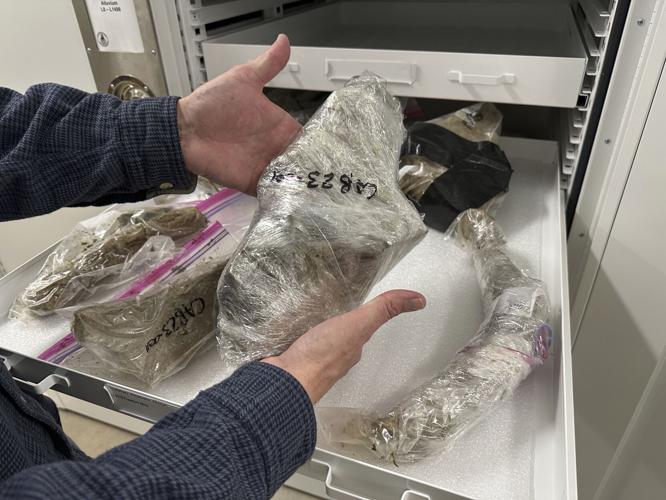
North Dakota Geologic Survey Paleontologist Jeff Person examines mammoth bones wrapped in plastic in a drawer at the Geologic Survey office Dec. 19 in Bismarck, N.D.
This ivory tusk, weighing more than 50 pounds, is considered fragile. It has been wrapped in plastic as the paleontologists try to control how fast it dehydrates. Too quickly, and the bone could break apart and be destroyed, Person said.
Other bones also have been wrapped in plastic and placed in drawers. The bones will remain in plastic for at least several months until the scientists can figure how to get the water out safely. The paleontologists will identify the mammoth species later, Person said.
The mining company plans to donate the bones to the state for educational purposes.
“Our goal is to give it to the kids,” Straley said.
North Dakota has a landscape primed for bones and fossils, including dinosaurs. Perhaps the best known fossil from the state is that of Dakota, a mummified duckbilled dinosaur with fossilized skin, Ullmann said.
The state's rich fossil record is largely due to the landscape's “low-elevation, lush, ecologically productive environments in the past," Ullmann said.
North Dakota's location next to the Rocky Mountains puts it in the path of eroding sediments and rivers, which have buried animal remains for 80 million years or more, he said.
“It's been a perfect scenario that we have really productive environments with a lot of life, but we also had the perfect scenario, geologically, to bury the remains," Ullmann said.
Excavation offers ‘exceptional’ look at a stratum of Roman history

People walk Wednesday in the excavation site of the ancient Roman Emperor Nero's Theater, 1st century AD, in Rome. The ruins of the imperial theater referred to ancient Roman texts but never found, have been discovered under the garden of the future Four Season's Hotel, steps from the Vatican, after excavating the walled garden of the Palazzo della Rovere since 2020, as part of planned renovations on the Renaissance building.

A fresco is seen Wednesday on a wall in the excavation site of the ancient Roman Emperor Nero's Theater, 1st century AD, in Rome.

Archeologists work Wednesday at the excavation site of the ancient Roman Emperor Nero's Theater in Rome. Referred to ancient Roman texts but never found, the theater was discovered under the garden of the future Four Season's Hotel, steps from the Vatican.

People walk Wednesday in the excavation site of the ancient Roman Emperor Nero's Theater in Rome.

A double-faced Junus head, dating approximately to the 1st century A.D., is seen Wednesday among other findings coming from the excavation of ancient Roman Emperor Nero's Theater in Rome.

1st Century AD Roman artifacts coming from the excavation of ancient Roman Emperor Nero's Theater, 1st century AD, are seen Wednesday in Rome.

Medieval artifacts, dated between the 10th and 14th century A.D., coming from the excavation of ancient Roman Emperor Nero's Theater, are seen Wednesday in Rome.

An archeologist shows pieces of bone used to carve Christian rosary beads, approximately dated to the 14th century A.D., that came from the excavation of ancient Roman Emperor Nero's Theater in Rome.

An archeologist shows a medieval glass Wednesday that dates to the 14th century A.D. that came from the excavation of Roman Emperor Nero's Theater in Rome. The ruins were discovered under the garden of the future Four Season's Hotel, steps from the Vatican, after excavating the walled garden of the Palazzo della Rovere since 2020, as part of planned renovations on the Renaissance building.

Archeologists work Wednesday on findings coming from the excavation site of the ancient Roman Emperor Nero's Theater, 1st century AD, in Rome.