WASHINGTON – Brazilian President Luiz Inácio Lula da Silva won reelection on Oct. 25, pulling off a stunning comeback to secure a fourth term in office and defeat conservative candidate Flávio Bolsonaro, an ally of U.S. President Donald Trump.
The 80-year-old leader defeated Bolsonaro with 51.76% of the vote in the country’s runoff election, in which affordability and the country’s relationship with the United States were prominent issues. The surprise victory for Lula comes after Bolsonaro emerged as the leading candidate in the country’s first-round election earlier this month.
Trump did not offer an official endorsement for Bolsonaro, 45, ahead of the election that saw Lula accuse the American government of intervening to help his opponent. The Rio de Janeiro senator and eldest son of former Brazilian President Jair Bolsonaro had touted his close relationship with the Trump administration.
People are also reading…

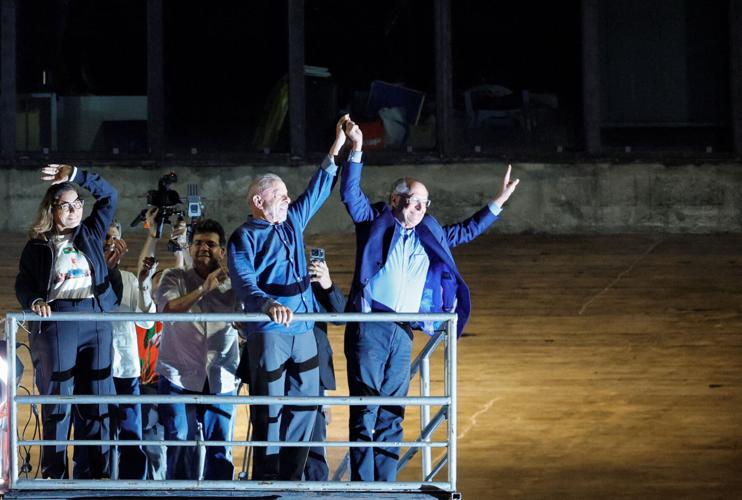
Brazil's President Luiz Inacio Lula da Silva, the Workers' Party (PT) candidate for re-election, greets supporters after his victory in the presidential runoff election, at Paulista Avenue, in Sao Paulo, Brazil, Oct. 26.
Lula’s victory denies Trump a new partner in the Western Hemisphere, where the United States has shifted resources and attention with its boat strikes in the Caribbean, military intervention in Venezuela, and formation of the Shield of the Americas security umbrella over the past year.
Trump endorsed candidates in other Latin American elections and openly favored governments in the hemisphere, actively involving himself in elections as he builds a stable of conservative leaders who are indebted to him.
Lula threw jabs at both Trump and Flávio Bolsonaro in a triumphant victory speech on Oct. 25.
"People went to vote because we convinced them it was important to preserve democracy," he said. "This country doesn’t accept being anybody’s colony."
Brazil’s President Luiz Inacio Lula da Silva has won an unprecedented fourth term.
Lula’s triumph over Bolsonaro interrupts a string of victories for right-wing candidates in Latin America that saw Trump acquire ideological allies across the region in Bolivia, Chile, Costa Rica, Colombia, Ecuador, Honduras and Peru.
"It shows that the left is not like a vanquished force. It's on the wrong end of the pendulum swing, but it's still a significant force in many of these countries," said Christopher Hernandez-Roy, the deputy director of the Americas Program at the Center for Strategic and International Studies in Washington.
In the lead-up to the runoff election, the Bolsonaro family appeared to be on the verge of sweeping every office they ran for this year after four other members of the family ran for and won federal office. The family was hoping that a win for Flavio Bolsonaro would also help liberate Jair Bolsonaro, Trump’s longtime political ally who is now serving a 27-year-sentence under house arrest after a Brazilian court convicted him of an attempted coup.
Brazil’s Supreme Court convicted the elder Bolsonaro last year of plotting against Lula after losing the 2022 election. He is the first former president in Brazil to be convicted of such a crime.

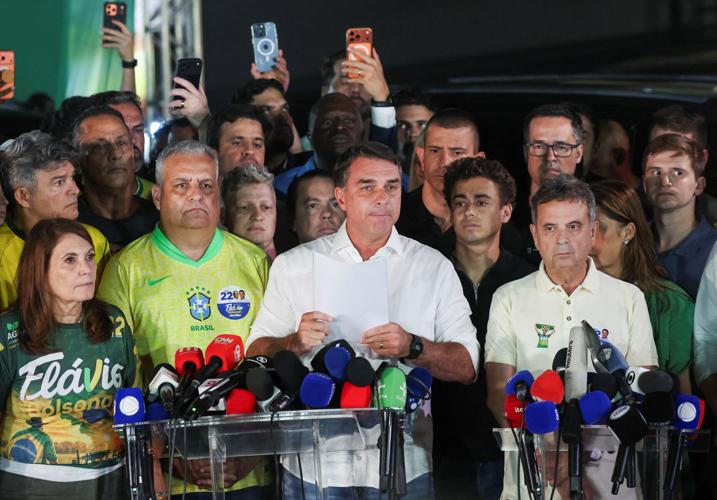
Brazilian presidential candidate Flavio Bolsonaro of the Liberal Party (PL) speaks after losing the presidential runoff election, in Brasilia, Brazil, Oct. 25.
Flávio Bolsonaro refused to concede his election and said he intended to seek an annulment.
"There’s a lot that needs to be cleared up before Brazil simply accepts this foul play," Flávio Bolsonaro said during brief remarks at a news conference.
A justice on Brazil’s Supreme Court ordered voting hours to be extended in a last-minute decision that came after ballots were already being counted and some polling stations had closed.
Both candidates had asked for voting extensions before the order, which extended the voting time by two hours. Lula cited public transportation delays while Flávio Bolsonaro expressed concern that heavy rain and floods prevented voters from accessing polling stations in southern Brazil.
Lula accuses Trump of election interference, favoring Bolsonaro
Allegations from Lula that the Trump administration interfered in the race featured prominently ahead of the election.
Lula refused to grant visas to two American diplomats who sought to visit the country in July over election meddling concerns and withheld diplomatic approval for Trump’s nominee for ambassador to Brazil.
The State Department said the accusation was baseless. In a tit-for-tat move, it revoked the diplomatic visa of Brazil’s ambassador to the United States.
In an Oct. 7 letter to the State Department, a dozen Democratic lawmakers said they were concerned the U.S. was seeking to “torpedo the relationship” with Lula’s government to “manufacture this diplomatic crisis months away from elections in Brazil.”
Appearing at the United Nations, minutes before Trump was set to take the stage in September, Lula said his country would not let internal or external enemies of democracy thwart the will of the Brazilian people.

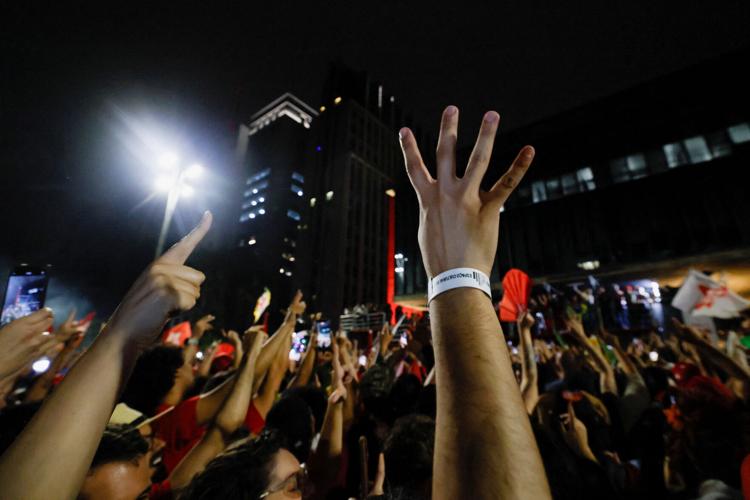
A supporter makes a "four" sign to indicate Lula's fourth term as people gather to watch Brazil's President Luiz Inacio Lula da Silva, the Workers' Party (PT) candidate for re-election, speak after his victory in the presidential runoff election, at Paulista Avenue, in Sao Paulo, Brazil, Oct. 25.
A Lula campaign ad subsequently called Bolsonaro "Trump’s candidate" and accused the American president of wanting to “colonize Brazil” for its resources. Brazil’s intelligence agency also warned of the potential for a "critical level" of American election interference.
The accusations followed a months-long thaw in relations between the two leaders in 2025 that led to the easing of some tariffs on Brazil and the removal of sanctions on a Brazilian Supreme Court justice who oversaw the conviction of Jair Bolsonaro. The pair also met behind closed doors in May of this year at the White House.
Trump also hosted Flávio Bolsonaro in the Oval Office in May. The presidential candidate posted a photo of himself with Trump on social media. He told reporters he did not ask for Trump’s endorsement at the time.
The U.S. president said in early October that he’d been watching the matchup "very closely" and predicted it would be a close election but declined to go further.
He said again on Oct. 25, as voters were at the polls in a second round of voting, that he was monitoring the election and did not want to say who he was supporting.
An overt endorsement from Trump could have backfired, regional experts argued, and made it easier for Lula to pick up enough votes to win. A senior White House official described Bolsonaro ahead of the election as a fan and supporter of the president who was aligned with many of the policies on Trump’s agenda.
Neither the White House nor the State Department immediately responded to comment requests after Lula's win.
Trump’s security alliance takes a hit
The Trump administration was hoping to gain a powerful ally in the region at a time when it is trying to assert American dominance in the Western Hemisphere.
If Bolsonaro had won, the current White House would have been able to count on ideologically friendly governments in Brazil, Argentina, Colombia, Chile and Peru – all five of South America’s largest economies. He was expected to join the Shield of the Americas, the Trump-formed security coalition of more than a dozen countries in Latin America, and expand intelligence and counter-narcotics cooperation with the United States.
Instead, Lula will maintain Brazil’s role as a bulwark against the Trump administration’s efforts to acquire further influence in the region.
In May, the State Department labeled Brazil’s two largest organized crime groups as foreign terrorist organizations, a move that came two days after Flávio Bolsonaro requested the designation during his Oval Office visit.
Lula denounced the decision, which came three weeks after his own visit to Washington. He accused the United States of treating Brazil like a "tinpot republic."
As part of his regional military efforts, Trump has authorized deadly airstrikes against alleged drug trafficking vessels in the Caribbean Sea and approved a military operation in Venezuela to capture the country’s leader Nicolás Maduro and bring him to the United States to face drug trafficking charges.
Lula’s victory will come as a disappointment to Trump, according to Murillo, who serves as the director of the Institute for Latin American Studies at Columbia. But she said the White House was going to do what it wanted in the region, regardless.
The United States is the dominant leader in the hemisphere, as you have seen with Venezuela, she said. "I don’t think Lula was happy with that outcome, but the U.S. is not asking for permission in any case."