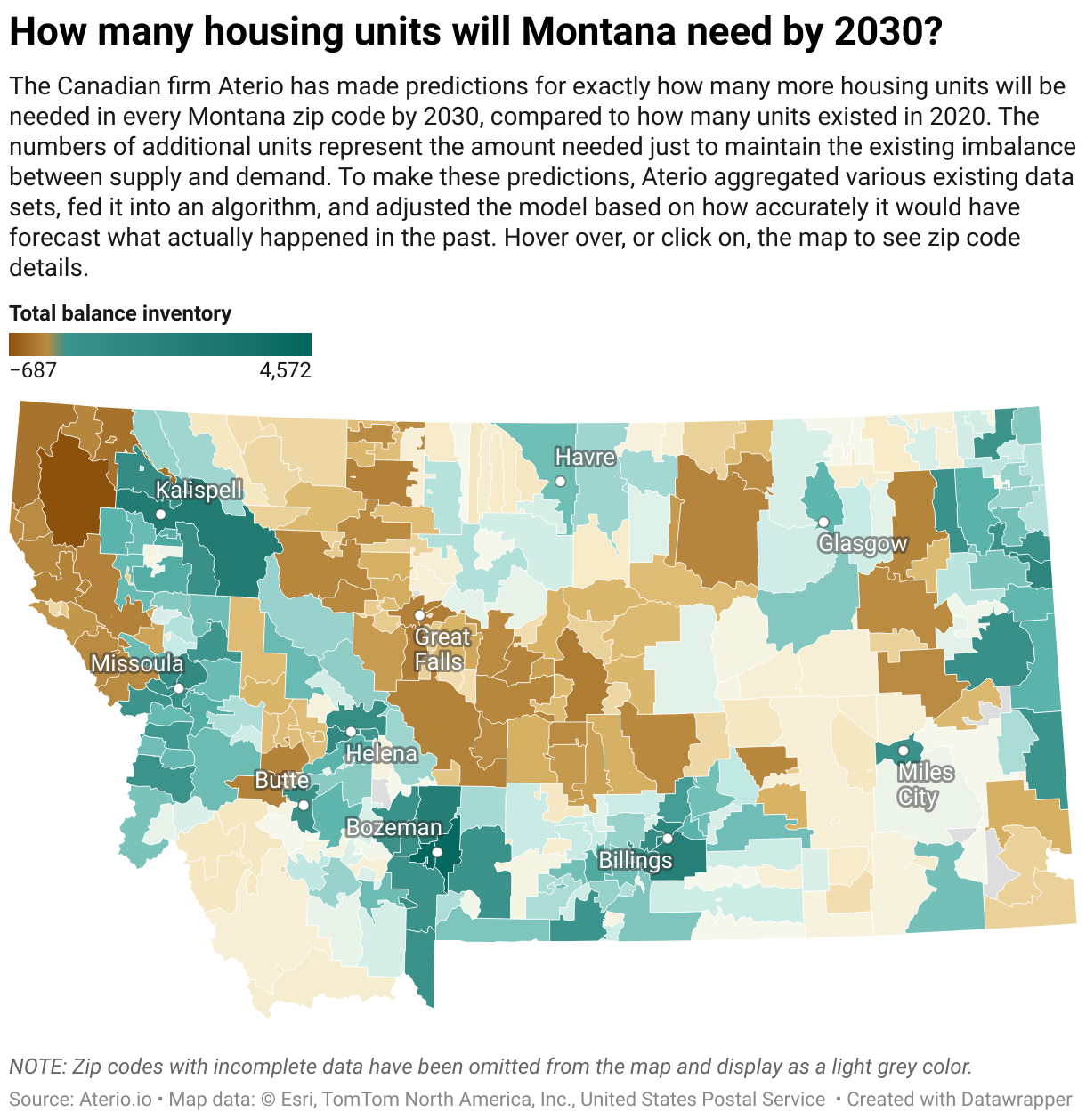
Sergio Torro, Aterio’s CEO, is quick to acknowledge that predicting the population and housing future of Montana is not a perfect science. But, he argued, it’s more than mere guesswork.
He likens what his company does to a weather forecast.
In both cases, he said, data scientists aggregate a bunch of existing data, feed it into an algorithm and create a model for what the future will approximately look like.
To predict population, Torro said Aterio relies in part on information about how population and housing have changed in the past. Much of that data comes from the U.S. Census Bureau’s American Community Survey.
But the company also looks to the future by aggregating existing population-growth models, including one from NASA that incorporates information about fertility rates, mortality rates and life expectancy.
People are also reading…

Contractors work to build a home in the Highland Meadows Subdivision in East Helena.
Torro and his colleagues at Aterio then employ machine learning to create a model that predicts changes in population and housing demand over time.
They first use this model, Torro said, to make "historical predictions" and to test how accurately their model would have forecast what actually happened in the past. Aterio then refines its model based on those results.
The company then incorporates information about real-time events — such as plans being unveiled for a new data center or news about a military base being downsized — that might lead to fluctuations in population over both the near- and long-term.
As in the case of a meteorologist, Torro acknowledged, the “forecast itself is not going to be exact.”
“It’s not going to tell you in three days it will rain this amount, at this specific time,” Torro said. “But it gets really close to it.”
The world, after all, is inherently more complex than the model, and sometimes things happen that Aterio hasn’t accounted for.
To take one pertinent example of what isn’t factored in, the model’s predictions for Montana do not include the effect of a new season of “Yellowstone,” a pop culture phenomenon that has contributed to the state’s recent growth.