Last year, the United States Mint pressed the last penny.
Preservationists warned that the death of the one-cent coin might seed dire consequences: coin shortages at checkout counters, confusion over how to pay bills not ending in zero or five, and higher prices as retailers would round up.
Yet, apart from scattered penny shortages, American society appears to have survived the loss of its least valuable coin.
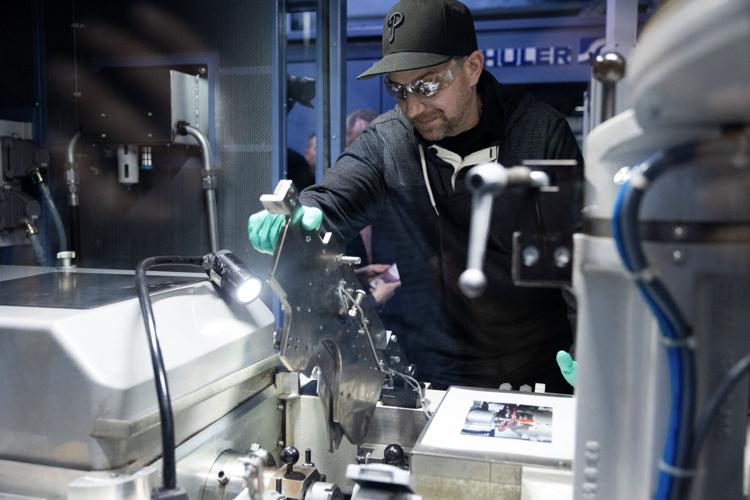
A U.S. Mint employee places the last penny to be struck into a coining press Nov. 12 at the United States Mint in Philadelphia, Pa.
Is the nickel next?
The question is logical: President Donald Trump killed the penny because the government lost money every time it pressed one. Nickels are money-losers, too.
In fact, nickels are bigger losers. The mint spent 3.69 cents making every penny in 2024. For every nickel, the government spent 13.78 cents, a loss of almost 9 cents per coin.
People are also reading…
The government lost about $18 million minting pennies in 2024. On nickels, it lost $85 million.
“The argument for getting rid of the nickel is that it costs more to produce — quite a bit more, actually — than its face value,” said David Smith, an economist at Pepperdine University.
Nickels cost more to make because they are larger than pennies and made of costlier stuff: 75% copper and 25% nickel. Pennies look like copper but were made mostly of zinc.
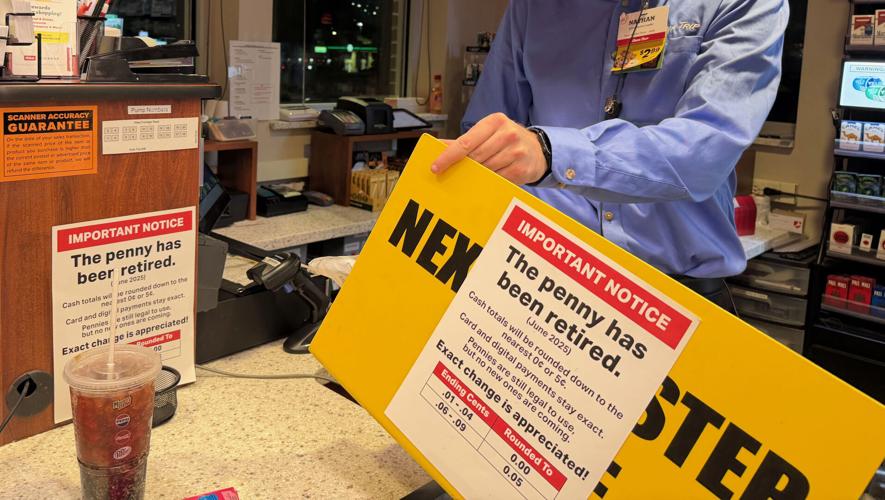
Signs address the end of the penny Nov. 13 at a Kwik Trip convenience store in Kenosha, Wis.
A 'no-brainer'
Ridding America of the penny “was a no-brainer,” said Robert Whaples, an economist at Wake Forest University who long argued for ditching the coin "because the value of the penny was so small, it wasn’t really worth our time to use it.”
Decades ago, a penny could purchase a gumball. Today, the average worker earns about a penny per second. If you spend more than a second with a penny, Whaples said, “you’ve wasted time.”
Pennies ran short long before the mint stopped pressing them. One big reason: Americans stopped picking them up. Pennies languished between couch cushions and on closet floors, clogging vacuum cleaners and landfills.
Many Americans regard nickels and pennies as more nuisance than currency. The typical household is sits on $60 to $90 in neglected coins — enough to fill one or two pint-size beer mugs, according to the Federal Reserve. Americans throw away millions of dollars in coins every year.
For every nickel, the government spent 13.78 cents, a loss of nearly 9 cents per coin.
On borrowed time?
The U.S. Treasury has no public plan to eliminate the nickel, according to Whaples and other coin experts.
“I don’t see any groundswell for getting rid of the nickel,” Whaples said. American consumers are more likely to carry nickels around in their pockets and return them to stores, keeping them in circulation, he noted.
The Treasury pressed only 113 million nickels in 2024 but minted 3.2 billion pennies.
Even so, the nickel’s days may be numbered.
The end of the penny leaves the nickel as the least valuable coin, and inflation erodes the coin’s buying power every year. A stamp hasn’t cost a nickel since 1968. A telephone call on a payphone hasn’t cost a nickel since 1951, not that many of us use payphones anymore.
The new penny?
With the penny gone, coin experts reason, consumers and shopkeepers will lean more heavily on the nickel. The mint will probably end up making more of them, and the losses will mount.
One big unknown is how retailers might handle the math of rounding off cash transactions. Would they round down, saving consumers a few cents, or round up, earning themselves a few cents?
A Common Cents Act, introduced by a bipartisan group of lawmakers last year, would round cash transactions to the nearest five cents, a potentially fairer solution. That bill hasn’t progressed, but some states seek “rounding” laws on their own.
“Let’s say something costs $4.91, and you can only pay $5,” said Ute Wartenberg Kagan, executive director of the American Numismatic Society. “That’s a difference of 9 cents. So, that is a lot of money if you add it up.”
In the coin world, Wartenberg Kagan said, the Darwinian struggle for survival favors more valuable coins. America turned a profit in 2024 on dimes, $36 million, and quarters, $166 million. The mint could profit handsomely from dollar coins, she said, if more Americans would use them.
“Through history,” she said, “all governments have had this problem that it’s very cost-effective to make a big piece of money. But what the ordinary people need is small money. That is the conflict.”
Government researchers have spent years studying ways to reduce the cost of making nickels, presumably by using a cheaper mix of ingredients. The goal, of course, would be to bring production costs below five cents per coin.
Some observers foresee the nickel’s demise, given the steady march of inflation and the gradual erosion of the coin's purchasing power.
“It’ll still be quite some time before we eliminate the nickel,” Smith said. How much time? “Ten to 15 years,” he estimates.
“My sense is, at some point it’s inevitable," he added. "But not necessarily any time soon.”
Best suburbs to live in America
![]()
Best suburbs to live in America
Suburbia is deeply ingrained in American culture, growing in popularity alongside the country's love affair with cars and its network of highways. As early as the 1830s, Brooklyn Heights laid claim to the title of the first suburb when it became connected to Manhattan by steam ferries. A little over 100 years later, Levittown became the new model of suburban development, offering affordable, mass-produced houses on Long Island for veterans returning home after World War II.
Suburbs get their share of criticism, from encouraging isolation to promoting urban sprawl, but their appeal endures. Americans will go to great lengths to stay in the suburbs—even when houses in these neighborhoods are unaffordable for the average home-buyer. A June 2025 report from Realtor.com found that people increasingly opt to rent in the suburbs rather than purchase a house.
To find the best of the 'burbs, Stacker compiled a list of top-ranked suburbs in the U.S. using Niche's 2025 rankings, which look at such factors as the cost of living, the educational level of residents, housing, and public schools. The data is the most current available. Some housing statistics, including median home values, might not reflect the current market. A deeper look at Niche's methodology can be found here.
Keep reading to see which of the country's suburbs made the cut—and whether any of them are a community near you.

#15. Blue Ash, Ohio
- Suburb of Cincinnati
- Population: 13,374
Thanks to its mixture of small-town charm, proximity to urban areas, and top-rated amenities, Blue Ash has been rated by Niche as the most desirable place to live in Ohio. With an exceptional education system, some 2,300 companies with offices in the area, and access to the Blue Ash Golf Course and the 130-acre Summit Park, there's really very little this suburb doesn't offer. Abundant community programming rounds out residents' lives here.

#14. Hinsdale, Illinois
- Suburb of Chicago
- Population: 17,155
Roughly 20 miles west of Chicago, the village of Hinsdale offers laid-back charm and a friendly, community-oriented atmosphere. The area is easily walkable and home to a highly-rated education system, making it an excellent choice for families with young kids.

#13. Cary, North Carolina
- Suburb of Raleigh
- Population: 176,686
"With excellence and innovation in its DNA," Cary, North Carolina, is renowned for its low crime rates and abundance of leisure activities. A walkable downtown, 80 miles of public greenway, and an inclusive community add to the charm. Roughly 20 miles from major universities like Duke and the University of North Carolina at Chapel Hill, the city is home to highly educated residents whose median household income sits well above the national average.

#12. Brentwood, Missouri
- Suburb of St. Louis
- Population: 8,151
Brentwood, which bills itself as "The City of Warmth," is a relatively small community about 15 minutes from downtown St. Louis. The town holds an annual festival each September called Brentwood Days, where the community comes together for live entertainment, food, carnival rides, and more.

#11. North Potomac, Maryland
- Suburb in Maryland
- Population: 23,994
An easy commute from Washington D.C., North Potomac is a high-earning, luxury community. Though it's only existed since the '80s, the area feels well-developed thanks to its number of job opportunities, private clubs, and public parks and trail systems. North Potomac is also located near the Universities at Shady Grove, a multi-university higher education center for mid-career professionals and non-traditional students looking to further their education.

#10. Clarendon Hills, Illinois
- Suburb of Chicago
- Population: 8,642
Clarendon Hills, which bills itself as "The Volunteer Community," holds several events downtown: a summer concert series called "Dancin' in the Street," Daisy Days, and a Christmas Walk and Annual Tree Lighting Ceremony. Volunteers, of course, are behind the annual gatherings in this affluent community west of Chicago.
Clarendon Hills takes sustainability seriously and placed seventh on the U.S. Environmental Protection Agency's 2020 Green Power Partner communities list. Sixty-eight percent of its electrical consumption came from renewable energy certificates as a result of wind power generation.

#9. Innsbrook, Virginia
- Suburb of Richmond
- Population: 8,559
Located in West End Richmond, Innsbrook is a favorite neighborhood for young professionals and families. Near three lakes and miles of walking trails, the community is located a short distance from the Short Pump Town Center, where many shopping and dining options await.

#8. Okemos, Michigan
- Suburb of Lansing
- Population: 25,503
Located less than 10 miles east of Michigan's state capital of Lansing, Okemos is also within easy reach of Michigan State University. Originally founded as the village of Hamilton, Okemos was a stopping point for travelers between Detroit and Lansing. It falls mostly within Meridian Township but has its own school system. The town is named after the Saginaw Chippewa Chief Okemos.
The town has birthed several notable names, but arguably the biggest one is "Saturday Night Live" alum and late-night host Seth Meyers, who spent his formative years there.

#7. Cinco Ranch, Texas
- Suburb of Houston
- Population: 19,139
Before Cinco Ranch was developed in the 1980s, it was a working cattle ranch and rice farm for over 50 years. Now, the community, which is located 30 miles from Houston, has several highly rated public schools, a golf course, athletic centers, and plenty of green spaces. In 2025, Niche ranked the cozy suburb the #1 place to live in Texas.

#6. Brookline, Massachusetts
- Suburb of Boston
- Population: 62,822
Seven miles from downtown Boston and surrounded by the city on three sides, Brookline was a streetcar suburb up through the mid-19th century. Though one of the largest towns in Massachusetts, it has little industrial development, and less than 6% of its land is zoned for commercial use. Its median housing prices are some of the highest in the state. Its community highlights are a skating rink, an aquatics center, and a golf course.
The historic town is also home to the birthplace of John F. Kennedy, a National Historic Site where visitors can tour the place where the 35th president spent his formative years.

#5. Penn Wynne, Pennsylvania
- Suburb of Philadelphia
- Population: 6,220
Penn Wynne is one of Philadelphia's wealthy Main Line suburbs, stretching along the former Pennsylvania Railroad out of Philadelphia. It's a predominantly residential community where most people own their homes. Penn Wynne Park offers multiple sports fields, a children's playground, and tennis courts. Penn Wynne Elementary School is well-regarded, and the local library provides numerous activities, including book clubs and workshops. Among other civic opportunities is the Penn Wynne Civic Association, a volunteer nonpartisan group that has organized community activities for over eight decades.

#4. Ardmore, Pennsylvania
- Suburb of Philadelphia
- Population: 14,165
Ardmore is the largest of the Main Line suburbs. The town is home to one of the country's earliest shopping centers, Suburban Square, which opened in 1928 and today is an outdoor shopping area with a farmers' market. Ardmore is also considered one of Philly's most walkable suburban communities.

#3. Johns Creek, Georgia
- Suburb of Atlanta
- Population: 82,115
Johns Creek is consistently ranked one of the safest cities in Georgia. Located just outside of Atlanta, it shares much of the larger city's diversity and benefits from the spillover of its vibrant culinary and arts scenes. Its distance from the state's capital means more green spaces, like the Autrey Mill Nature Preserve and Heritage Center, for residents to enjoy.

#2. Madison, Alabama
- Suburb of Huntsville
- Population: 58,335
With several high-quality schools, a low cost of living, and various recreational options, Madison is a fun place to raise a family. Home to the Rocket City Trash Pandas, a minor-league baseball team, and the Rainbow Mountain Trails system, Madison has plenty to keep even the most active families busy. A lower-than-average crime rate adds to the city's appeal.

#1. Chesterbrook, Pennsylvania
- Suburb of Philadelphia
- Population: 5,439
Chesterbrook is the third Philadelphia suburb to land on this list, making Pennsylvania the most represented state among the best suburbs in America. The town provides close access to Valley Forge National Historical Park, and is served by the Tredyffrin-Easttown School District, which is perennially highly rated. Nearby Wilson Farm Park boasts a wide array of opportunities for play and leisure within the community, including multiple sports and multi-use fields, an amphitheater, a pavilion, a putting green, and sand volleyball courts. Chesterbrook is also the #1 best place to raise a family in the U.S., according to Niche's 2025 rankings.
Story editing by Cu Fleshman. Copy editing by Robert Wickwire.
Suburbia is deeply ingrained in American culture, growing in popularity alongside the country’s love affair with cars and its network of highways. As early as the 1830s, Brooklyn Heights laid claim to the title of the first suburb when it connected to Manhattan by steam ferries. A little over 100 years later, Levittown became the new model of suburban development, offering affordable, mass-produced houses on Long Island for veterans returning home after World War II.
Stacker compiled a list of top ranked suburbs in the U.S. using Niche’s annual rankings, which look at such factors as the cost of living, the educational level of residents, housing, and public schools. The data is the most current available. Some housing statistics, including median home values, might not reflect the current market. A deeper look at Niche’s methodology can be found here.
Suburbs get their share of criticism, from encouraging isolation to promoting urban sprawl, but their appeal endures. Just over half of Americans describe their neighborhood as suburban. The best of them offer safe streets, a strong community, parks and other recreational and cultural opportunities, and a respite for crowds—while remaining within reach of urban amenities.
Keep reading to see which of the country’s suburbs made the cut—and whether any of them are a community near you.
You may also like: Best small towns for retirees in every state
![]()