Arizona may be one of the youngest states in the nation, but that doesn't mean it isn't full of old and historic places.
Though the Grand Canyon State officially achieved statehood in 1912, many of its oldest places, such as bars, schools, grocery stores and churches, all significantly predate that historic day.
The Arizona Republic has rounded up all of those history-making places. Many of these are places you can still visit or may regularly see on your daily commute.
Step back in time to experience all the history the state has to offer.
Arizona's oldest grocery and general store
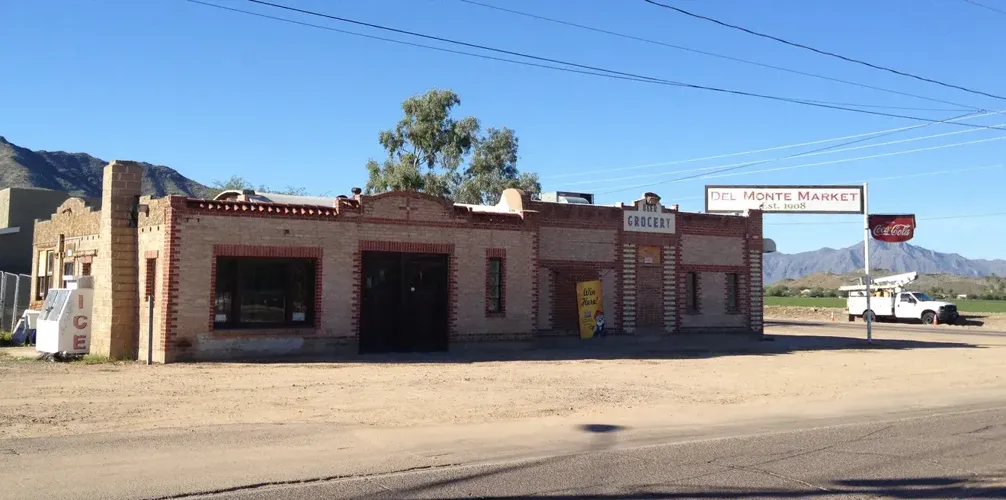
Del Monte Market at 2659 W. Dobbins Road in Laveen opened in 1908 and has continued to stay open for 118 years.
It was originally called "Brutcher's Store" and served as a grocery store, but it went through several ownership changes over 118 years. Now the sign reads "Del Monte Market" and sells tamales, corner store snacks, liquor and other conveniences.
People are also reading…
However, the decorative brick building separates it from other corner stores, maintaining its vintage feel as well as a hitching post for those who still choose to ride horseback to the store.

Del Monte Market at 2659 W. Dobbins Road in Laveen opened in 1908 and has continued to stay open for 118 years.
The historic store hangs a plaque marking its historic registry in Phoenix.
Arizona's oldest bar
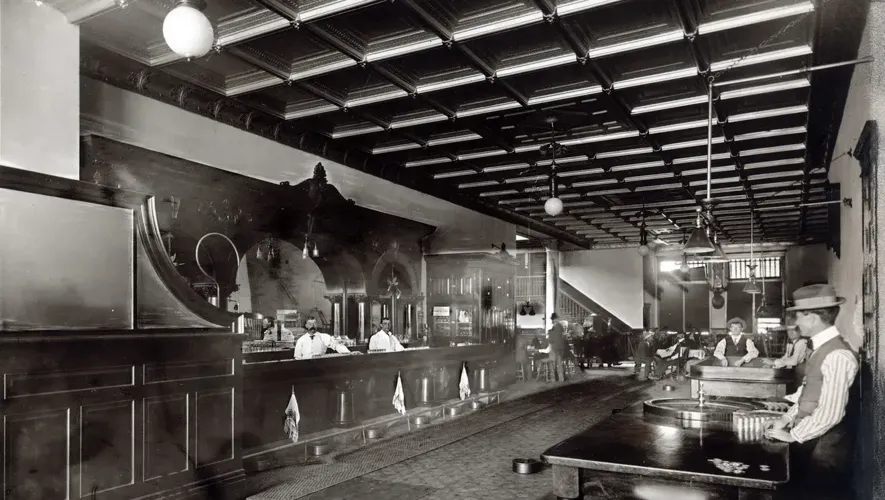
The Palace Restaurant and Saloon opened in 1877 within Prescott's Whiskey Row, which was known for its nightlife even in the 1800s.
Its position on Prescott's iconic Whiskey Row made the Palace Saloon a prime spot for those looking for a good time. Most famously, the Palace Saloon attracted Wyatt Earp, Virgil Earp and Doc Holliday.

The Palace Restaurant and Saloon opened in 1877 within Prescott's Whiskey Row, which was known for its nightlife even in the 1800s.
Although the Palace Saloon likely hosted some rowdy cowboys during its time, the bar stayed unscathed and in business until 1900, when a fire destroyed Whiskey Row and much of the town since the buildings were mostly built out of wood at the time.
Patrons of the Palace Saloon famously carried the Brunswick-brand bar table out of the fire in order to preserve elements of the bar.
Since most of Whiskey Row was destroyed, the eager Palace Saloon owner, Bob Brow, rebuilt the Palace Saloon alongside Ben M. Belcher and Barney Smith, owners of the former Cabinet Saloon, alongside a hotel, Chinese restaurant and barber shop in the back of the saloon.
Arizona's oldest mall

Town & Country Village on Camelback Road in Phoenix opened on Jan. 26, 1957, with a grand ceremony.
With a quick internet search, one might assume that Arizona's first mall was Park Central in Phoenix. However, after reviewing archived articles from The Republic, the grand opening of Park Central Mall took place April 1, 1957, more than two months after Town & Country Village opened in Phoenix in January 1957.
The shopping center is still open today under the same management, maintaining the open-air design as it was in the early days, as well as a large metal and stained-glass flying phoenix that was installed in 1958.
Although the mall has kept some of its original architecture, the unique local stores that once filled the buildings are no longer there. Shops like Ernie Brewer's shoe shop, Culver's, Ed Pabst Windsor Shop, Edens Candies, Cine Capri Theatre and beloved Jutenhoops were some of the first businesses to occupy the space.
The original Town & Country Village also had a nine-hole outdoor golf course as part of the mall's attractions.
Arizona's oldest church

San Xavier del Bac Mission near Tucson is Arizona's oldest church. This photo from April 10, 1940, was taken as part of the Historic American Buildings Survey conducted by the Library of Congress.
San Xavier Del Bac Mission is Arizona's oldest church, founded by Father Eusebio Francisco Kino in 1692. However, the church building itself was not completed until 1797. San Xavier Del Bac Mission is still considered Arizona's oldest church, and it is still in operation today.
Kino traveled to present-day Tucson to spread Catholicism among the Tohono O’odham tribes and foster peace among the communities, according to a history of the San Xavier Del Bac Mission.
The relationship between the Spanish and the Tohono O’odham people was complex. Some Indigenous communities helped build the original adobe structure of San Xavier Del Bac Mission as the mission introduced them to livestock, wheat cultivation and other trades. Others maintained distance and kept to their traditional Tohono O’odham ceremonies.
Regardless, the church maintained its influence in Tucson, blending Roman Catholicism with Tohono O’odham traditions within prayer, philosophy and songs.
Not only is the church a historic monument, but it is also a gorgeous building showcasing traditional Spanish Colonial architecture that has been impressively preserved for over 200 years.
Arizona's oldest university
Although it's nearly a tie between the two largest rival universities in Arizona, the University of Arizona is the state's oldest university.
Both ASU, then called the Territorial Normal School, and University of Arizona were established in 1885.
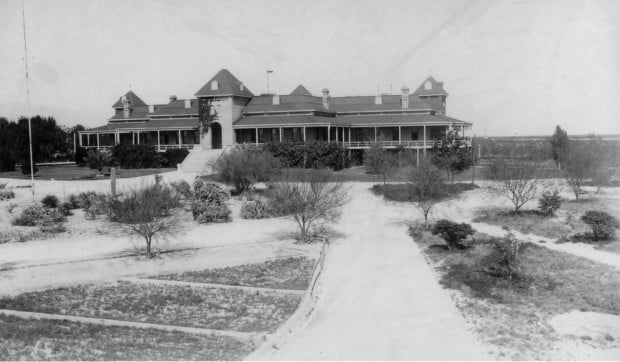
Old Main was the University of Arizona's first building and was completed in 1891. This photo was taken in 1906.
Since the opening of Territorial Normal School in 1886, it underwent many name changes from Tempe Normal School of Arizona to Tempe State Teacher's College, then to Arizona State College. After much deliberation and a statewide vote in 1958, the Arizona State College became Arizona State University.
However, the University of Arizona was established as a university in 1885, becoming the first official college or university in the state. It has maintained that title ever since.
Arizona's oldest school
The Strawberry Schoolhouse in Strawberry was built in 1884 and is Arizona's oldest still-standing school. The building is no longer used as a school; the quaint one-room log cabin can be toured and serves as a reminder of Arizona's educational growth.
Although the Prescott Free Academy was built in 1876 and was Arizona's first school, the building was torn down in 1903 to make way for Washington Traditional School. Since the Prescott Free Academy schoolhouse is no longer standing, the Strawberry Schoolhouse is now revered as Arizona's oldest school.
The Strawberry Schoolhouse was used for classes, church and an overall community hub, serving as a vital part of the early Strawberry community. However, in 1916, the schoolhouse closed down, and slowly the building decayed over time.
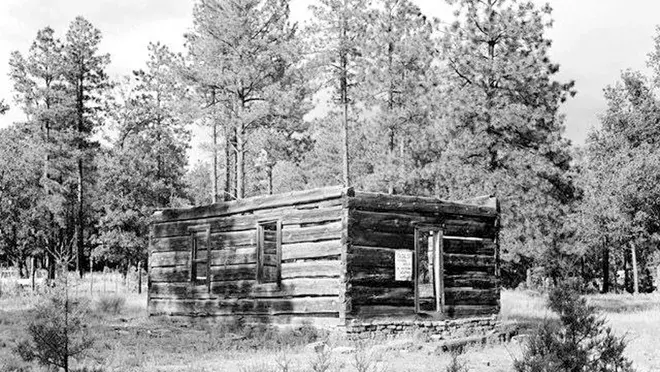
The Strawberry Schoolhouse in Strawberry was built in 1884 and is Arizona's oldest still-standing school.
The Pine-Strawberry Archaeological and Historical Society worked to preserve the building in 1979, consulting past students and teachers of the schoolhouse, returning the building to its original form. Now the schoolhouse is a historical monument open for public viewing.
Arizona's oldest movie theater
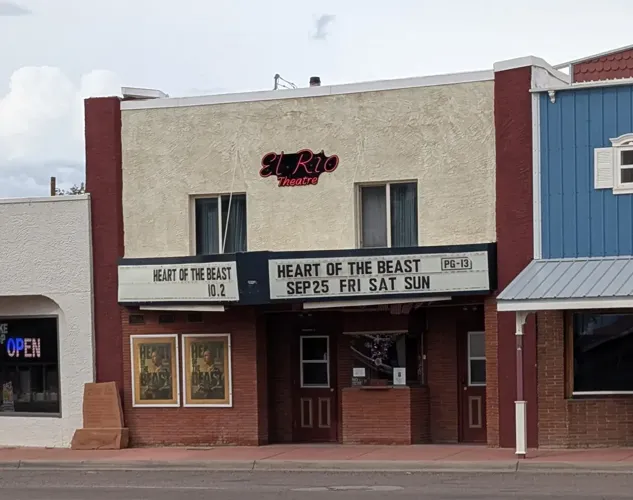
The oldest Arizona movie theater still in operation is the El Rio Theatre in Springerville. Construction started on the theater in 1913, just a year after Arizona's statehood; it opened in 1915.
Originally, the theater was named the Apache Theatre, but it went through a name change in 1937 and became the El Rio Theatre.

The oldest Arizona movie theater still in operation is the El Rio Theatre in Springerville. Construction started on the theater in 1913, just a year after Arizona's statehood; it opened in 1915.
When it opened, the theater, which was built of adobe and plank, showed 35 mm black-and-white silent films on a hand-crank projector, according to the El Rio Theatre.
The theater is still in operation with updated Dolby surround sound systems, but it still has the same popcorn machine as it did in 1915, when the theater opened.
Arizona's oldest freeway
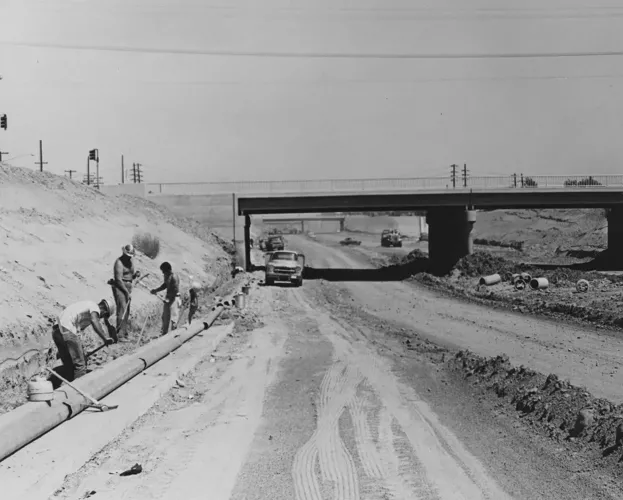
Arizona's oldest freeway is Black Canyon Freeway. Freeway construction started in 1950 and finished seven years later, bringing Arizona up to date with automobile transit in the U.S.
The original Black Canyon Road was a Native American trail that later became a U.S. Army route from Fort Whipple, outside Prescott, to Fort McDowell, east of Phoenix, according to the Arizona Department of Transportation. It was later used as a stagecoach line.
After Congress approved a major spending bill to build 40,000 miles of interstate highways, the freeway began to take shape.

Arizona's oldest freeway is Black Canyon Freeway. Freeway construction started in 1950 and finished seven years later.
The Black Canyon Freeway initially started with an interchange at Grand Avenue that opened in 1957. Just a few years later, it reached Northern Avenue, according to ADOT. It just kept expanding from there. By 1964, the Black Canyon Freeway section of I-17 connected to the Carefree Highway; it was extended to Flagstaff in 1978.
Oldest movie filmed in Arizona
While many short silent films were made in Arizona as early as 1909, the first feature-length film made in Arizona was, well, "Arizona."
The 1940 movie is somewhat of a romance, starring Jean Arthur as Phoebe Titus and William Holden as Peter Muncie. William meets Phoebe in southern Arizona while he is passing through on his way to California. Though William's charm works on Phoebe, his inability to stay in one place makes him leave her for California.
Although upset by his disappearance, Phoebe's stark independence allows her to move on, focusing her efforts on creating a freight line in Tucson. However, she runs into issues when she gets into business with two men looking to sabotage her. Luckily, William comes back just in time to help.
"Arizona" wasn't exactly the hit Columbia Pictures was looking to make, but the movie is the reason why so many great Westerns were filmed in Tucson. The movie was set in the 1860s, during the Civil War; in 1940, Tucson was too modern to depict an accurate scene.
So, Columbia Pictures built Old Tucson Studios for "Arizona." The film cost over $2 million to make, including the set, which took over 200 laborers to construct, according to KGUN 9 Tucson. Unfortunately, "Arizona" was not able to recoup the losses at the box office, but the movie was the catalyst for Hollywood Westerns filmed at Old Tucson Studios.
Since "Arizona" in 1940, over 500 movies and shows have been filmed at the Old Tucson Studios. Some of the most notable are "Rio Bravo," "McLintock!" and "El Dorado," which all star John Wayne, as well as the 1993 "Tombstone" and the Western comedy "Three Amigos."
Celebrating Tucson's 250 years with historic photos
Congress Street

Aug. 20, 2023 is Tucson's 248th birthday and we are taking a trip down memory lane to celebrate!
This snapshot of Congress Street in the 1880s captures the old western aesthetics of the time with the wooden patios lining storefronts, the dirt road stretching out towards the desert and the striped barber's pole outside of the brick building on the left.
Tucson had been around for over 100 years at this point, after it was founded as the Presidio of San Agustín del Tucson on Aug. 20, 1775. Arizona later achieved statehood in 1912.
Photo credit: Tucson Citizen.
"Arizona" world premiere, 1940

Did you know Tucson was home to Arizona's first-ever world premiere of a film? Crowds flocked to downtown Tucson for a parade, seen above, that happened just before the Nov. 15, 1940 premiere of the movie "Arizona."
It was the first full-length movie filmed at Old Tucson Studios and was shown at five different locations on opening night: Rialto Theatre, Lyric Theatre, Fox Tucson Theatre, the Temple of Music, and the State Theatre, according to the Arizona Daily Star's archives.
"Arizona" cost $2.5 million to make and Columbia Pictures had a replica of Tucson in the 1860s built, since that was when the movie's plot took place.
Photo credit: Tucson Citizen 1940.
Downtown Tucson, 1949

Downtown Tucson, looking southeast from the Old Pima County Courthouse in 1949.
The historic Valley National Bank building towers in the background. At the time, it was the tallest building in the city.
The back of the Fox Theatre is in front of the Valley Bank building. At right is the St. Augustine Cathedral.
Sabino Canyon Recreation Area, 1951

People fish in the lake at Sabino Canyon north of Tucson in May 1951, after it was stocked with trout for the first time. Photo credit: Arizona Daily Star
Tucson firefighters, 1956

These Tucson Firefighters are working on a vintage 1928 pumper at a city fire station in 1956. This photo is even more fun if you imagine the four men are performing "Greased Lightnin'," which they obviously are not. Sadly.
The Tucson Fire Department was founded in 1881 and was entirely made up of volunteers until the early 1900s. By 1916, all Tucson firefighters were being paid for their work. Photo credit: Tucson Citizen.
University of Arizona campus, 1959

Some things just don't change on the University of Arizona campus. The crowd of students walking to their next class, cars stopped by pedestrians in crosswalks and even the potential jaywalkers seen in the top left of this photo from 1959 are all still familiar sights.
UA was founded in 1885 and opened for classes in 1891, to the dismay of some Tucson residents who wanted the property to house Arizona's capitol or even a state asylum.
In 1930, Arizona's first university had just over 1,900 students enrolled, according to the Arizona Daily Star archives. Today, UA's total enrollment is over 53,000 and the campus area is booming with businesses, nightlife and of course, sports fans ready to "Bear Down."
Photo credit: Tucson Citizen.
John F. Kennedy visits, 1960

When Sen. John F. Kennedy arrived at Tucson Municipal Airport in April 1960, a crowd of 150 people were there to greet him, many waving signs that read "Viva! Kennedy," according to the Tucson Citizen. Here, he is seen being gifted a sombrero.
The future U.S. President made the stop in the Old Pueblo as part of his presidential campaign, attending several events around town that week. Later in 1960, Lyndon B. Johnson, Kennedy's running mate, also visited Tucson while campaigning and spoke to young voters at the University of Arizona.
Ronald Reagan, Barry Goldwater, Richard M. Nixon and Hubert H. Humphrey were among other famous politicians who visited Tucson in the '60s and '70s. Photo credit: Tucson Citizen.
Tucson Rodeo Parade,1964

The Tucson Rodeo Parade has been a long-running tradition just like the yearly La Fiesta de los Vaqueros it ushers in. A Tucson police officer is seen here with kids watching the 1964 parade as it moves through downtown Tucson.
Members of the Tucson community, from mayors and local business leaders to high school marching bands and nuns from St. Mary's, have been a part of the parade for almost 100 years.
The first Tucson Rodeo was held in 1925 and lasted three days. Photo credit: Tucson Citizen.
A-10 Thunderbolt II, 1975

Tucson has a long history with aviation. Here, Air Force officers check out a Fairchild A-10 Thunderbolt II during a special showing at Davis-Monthan Air Force Base in June 1975.
The Air Force is planning for a new wing of its Special Operations Command at D-M that will replace the A-10 mission as the renowned “Warthog” close air-support jet is retired over the next several years. Photo credit: Bruce Hopkins/Tucson Citizen.
La Placita Village, 1977

A quiet day at the hospitable confines of La Placita Village in 1977.
The village, located near Broadway and Church, was originally built in 1973 and featured around 90 shops, offices and restaurants.
Eventually, La Placita Village was demolished in 2018 to make way for residential apartments. Photo credit: Tucson Citizen.
Tucson Meet Yourself, 1981

Music and dance have long been key elements of Tucson Meet Yourself, as these Leikarring dancers illustrate at the 1981 festival in downtown Tucson.
A Tucson Citizen story from that year stated visitors would hear a wide array of music, "from contemporary Papago polka tunes to old-time fiddling," along with Mariachi music, Scottish bagpipes, and traditional African singing.
As for dancing, the Norwegian dance troupe shown above was joined at the festival that year by Greek, Mexican, Scottish, Cuban, and Indian dancers showing off traditional moves. Photo credit: Joe Vitti/Arizona Daily Star.
The Loft, 1981

The audience at the "Rocky Horror Picture Show" cover their heads as rice is thrown at the New Loft Theatre, 504 N. Fremont Ave., in January 1981. Photo credit: Jack W. Sheaffer / Arizona Daily Star.
McDonald's on Speedway, 1982

What is that contraption at the counter? It's the cash register at the McDonald's restaurant at Speedway and Campbell, as shown here in September 1982. Photo credit: Tucson Citizen.
Foothills Mall, 1983

The line for the opening of the Star Wars film, "Return of the Jedi," at the Foothills Cinemas at Foothills Mall on May 24, 1983. Photo credit: Jim Davis / Arizona Daily Star.
Biosphere II, 1987

Raising their glasses in celebration, Margret Augustine and Carl Hodges toast the groundbreaking for the Biosphere II project in Oracle on Jan. 30, 1987.
The complex was built as a self-sustaining environment for humans, and in 1993, eight “biosphereans” ended a two-year stint living inside its sealed ecosystem. Photo credit: David Sanders / Arizona Daily Star.