“A las tres de la tarde, en el tres de Mayo.” At 3 p.m. on May 3, 1887, the bell began to ring at the Church of San Miguel in Bavispe, Sonora, marking the hour as it had for years.
This time, though, it kept ringing — and ringing — until the church collapsed into a pile of dust and debris, shaken to the ground by one of the largest earthquakes in Mexican history.
Measuring an estimated 7.4 on the Richter Scale, the Sonoran Earthquake lasted two minutes. It leveled every structure in town. It killed 53 people, more than half of them children, leaving the largest visible fissure on earth.
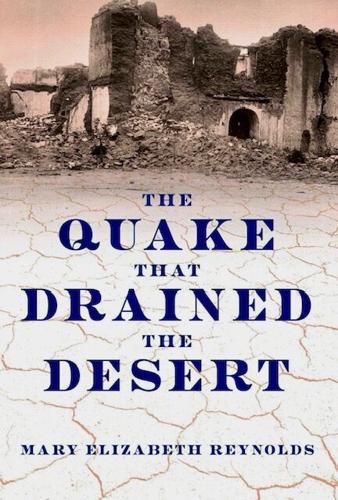
And it’s still being felt today, as evidenced in a new book, “The Quake that Drained the Desert,” by Tucsonan Mary Elizabeth Reynolds.
People are also reading…

Released Oct. 1 by University of Nebraska Press, “The Quake” explores how this little-known, long-ago event changed the ecosystem of the entire Sonora-Arizona corridor. More specifically, we learn how it altered the region’s network of waterways — both above ground and below — contributing over time to the water crisis that grips Arizona today.
Consider this: Tucson is 217 miles northeast of Bavispe, yet within days of the earthquake, El Ojito Spring in the old barrio ran dry.
By the end of the year, the Rillito River no longer flowed past Fort Lowell, instead becoming a sandy streambed.
The earthquake rerouted rivers and drained several area aquifers, diverting the water elsewhere and sending it deeper into the earth.
“Growing up in Tucson, we never gave much thought to earthquakes,” Reynolds said. “We still don’t, which is probably why I was so interested when I learned about this one.”
“The Quake” is Reynolds’ first book, at once a warmly personal and deeply scientific study she began 15 years ago.

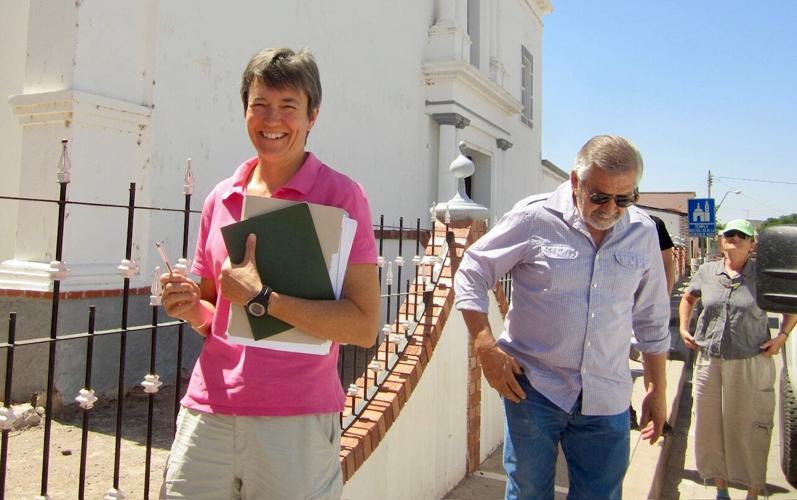
Tucson author Mary Elizabeth Reynolds in front of the "new" Church of San Miguel Archangel in Bavispe, Sonora, with Bavispe Mayor Adam Eduardo Langford Kemson. The original Church of San Miguel in Bavispe collapsed in the 1887 Sonoran Earthquake, one of the largest earthquakes in Mexican history, which Reynolds writes about in her new book, "The Quake that Drained the Desert."
“I was working for the town of Sahuarita, on a task force studying the West Nile virus,” she recalled. “One day we had a speaker from the state health department. He said mosquito-borne diseases had been common in Arizona. Fort Lowell, Fort Buchanan and Camp Verde all had cases of malaria.
“So did St. David … until the earthquake of 1887 caused a surge in the San Pedro River so large it cleared out the malarial pools and saved the town.”
There was a lot to unpack there, but Reynolds — with a degree in history, a master’s degree in urban planning and some experience with earthquakes when living in California — was uniquely positioned to connect all the dots.
“I had never heard about the earthquake, the flood, any of that,” she said. “Right away, I wanted to learn more. I thought it might make for a good magazine story or two. After that, one thing just started leading to another.”
For 15 years.
As most of us former Californians know, an earthquake measuring 7.4 is a doozy. The 1989 Loma Prieta quake that pancaked the Oakland Bay Bridge measured 6.9. The 1984 Northridge quake that wrecked the Harbor Freeway in Los Angeles was a 6.7.
For such a quake to strike a small rural village … in 1887 … was the stuff of legend
Indeed, descendants of those who were there that day still talk about it, Reynolds learned. While researching her book, she visited Bavispe and met a number of them.

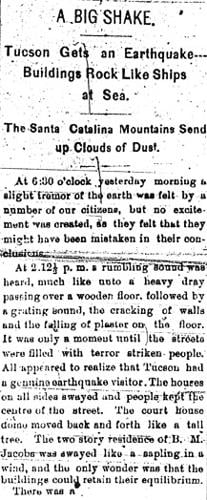
The Arizona Daily Star article on May 4, 1887, the day after the massive Sonoran Earthquake whose shocks also rocked Tucson. The article was headlined: "A Big Quake. Tucson Gets an Earthquake. Buildings Rock Like Ships At Sea. The Santa Catalina Mountains Send up Clouds of Dust."
Victorio Ochoa Olivas told Reynolds his grandmother, a child then, was at the nearby Bavispe River washing clothes.
“She told us the river dried up in minutes,” Olivas said. “The earth opened up and swallowed the water.”
Antonio Borquez Renteria said his grandfather, age 9, was on his way to the river to collect water for his family. “He saw springs of water shoot up, red muddy water. Colorado.”
Renteria also shared the story of a man who raced into the church shortly after the tremors began. Just as the building was beginning to fall, he emerged … carrying a statue of the town’s patron saint. That same statue is now on display in the “new” Bavispe church, built in 1945.
While Bavispe took the worst of it, the tremors could be felt hundreds of miles away.
In St. David, the earthquake leveled the stone bell tower atop the town’s church and school.
At Mission San Xavier, it cracked the arch in front of the chapel and collapsed the rock wall around the cemetery.
All that said, the real rockin’ and rollin’ was taking place miles beneath the earth’s surface, and much of Reynolds’ new book explores the science of it all.
Granted, it took a while. Reynolds is the publicity manager at University of Arizona Press, so the book became a project for nights and weekends.
But at the University of Arizona’s Science and Engineering Library, she found the original draft of a report by José Guadalupe Aguilera Serrano, an engineer sent to Bavispe by the Mexican government after news of the disaster reached the capital.
“I untied the protective ribbon of its protective folder,” she writes. “I breathed in tiny dust particles from the 19th Century. I unfolded the 130-year-old maps, brightly colored rings of earthquake intensity emanating from the epicenter near Bavispe.”
Reynolds reviewed the reports by naturalist George Goodfellow and the photos from C.S. Fly, who traveled to Bavispe together to assess the damage.
She befriended Max Suter, who had spent years studying the Sonoran Earthquake while a geophysicist and seismologist at the National University of Mexico. She read 20 books along the way, including “Requiem for the Santa Cruz.”
Finally, six weeks ago, a box filled with copies of Reynolds’ new book arrived on the porch of Reynolds’ Tucson home. After 15 years, hundreds of hours of interviews, and three cases filled with various notes, there was a book to show for it all.
“I felt such joy I almost cried,” she confessed. “I called my partner Lisa on Face Time so I could tear open the box with her. After that I cranked up some ‘80s music, danced around the living room … "
… and partied like it was 1887.
Footnotes
The University of Arizona Poetry Center will host a bilingual reading by Mexican author Juan Villolo and Tucson’s Francisco (Paco) Cantú Thursday evening, Oct. 14. To learn more, visit poetry.arizona.edu.
“The Great Arizona Shakeout,” an earthquake awareness and preparedness day, will be observed Friday, Oct. 15. To learn more, visit shakeout.org/Arizona/.
The Richard Elías Mission Library will host an appearance by authors Jonny Garza Villa and Sonido Reyes next Saturday, Oct. 17, at 2 p.m. To learn more, visit library.pima.gov.
Tucson novelist Lydia Millet is newly published again. “Fair Ones,” her 18th book, was released Oct. 1. It is subtitled “A Double Novel” since the story is told by two women reflecting on life before and after the death of a friend.


 How an 1887 Sonoran earthquake dried up Southern Arizona wells and springs, fed others