U.S. states filed two lawsuits on Wednesday accusing President Donald Trump's administration of illegally weakening the federal Endangered Species Act, a landmark law that has shielded the bald eagle and other wildlife from dangers posed by development.
The lawsuits by the Democratic attorneys general of 20 states and Washington, D.C., were filed less than two months after the Department of the Interior and the Department of Commerce announced final rules that could make it easier for developers, fossil fuel companies and others to disturb lands that environmental advocates say need protection from business interests.

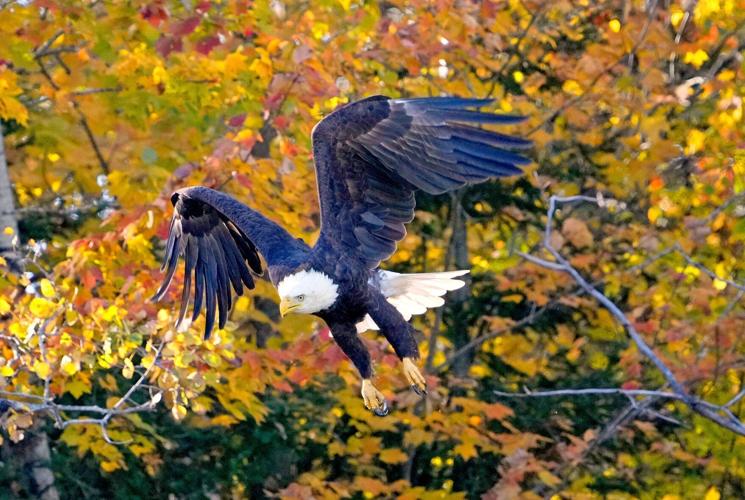
A bald eagle takes flight in October 2024 from a tree covered with fall leaves changing colors along U.S. Highway 51 south of Minocqua, Wis.
In one lawsuit, the states challenged a rule that narrowed the Endangered Species Act's definition of "harm," which had long included encroachments on habitats where endangered animals live. The new rule allows oil drilling, mining and other activities in those habitats so long as those activities do not directly kill or injure the animals.
People are also reading…
The other lawsuit challenges two rules. One rule eliminates broad protections for newly threatened species unless the U.S. Fish and Wildlife Service, part of the Interior Department, creates species-specific protections. The second rule requires the government to consider objections by businesses before declaring areas as "critical habitats."
"The Trump administration is trying to undermine the law, the will of Congress and the will of the people who overwhelmingly support protections for endangered species," Washington Attorney General Nick Brown said at a news conference. "Instead of stewardship, this administration's approach to our land, to our water is one of exploitation."

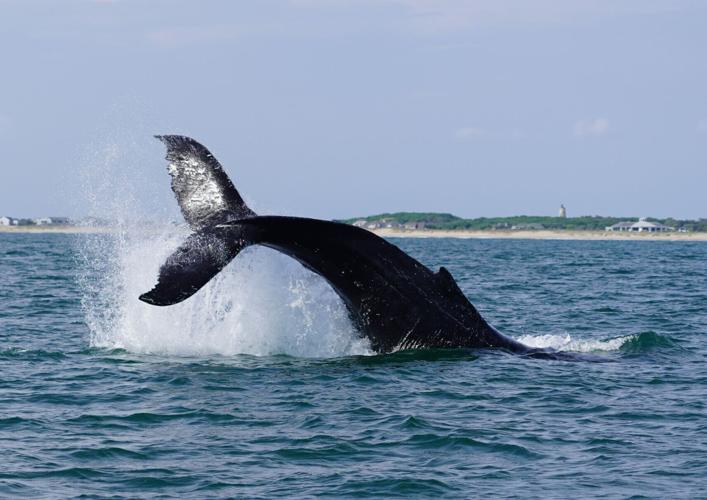
A humpback whale is spotted during the Brunswick Community College/University of North Carolina Wilmington dolphin survey.
Interior Department resists 'overreach'
Both lawsuits were filed in federal courts in northern California, targeting actions by the Fish and Wildlife Service and by the National Marine Fisheries Service, part of the Commerce Department.
Copies of the complaints were not immediately available. Environmental groups also sued to block the revised definition of harm.
"The role of federal agencies is to faithfully implement the Endangered Species Act as written, not to expand its reach through interpretations favored by advocacy organizations," an Interior Department spokesperson said.
"This lawsuit seeks to preserve a decades-old regulatory overreach that expanded the Endangered Species Act beyond the authority granted by Congress," the spokesperson added. "The department will vigorously defend its authority to implement the law according to its plain text."
A spokesperson for the fisheries service said that agency does not discuss pending litigation.
Democratic-led states filed dozens of lawsuits challenging sweeping policy changes during the second White House term of Trump, a Republican.

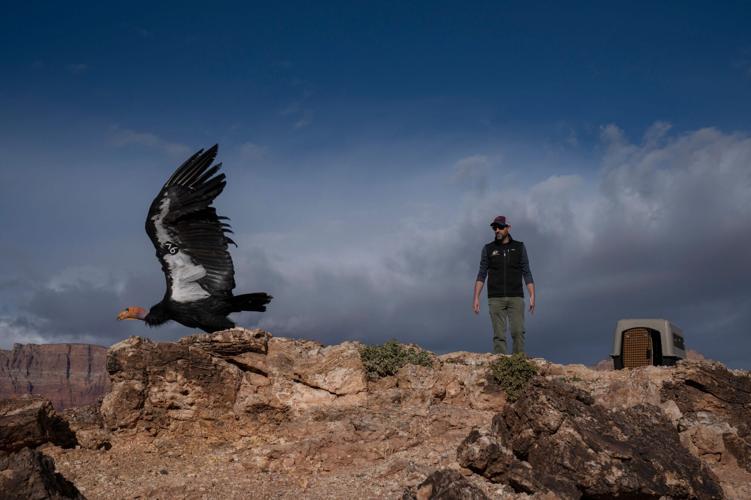
Program director Tim Hauck releases California condor No. 987 on Jan. 8 at Badger Canyon, Grand Canyon, Arizona.
Future generations benefit from law, state AG says
Enacted by Congress in 1973, the Endangered Species Act is credited with saving animals including the California condor, grizzly bear and humpback whale from possible extinction.
Weakening the law aligns with Trump's goal to reduce regulations that he says constrain American businesses.
These include scaling back a variety of environmental initiatives and standards, including by reducing government support for clean energy and repealing a scientific finding by former President Barack Obama's administration that climate change threatens public health.
Many wildlife advocates consider habitat loss the biggest cause of animal extinction.
"We owe future generations a world where bald eagles soar, sea turtles swim and all wildlife thrives," New York Attorney General Letitia James said in a statement.
Videographers Heather MacAulay and Chris Murphy got quite the shot on Sept. 1 when they spotted a North Atlantic right whale off the coast of Blackhead Cove, N.L. The whales are a critically endangered species, but encouraging signs are pointing to the population stabilizing.
Less deference to federal agencies
Interior Secretary Doug Burgum has said the Endangered Species Act was "weaponized" to stop projects, weakening competitiveness, undermining national security and hurting Americans' pocketbooks.
He has said the new rules more closely align the law with its original intent.
The changes followed the U.S. Supreme Court's decision in 2024 to overrule a 40-year-old precedent that required courts to defer to federal agencies' reasonable interpretations of laws they administer.
Wednesday's lawsuits were led by Washington State, California, Maryland and Massachusetts. Other plaintiffs include New York, Arizona, Colorado, Connecticut, Delaware, the District of Columbia, Hawaii, Illinois, Michigan, Minnesota, New Jersey, New Mexico, Oregon, Rhode Island, Vermont, Virginia and Wisconsin.