In 2022, a grandmother in Catawba County, North Carolina, asked the county’s school board to remove 24 books from the district’s libraries. Her request was part of a wave of book challenges across the country.
Michelle Teague said she wanted the books removed for explicit content to which she felt children should not be exposed. Four months after instigating the book challenges and an ensuing debate, Teague filed for election to the Catawba County School Board. By the end of the year, she was sitting on the board that would vote on whether the school should ban the very books she challenged -- or change the process by which those books were reviewed.
In 2022, concerned community member Michelle Teague asked that the Catawba County School Board remove 24 books from the district’s school libraries. Claiming that these books contained explicit content that she felt children should not be exposed to. Now these books as well as many more are being challenged in libraries across the country.
She is one example of book banning advocates seeking seats of power on North Carolina school boards as the fever pitch for banning books grows nationwide, a Lee Enterprises Public Service Journalism Team investigation shows.
People are also reading…
Teague brought forth years of debate over the challenged books and school board policy for reviewing those books, as many others have in the U.S.
In 2023, a reported 9,021 books were challenged in public schools and libraries across the country, according to the American Library Association.
Those challenges can come from community members, parents or activists. In western North Carolina, some school boards saw those challenges come from school board candidates and school board members themselves. The issue has become a political boost for some, who seek election to school boards to effect change on a higher level, ALA director of the Office of Intellectual Freedom Deborah Caldwell said.
“Challenges are demands to remove books that have a long history of being available for teaching young people about puberty and adolescence and sexuality,” Caldwell said. “(Some books are) being described as illegal, obscene material that is illegal to give to children, which is completely untrue. But that narrative has taken hold, and has become, in many ways, a political wedge issue for elected officials for people standing for office.”
Teague cites sexually explicit content not appropriate for children as her reason for requesting that the school district review the 24 books she challenged, according to Hickory Daily Record articles. During public comments at Catawba County Board of Education meetings, Teague said there are more books she thinks should be challenged.
“We are real concerned about what these kids are being exposed to and what they are coming up against,” Teague said during a public comment at a board meeting in April 2022.
Which books are most challenged in schools?
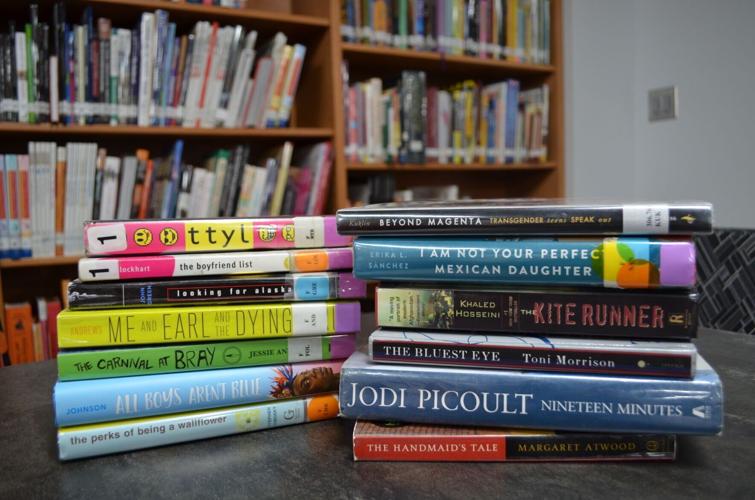
Included on the list are titles like “Beyond Magenta: Transgender Teens Speak Out” by Susan Kuklin; “All Boys Aren’t Blue” by George Matthew Johnson; “I Am Not Your Perfect Mexican Daughter” by Erika L. Sánchez; “The Perks of Being a Wallflower” by Stephen Chbosky and “The Bluest Eye” by Toni Morrison.
Many of the books challenged in Catawba County are being challenged in school and public libraries across the country as part of the growing number of book challenges in the past couple of years.
Book challenges — a request to review and remove a book from a library — are not new. The ALA was tracking the prevalence of such challenges before the recent attention. In late 2020, a slight increase in challenges of books in public libraries and schools began. It was in 2022 when Caldwell noticed a sharp increase, from three or four reports of challenges each week to four or five every day.
In 2023 alone, 4,240 unique book titles were challenged in the United States — 65% more than in 2022, according to ALA data.
“It's truly unprecedented. And what's concerning to us is that it does seem to be organized groups, organized social media communities, all aimed at removing books from school libraries and public libraries,” Caldwell said.
Caldwell noted that many of the challenged books are "primarily dealing with the stories and experiences of marginalized groups."

Several of the 24 books Michelle Teague challenged in Catawba County Schools have been challenged in other school systems across the country.
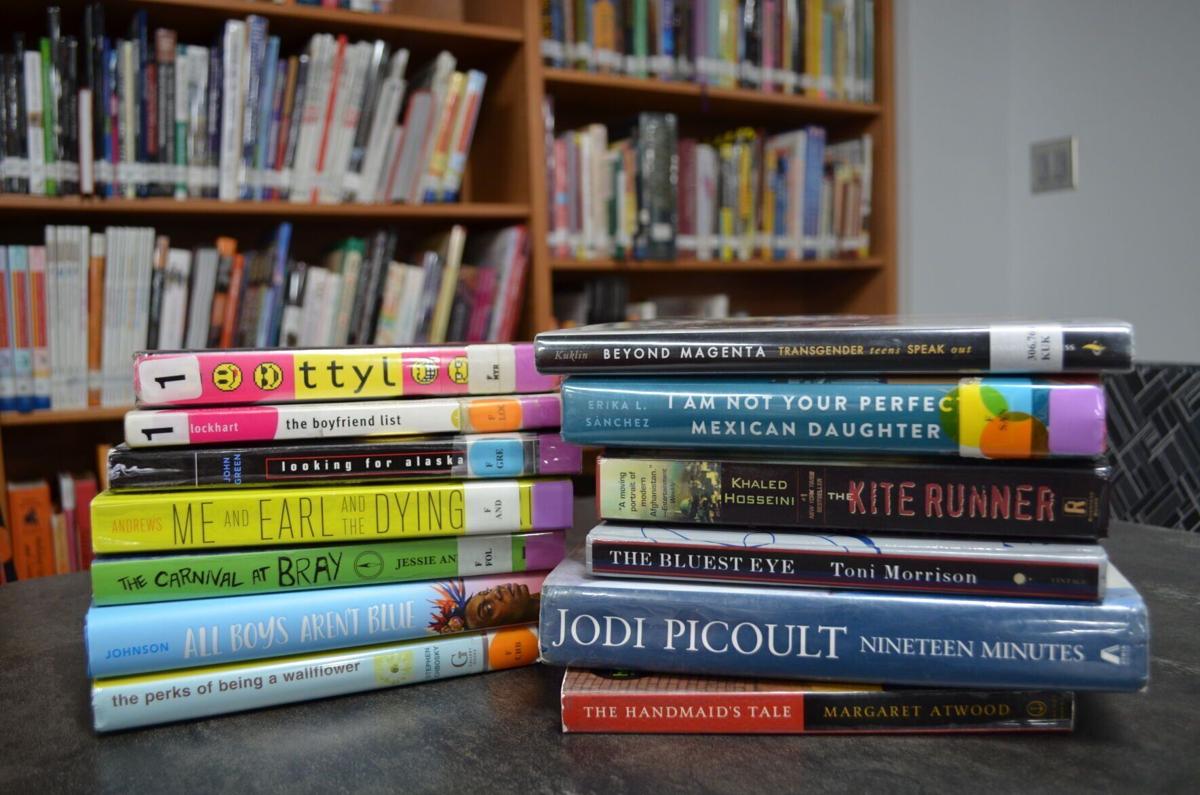
Several of the 24 books Michelle Teague challenged in Catawba County Schools have been challenged in other school systems across the country.
Many challenged books address sexual orientation, LGBTQIA+ topics, transgender stories and Black and Brown lives. The ALA’s data found a book titled “Gender Queer: A Memoir,” by Maia Kobabe, was the most challenged book in the U.S. in 2023 with 106 challenges.
“A great emphasis has been on books touching on gender identity and sexual orientation and an effort to move the needle on what is considered inappropriate for young people to read," Caldwell said. "So that any topic, any book, touching on issues dealing with sex or sexuality are off-limits for young people.”
Books depicting same-sex couples, transgender people and gay people are described by challengers as pornographic even when there is no sex depicted in the book, Caldwell said. Stories of Black lives, the history of racism in the United States or books from the perspective of minorities often are included in challenged, too, she said.
Though the rise in book challenges is a recent trend, schools often face criticism — whether it’s over books, curriculum or schedules, University of North Carolina at Chapel Hill School of Education Associate Professor Ethan Hutt said. In the 1800s there was debate over which Bible to use in schools, Hutt said. In the 1900s debate flared over teaching evolution in schools. Now there’s controversy over books.
Hutt said there are legitimate debates to be had over books, but the rise in challenges can take away educators’ discretion and authority.
“When you have these sort of flashpoints around certain texts, it just limits what educators do,” Hutt said. “I tend to trust our teachers, and I tend to trust their judgment. They spend a lot of time with our students, they tend to know how to engage them, they tend to understand the things that are on their minds.”
Advocates like Teague disagree. She took her fight to the polls.
Those who seek removal of books go for office
Teague brought the book controversy to Catawba County with 24 challenges in March 2022, after which people have flooded board meetings to speak for and against book bans. In July of that year, she filed for election for a seat on the Catawba County Board of Education.
Teague’s campaign centered around being a Christian conservative grandparent fighting for parents’ rights. Book challenges weren’t the only topic upon which Teague campaigned, but it was the cornerstone of her platform. In a candidate profile in the Hickory Daily Record, Teague said she researched more than 100 books in school libraries she found inappropriate.

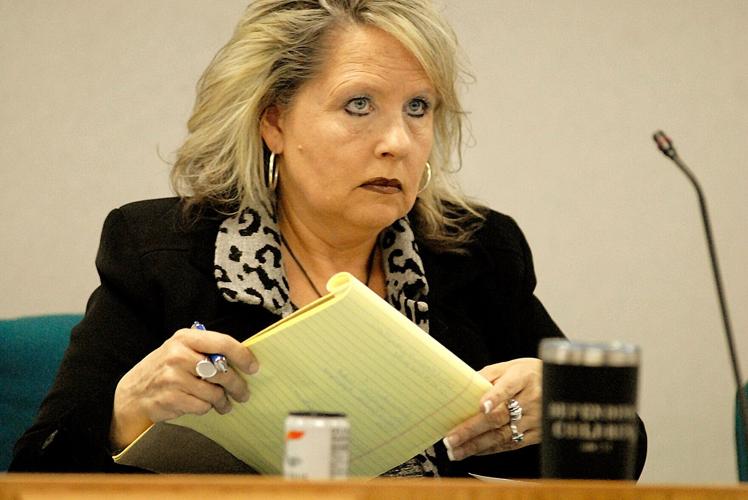
Catawba County Schools Board of Education member and book challenger Michelle Teague prepares her notes for a presentation in March 2024 on why she wanted Jodi Picoult's "Nineteen Minutes" removed from school libraries.
Catawba County Schools Board of Education member and book challenger Michelle Teague prepares her notes for a presentation in March 2024 on why she wanted Jodi Picoult's "Nineteen Minutes" removed from school libraries.
Teague was the top vote getter in the election, according to the North Carolina State Board of Elections. She took office in December 2022. After winning the election, Teague said in a Hickory Daily Record article that she wants to make a difference for kids.
“I am not trying to ban books,” Teague said in November 2022, after winning the election. “But what I am trying to express is that I have an opposition, or that I feel that the books are not appropriate for the age of the children, for the kids, that are reading these books.”
During her campaign, Teague said she hoped to change the process by which books are challenged and reviewed in Catawba County. In the candidate profile, Teague said the policy needed to be streamlined.
Others have run for school board on similar issues.
In Burke County, Catawba County’s neighbor to the west, one current school board candidate, Jamey Wycoff, initiated book challenges as early as September 2021, according to records from Burke County Public Schools. Since then, he filed more book challenges and regularly spoke before the Burke County Board of Education, board member Wendi Craven said. Craven remembers Wycoff as the person who brought the book issue to the board’s attention.
In December 2023, Wycoff filed for election to the board of education. In the March Republican primary, Wycoff ousted an incumbent board member. He will face a Democratic opponent for the seat in November in the general election.
After winning the primary, Wycoff said he believes people are looking for change, according to an article in the Morganton News Herald.
“People, obviously, they wanted some change, and they proved it in this election,” he said.
Man who challenged books says his campaign focuses on parents' rights
Wycoff’s campaign is focused on parents’ rights, including removing books he deems inappropriate from schools. Wycoff is a former police officer who retired in 2022 in part to focus on his work on parents’ rights and books in schools, according to his campaign website.
Wycoff shares videos and podcasts reviewing books he describes as pornographic, explicit or inappropriate for schools and promoting his campaign to remove these books from school libraries. His campaign materials also focus on changing school media policies to change the process of book challenges in Burke County schools.
In an episode of his podcast, “Jamey’s Conservative Review,” Wycoff said his interest in school issues started when the board debated mask requirements during the COVID-19 pandemic. He felt the board was not listening to what the community wanted.
“I realized that I was part of the problem, and the problem was that I voted for most of the individuals who were not listening to their constituents,” Wycoff said in the podcast posted in November 2023.
After several months of submitting challenges to books and speaking on books he felt should be removed, Wycoff said he felt the schools’ policy on book challenges needed tweaks. Some changes the board made stopped Wycoff from being able to challenge some books he felt should be removed, he said. These factors led Wycoff to run for a seat on the school board.
“I felt compelled to bring the issue to the people of Burke County,” Wycoff said in the podcast episode. “I never thought in my wildest dreams that I would ever be one day be running for political office, but this is something that I sincerely do believe that is something that God wants me to do.”
In Catawba County, Teague found the process for the book reviews lengthy and difficult to navigate, she said at a school board meeting in September 2022. It took nearly two years for all 24 books she challenged to be reviewed, including appeals. By then, Teague sat on the board of education.
At a candidate forum in October 2022, Teague said she hoped to effect change to Catawba County’s media policies as a school board member.
“It is so hard to get those books out because the process is involved,” Teague said at the forum, according to a Hickory Daily Record article. “It’s very involved, and it needs to actually be more streamlined.”
Sitting on the board, members have a hand in affecting policy or book challenge decisions, directly impacting what books are removed, who can challenge books or how challenged books are reviewed.
Some school boards change how they handle book challenges
The rise in book challenges across the country has caused some school boards to consider changing policies for how books are challenged and reviewed.
Some districts have changed policies in North Carolina, but it’s inconsistent across the state, North Carolina School Boards Association Legal Counsel and Director of Policy Christine Scheef said. She has noticed an increase in conversations with school boards about how to handle book challenges. Each board handles it differently, she said.
The association has recommended sample policy that boards can follow. Some book policy aspects have changed in recent years as parents' rights have come to the forefront of conversation, Scheef said.
In Burke County, the board of education began examining its book policy soon after Wycoff brought book challenges to the board’s attention, Craven said. Craven was chair of the board at the time. Since the process began, the board has reviewed and changed its policy several times. The changes have included altering who can make book challenges and how the books are reviewed.
“We have all worked so hard to try to come up with this really great policy that I personally think is a model for the state of North Carolina,” Craven said. “It's intense. We really, I feel like we evaluated every piece, and we did listen to the community.”
Burke County Public Schools have seen about 40 book challenges in the past three years, Craven said. Those include a list Craven herself requested be reviewed.
Craven joined the board in 2019, and her term will end in December after losing in this year’s primary election. She felt more books should be reviewed for appropriateness than were challenged by the public and requested that the school review many of them.
Craven said she is fine with controversial material but wanted to ensure books were developmentally appropriate for children. While a separate committee decides the result of book challenges, Craven supported some books being age-restricted or moved out of lower grade levels.
“As an educator, my stance was always, ‘Is it developmentally appropriate?’,” Craven said. “And that's where I stand. One thing people would say is that, well, they (kids) see it on their phones or the internet.’ My answer was, yes, that's true. But we have a duty to protect them.”
Craven found herself to be both a board member asking for books to be reviewed and approving policy on how books should be reviewed.
While Teague issued the challenges before being elected, she since has had a say in school board policy on public comments, school books and book challenges.
Teague has voted on appeals on book challenges she made, a practice Board Chair Jeff Taylor disapproves of. Taylor said he respects his fellow board members but would like to see Teague recuse herself when voting on whether to remove the books she challenged from libraries. Only some of the books come before the board if Teague appeals the decision of the review committee.

Catawba County Schools Board of Education Chairman Jeff Taylor asks deputies to escort someone out of a book hearing in March 2024.
“At almost every meeting we've had one of these (appeals) there has been a motion to recuse her, which is not passed,” Taylor said. “I find it inconsistent that you can bring a challenge and then sit in judgment of the challenge that you initiate.”
In board meetings, Teague has said she has chosen not to recuse herself because she believes she is not biased on the subject. She said board policy says a conflict of interest is only when a board member would have personal or financial gain, according to a Hickory Daily Record article from August 2023.
“There is no law, controlling court decision that says a passionate board member cannot participate in a book hearing,” she said before the board in August 2023.
Taylor believes most parents and citizens aren’t affected by these book challenges or removals. He also believes if the challenges continue, it could affect the county in a bigger way.
“What worries me is that if we move too far to the right, if we become too reactionary, people will go somewhere else,” Taylor said. “It could affect the larger economy of our county. I don't want to be alarmist, but people in my experience want three things important in their lives. They want safe neighborhoods, they want to be able to have good quality of life and they want good schools for their kids. If any of those get out of balance, it’s like a stool. You kick one leg out from under a three-legged stool, and it’s gonna tilt over.”
Caldwell, an expert on the subject, says the book challenge trend could persist. While there has been pushback in some states, she believes that because it has become a political issue, conversations about challenges and bans may continue to arise for school boards across the country.
Virginia Annable is a member of Lee Enterprises' Public Service Journalism Team based in the east region. Find Virginia on Twitter @annablevl or reach out at vannable@lee.net.