Orion Barbosa was sitting in class, frustrated with her teacher's lecture, when she sent a message to a friend using a messaging service on her school-issued Chromebook.
"Oh my gosh, if he doesn't stop, I'm gonna punt him into the sun," she recalls the message saying. A few hours later, in math class, she texted the same friend something like, "If you give me 20 bucks, I'll slap him right now," about a friend who was annoying her.

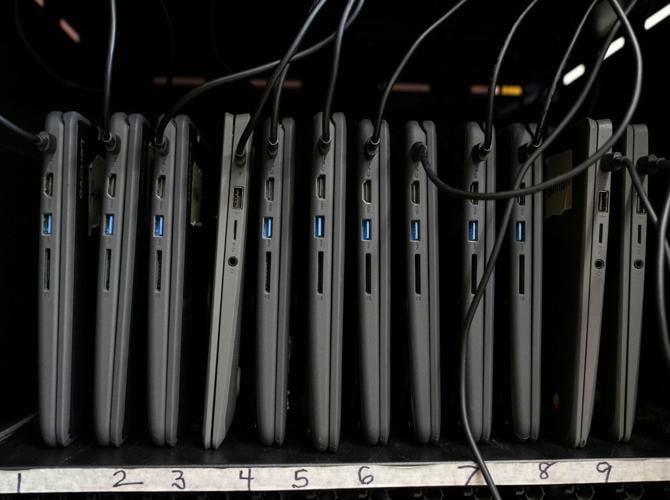
Chromebooks sit in a third-grade classroom at The Oaks Academy in Indianapolis.
By the end of the day, she and her friend were sitting in the principal's office with printouts of their messages in hand. She was questioned, and later lectured at length, since school administrators thought her Gen Z-coded jokes may have been a threat.
"That was a very scary realization of like, 'Oh, they can see everything,'" Barbosa said. "A lot of people are like, 'Oh, well, it's a school device, you should know that you're being monitored,' but I think it's the intensity of the surveillance that takes people by surprise."
People are also reading…
Her former school district is one of many in Indiana and across the country that spend tens to hundreds of thousands of dollars per year to track students' online activity, sometimes down to the keystroke, in the name of safety. In some districts such as Pike Township and Center Grove, monitoring can extend past school hours and into the web histories of personal devices logged into school accounts.
School administrators and their vendors say monitoring has saved lives through the increased detection of threats of violence and mental health crises. Teachers and administrators also told IndyStar that in-class screen monitoring and web tracking are crucial tools to keep kids on task and away from inappropriate material.
However, critics argue that school leaders are being won over by slick marketing that promises increased safety despite limited independent research proving it works. The tradeoff, they say, is sacrificing students' privacy and violating their trust through intensive monitoring that could alert school officials to activity ranging from an innocuous Google search to personal conversations.
Many parents don't know about or understand the extent of monitoring. Schools often sign off on the contracts with little or no public debate. And, while the cost is not a major budget item, it's not insignificant. An IndyStar analysis of the state's 30 largest school districts found that one of the most expensive contracts was a three-year, $420,000 contract between Evansville schools and Linewize.
IndyStar spoke to students, parents, school staff, critics and company leaders about the prevalence and implementation of the technology. All agreed that students need to be kept safe at school and should know that a school device isn't a black box. Where they differ is how to draw a line between safety precautions and surveillance operations.
Ultimately, it's district leaders who get to decide.
How monitoring technology works
Monitoring technology gained a foothold in classrooms after a new law in 2000 required schools that receive certain federal funds to block inappropriate web content from children. Concerns about school shootings and an explosion in e-learning during the pandemic further contributed to the technology's rapid spread. Today, electronic monitoring contracts are a fixture in most districts' IT budgets.
Some of the most commonly used companies include Securly, GoGuardian, Gaggle, ManagedMethods, Linewize, Lightspeed, Hapara, ContentKeeper and Blocksi. The level of monitoring varies in each agreement.
At its most basic, schools track where students go on the internet and use web filters to block inappropriate and distracting websites. For example, last spring semester, the most blocked search terms for Center Grove schools were "tiktok," "roblox" and "games," according to a Securly report. It also restricted searches for "sex," "jeffrey epstein" and "poker."
Schools can pay for more monitoring through add-ons — like the "heated seats" of a car, as one Hamilton Southeastern Schools board member described it. A step up is monitoring what students are doing in their school emails, drives, messengers — basically anything tied to school-issued Google or Microsoft accounts. Schools can also set up classroom-focused monitoring, where a teacher can see every student's screen and close tabs or lock websites to keep kids on task.
The most expansive monitoring can track every keystroke, during and after school hours.
Companies primarily track keywords and phrases using artificial intelligence. They then work with schools to decide when they want to be alerted. In some cases, schools are immediately notified. In others, a human review team first evaluates the flagged words to decide if school officials should be made aware.
"We don't force it. We say, 'You decide.' We warn people. 'Okay, here's the technology. Here's what it can do,'" said David Waugh, a founding leadership member at ManagedMethods. "Whether it's public or private, it's the school and their employees that are running our technology that have to make those decisions."
Representatives from several companies said the goal is to make the internet a safer place and provide guardrails that alert adults when students go too far. The companies say they want to give administrators a safety tool, not a surveillance operation.
"We try very hard to make sure that our products do what they're intended to do, which is keep kids safe, right? Block out the bad, harmful things, the rabbit holes that we know the internet can lead kids to," said Teddy Hartman from GoGuardian. "It's not thought police. We're not tracking what kids are checking out at the library and things like that."
Lightspeed's Jennifer Duer said her company doesn't exist to get kids in trouble and they are conscientious about flagging signs of harm, not merely bad behavior. Their focus is on what's best for students' safety and learning outcomes, she said.
Gaggle founder Jeff Patterson emphasized that the student mental health crisis requires technology like this to keep them alive. After alerts, he said, kids were found attempting suicide. The median time between a student typing a suicide note and a call out to the school is about seven minutes, he said. It's about giving a school the opportunity to intervene, he said.
Accusations of misuse, compromised privacy
Companies can urge their customers to abide by best practices, but it's ultimately up to school administrators to decide how to use the technology. Heavy-handed officials have made headlines elsewhere, raising concerns about whether overzealous monitoring is doing more harm than good.
In Kansas, student journalists filed a lawsuit claiming the technology violates their privacy rights and administrators used it to interfere with their work. In Florida, a 14-year-old who typed "I have a gun" into Google Translate was arrested and charged with a felony, even though he did not have a gun in his possession. In Arizona, a top-performing student was suspended for 45 days, though it was shortened to 11, after he typed and then deleted a school shooting joke in an email to a teacher. His family is now suing.
A 2025 University of California San Diego study found that 86% of companies monitor students 24/7, and historically marginalized students could face a higher risk of being flagged due to algorithmic bias. Several news outlets have reported on disruptions or increased arrests that followed software alerts.
U.S. Sen. Elizabeth Warren previously called for more transparency over whether the software is being misused to over-monitor students, resulting in increased disciplinary actions and run-ins with police. The American Civil Liberties Union, Center for Democracy & Technology, Electronic Frontier Foundation and Knight First Amendment Institute at Columbia University have each written reports or sued for information about the expansive nature of this technology.
Society has accepted the idea that some children's rights can be compromised to keep them safe, said Chad Marlow, senior policy counsel at the ACLU. However, he is highly critical of whether these technologies are as effective as companies promise and whether the harm inflicted on students' privacy and speech rights is worth the limited benefits. He said the industry's safety claims have not been independently verified.
"I don't think you want to compromise kids' privacy for no good reason," he said. "In the case of these technologies, there is no good reason because, again, there's very little evidence beyond a broken clock is right twice a day."
Lightspeed's Duer said her company is considering commissioning third-party research, but it can be difficult to prove outcomes when success stories can be so sensitive. She and other company leaders said the feedback they hear from schools and families is proof their tools are working. Gaggle's Patterson pointed to a 2022 EdWeek Center survey of the company's customers that found wide approval among school leaders.
Monitoring contracts get little public vetting
At a sparsely attended school board meeting last June, members of Indianapolis' Pike Township school board learned the district will lose $6.7 million following major statewide property tax reforms. In the same meeting, the board approved 13 vendor agreements, including a renewal of the district's contract with Blocksi. The board spent just 47 seconds on the topic.
Pike Township is not unusual. When students are on summer break, school board members usually approve a bevy of routine contracts, including for student monitoring technology. Often, a company's name or the contract's worth isn't mentioned. No hours of public comment or testy debates. Just routine approval.
In the last four years, at least 81 of Indiana's 288 school districts contracted with monitoring companies for services ranging from basic web filtering to intensive device and account monitoring, according to GovSpend, a government data collection aggregator. Those contracts add up to $4.36 million. Some schools are taking out loans with the state to pay for this technology.
The cost of these contracts can vary widely. At the low end, several districts, including Avon, Brownsburg and Washington Township, pay just below $20,000 a year for classroom management and web monitoring software.
Some of the larger districts pay significantly more. Indianapolis Public Schools and Hamilton Southeastern Schools both pay around $160,000 per year for GoGuardian and Lightspeed. The Evansville-Vanderburgh School Corp. will pay at least $885,000 to GoGuardian and Linewize over a seven-year period, according to public records. The three school districts did not respond to IndyStar's request for interviews on their vetting and decision processes.
A new Indiana law going into effect next January may mean schools have to pay even more. House Enrolled Act 1004 requires schools to provide parents with more control to increase content filters and limit screen time.
This comes as school districts around the state debate whether to propose referendums to raise property taxes as a means to make up lost funding after state lawmakers and Gov. Mike Braun approved property tax cuts last year.
"Is this technology worth the entire big picture number?" Lafayette parent Sam McDowell asked.
Some Hoosiers are even calling for schools to drop Chromebooks for pen-and-paper learning.
McDowell said the price of monitoring technology is just part of a broader spending pattern that schools need to re-evaluate. She thinks schools will continue to embrace technology, even if it's not improving outcomes, since so much money has already been invested.
McDowell is worried salespeople have inundated schools and that the outcomes aren't what's best for kids. She is exploring options to limit educational screen time for her daughter, such as partnering with a handful of parents and splitting the cost to hire a teacher. She said she'd rather schools spent the money on teachers, security and counselors instead of Chromebooks and software.
"Why are we trusting people with marketing degrees over people with education degrees?" she said. "We're being convinced that our kids are in constant danger because they're selling us something."
A matter of trust
A school safety plan is a complicated puzzle. Amid pressure from parents and the community to ensure safety, industry experts emphasized that school leaders need to decide what issue they are trying to solve before signing a contract.
Ronak Shah, a teacher who's worked in Indianapolis for 14 years and currently teaches at Thomas Carr Howe Middle School, said it's very helpful to have classroom technology engineered to keep students on task, but it crosses a line when it stretches outside the classroom and onto personal devices.
"The safest way to have a school work is for kids to trust the adults who are there," he said. "I would rather have less surveillance and more trust than to have this culture of 'Well, we have to observe everything.'"
He thinks the scope of monitoring should be limited, because without safeguards, it could create a culture where students lose trust in the adults at school, he said, and an overreliance on this technology could replace the in-person relationships that prove most fruitful in providing needed support.
But Devin Arms, Tippecanoe School Corp.'s IT director, said schools don't have the time to intimately watch students' online activity all day.
"We're not sitting here looking to invade the privacy and the personal thoughts of students," Arms said, "unless that activity crosses the line and it becomes inappropriate, explicit or could put the student in danger or others in danger."
Ultimately, districts provide students with devices to do their schoolwork, he said, not the extracurriculars that fall between innocent curiosity and necessary intervention. There's no perfect technology or approach, but he believes there are more pros than cons when using these tools to protect students.
Kenneth Trump, a safety expert who consults with schools, said people want quick-fix, fail-safe solutions. There's no one-size-fits-all solution, and he encourages school leaders to use an 11-page checklist to vet their decision-making before signing a contract.
He said he often hears educators say, "I just can't cut through the noise," "I'm bombarded with vendors," or "Everybody tells me that their product or technology is going to make our schools safer."
Many schools opt for "security theater" and fall into "shiny object syndrome," Trump said.
Instead, going back to the basics — students talking to trusted adults — is the most assured way to find out about these emergencies before they happen, he said. Student relationships are not as flashy or lucrative as monitoring software or other technology offered by other vendors, such as weapons detection cameras, he said. They aren't as appeasing to parents and school board members demanding solutions to prevent tragedies.
If a school does use this technology, he said it still requires a plan for how to deal with these situations. Kids need to be redirected to social workers, counselors, or intervention specialists anyway to address the core issue, he said, but school officials may be without those resources and can be left scrambling without a plan when these issues arise.
Gaggle's Patterson agrees. He said they work with schools to make sure they have a plan. He wants the industry and contracted schools to take a pledge that prioritizes student safety and doesn't put students at risk, including when it deals with their identity.
"How we approach the students, how we interact with the students, how we support the students is very important," he said. "This isn't about punishment. It's really about helping the kids."
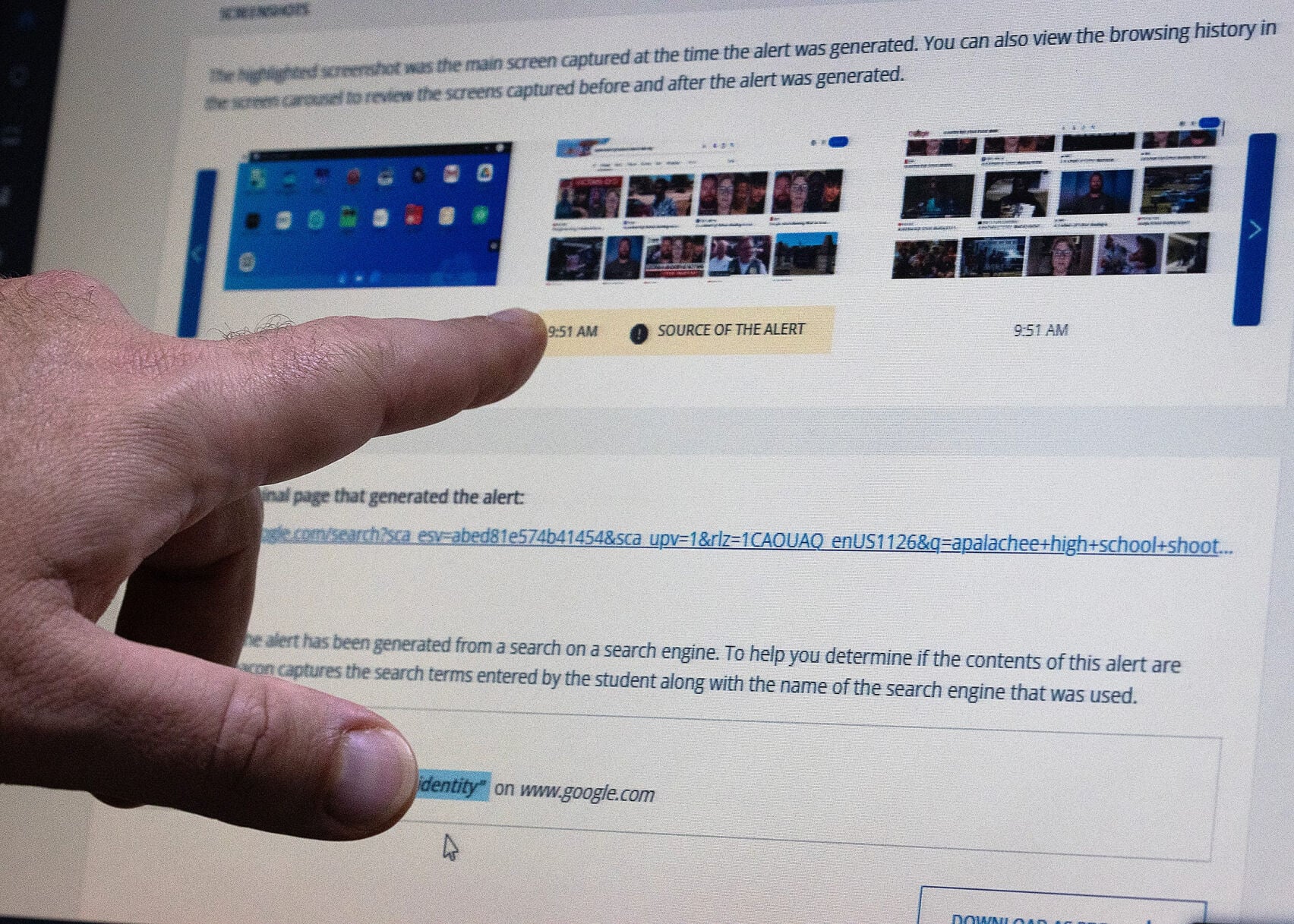
David Cobb, a Bay County sheriff deputy, monitors alerts using the application GoGuardian Beacon at Arnold High School in Panama City Beach, Fla. The application alerts his team of suspicious internet searches by students on school-owned computers.
Concerns about chilled speech, barriers to learning
Beyond the disputed safety measures, some students have reported that they've chilled their speech or that the software has even gotten in the way of learning.
A 2022 Center for Democracy & Technology study found that three in five students did not feel comfortable sharing their true thoughts and feelings online if they knew they were being monitored. Several students told IndyStar that they weren't aware of how intensely their schools were monitoring their data and that they planned to act differently after researching the extent.
Monitoring technology chills the breadth of reporting student journalists can do during the school day, said Ryan Gunterman, director of the Indiana High School Press Association. Knowing administrators can see it, he said, students and advisors are increasingly cautious about how and when they research and report on school devices and accounts.
GoGuardian's Hartman said students are aware of monitoring through a small schoolhouse icon on their desktop screen. The company did an analysis to assess whether students chilled their activity when that icon was displayed as a reminder, he said, and there was no change in student behavior. Not all vendors signal monitoring.
Multiple vendor representatives told IndyStar students shouldn't be worried about overreach because the technology is not designed for that purpose. But advocates worry not enough guardrails exist to protect students from overzealous use.
In addition to a chilling effect, Jennifer Jones of the Knight First Amendment Institute said it's possible that students are running into blocked websites inhibiting their right to learn.
For students like Barbosa, the technology at times became a nuisance, where a heavy filter blocked schoolwork-motivated searches. She said researching a historical figure's death or a website misclassified as entertainment can inhibit routine research. She and others often found ways to get around the filters, a problem each company is constantly battling.
Nearly all people who spoke with IndyStar said transparency over monitoring can be improved and should be a priority. Another Center for Democracy & Technology survey found that a third of parents weren't sure whether their school uses such technology.
"I don't think the broader public really understands the grasp of this quite yet," Jones said.