Russia is expanding its campaign of hybrid attacks against countries that supply weapons and money to Kyiv and has caught Europe without a plan to respond.
From cyberattacks to armed drones and mysterious cases of arson, tensions are rising across the continent as the war in Ukraine is set to enter its fifth winter. Just this month, Poland said it thwarted an attempted assassination of a U.S. citizen originally from Ukraine that was ordered by Russia while Estonia accused Moscow of being behind a fire at a drone maker.
Meanwhile, German Chancellor Friedrich Merz said Tuesday that those responsible for hybrid attacks “will pay the price” after an explosive-laden drone was discovered at an airport in Leipzig near a Ukrainian cargo plane, raising speculation that Moscow was involved in an attempted strike.
Amid an uptick in sabotage efforts, CIA Director John Ratcliffe traveled to Russia for meetings on Tuesday, according to people familiar with the matter. It was unclear what the talks were about. The Central Intelligence Agency declined to comment.
People are also reading…

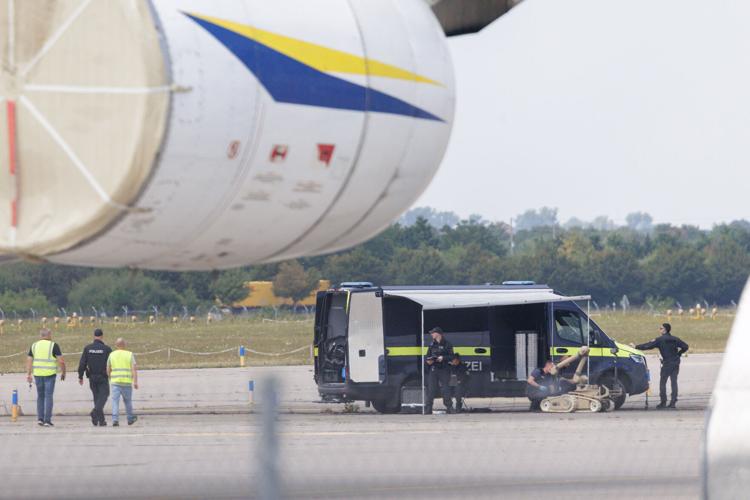
Police investigators work on the tarmac with a robot that is capable, among other things, of defusing explosives, near to a Ukrainian Antonov cargo plane Aug. 5 at Leipzig/Halle Airport near Leipzig, Germany.
On Thursday, Russia warned that it could strike British military targets inside and outside Ukraine in response to Ukrainian attacks on targets inside Russia using long-range British cruise missiles.
European officials have been anticipating for months that Russia may escalate its aggressive campaign against the continent. But the bloc has yet to change its fundamentally defensive posture, according to people familiar with how the institutions gauge outside threats, who spoke on condition of anonymity.
That has likely encouraged Moscow to probe how far it can go in trying to intimidate and wear down western allies as it remains locked in a war of attrition with Ukraine.
“NATO, European and national responses have largely been reactive and defensive,” said Agnia Grigas, a non-resident fellow at the Atlantic Council in Vilnius. “They have focused on detecting and countering individual provocations, but have not built a record of effective deterrence by consistently dissuading Moscow from continuing or escalating them.”
That lack of preparedness comes as Europe has taken on the primary role in supporting Ukraine with the U.S. shifting away from the continent. While NATO’s mutual defense clause commits member states to help each other in case of an attack, Russia’s alleged actions have so far fallen short of what would trigger such a response.

Moscow has increasingly relied on recruitment via social media to carry out arson or other sabotage attacks, after large-scale expulsions of its diplomats following the invasion of Ukraine.
Two Ukrainian nationals were handed prison sentences in the U.K. in June, after a jury found them guilty of conspiring to commit arson attacks on a car and property linked to then-Prime Minister Keir Starmer. The prosecution said during the trial that one of the perpetrators was recruited online by a Russian-speaking Telegram user.
Lithuanian Prosecutor General Nida Grunskiene said last week that the drone attack in Germany has “links” to an ongoing investigation into an attempt to detonate a parcel on a DHL cargo plane in 2024. Lithuania charged five in the attempted sabotage, allegedly hired by Russia’s military intelligence.
While Germany hasn’t singled out Russia as being behind the armed drone, or the recent discovery of a cache of weapons on the outskirts of Berlin, a slew of investigative media reports pointed the finger at Moscow. It also added to fresh warnings that Europe’s biggest economy must grapple with the new dimensions of asymmetrical risks.

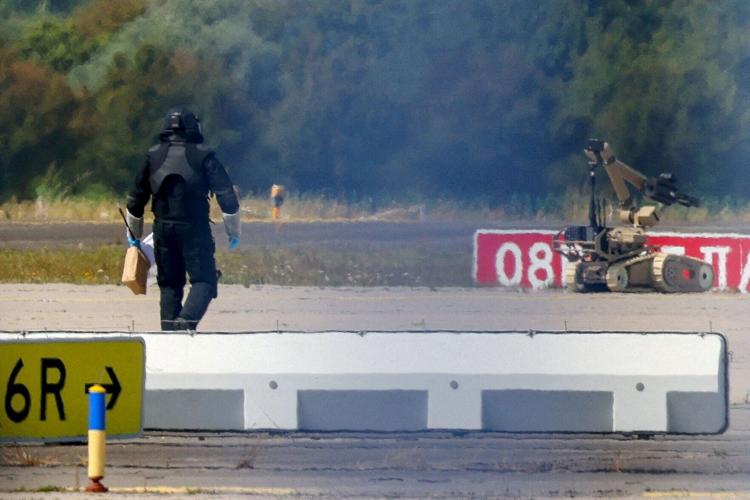
A police officer in protective clothing walks next to an explosive-disarming robot (EOD) Aug. 5 at Leipzig/Halle Airport in Schkeuditz, Germany, after the police said explosives experts examined a drone found near a runway, and after a DHL cargo aircraft hit an unknown object as it was climbing away from the airport overnight, prompting an unscheduled landing in Hanover, according to a source familiar with the incident.
Russian hacker group Server Killers declared a cyber war against Norway in a post on Telegram over the country’s defense cooperation deal with Ukraine, broadcaster TV2 reported Tuesday. A number of Norway’s banking and government websites have been facing disruption from so-called distributed denial of service attacks since Monday, it said.
There are indications that Russian intelligence and security services are looking at hybrid warfare operations against the Baltic States and Poland, an intelligence official told Bloomberg earlier this month. Lithuanian Defense Minister Robertas Kaunas said Moscow is weighing a potential false flag operation using captured Ukrainian drones to strike critical infrastructure in the Baltic region.
“Russia’s ongoing hybrid warfare in Europe is a highly coordinated, sub-threshold campaign aimed at destabilizing Western political systems, fracturing NATO and E.U. unity, and eroding support for Ukraine,” said Alex Kokcharov, geoeconomics analyst at Bloomberg Economics in London. “To achieve these goals, the Kremlin maintains plausible deniability by exploiting anonymity and utilizing proxies to obfuscate direct state attribution.”
Some European Union members have called on the bloc to respond by adopting the sanctions that have been blocked including seizing assets, a ban on transporting Russian liquefied natural gas and restricting visas, according to people familiar with the matter. The E.U. is preparing another package of sanctions on hundreds of individuals and entities, which it aims to adopt in the fall, they said speaking on condition of anonymity.
But as previous such measures have failed to restrain Moscow, it’s unlikely they will do so now.
“Russia is willing to use kinetic means because until now they have been unsuccessful in discouraging support for Ukraine,” said Marek Kohv, head of the Security and Resilience program at the Tallinn-based International Centre for Defense and Security. “It is directly connected to how Russia is doing on the front line.”
NATO members have pledged $80 billion in military aid to Ukraine for 2026 and “at least the equivalent levels” in 2027 at the alliance’s July summit in Ankara. The money is overwhelmingly coming from Europe.

Britain's Prime Minister Andy Burnham greets staff during a visit Wednesday to a Sainsbury’s store in London.
U.K. Prime Minister Andy Burnham handed over cruise missile blueprints to Kyiv in a visit Monday. He also compared Ukraine’s fight to Britain’s resistance to the Nazis in World War II, drawing a response from Kremlin spokesman Dmitry Peskov.
He accused the U.K. of “methodically and regularly adding fuel to the fire” and “methodically and regularly plotting to prevent any progress in the peace process” in his remarks to reporters on Monday.