WASHINGTON — As scandals continue to plague popular online betting platforms, calls to intervene grow louder within Congress.
Controversies last month — from political candidates profiting from their own campaigns to a soldier's alleged bet on a major military operation — prompted a unanimous April 30 decision to change the Senate's rules. Senators and their staff members were banned from trading on prediction markets, where people can buy and sell bets online on future events.
Sen. John Curtis, R-Utah, vowed that it was just the beginning of a new wave of federal scrutiny. Next on the legislative agenda, he said, would be prohibiting all government officials from using insider information to bet on prediction market contracts.
"It should be everybody," Sen. James Lankford, R-Okla., told USA Today. "Starting with members (of Congress)."
People are also reading…
Arkansas Rep. French Hill, the Republican chairman of his chamber's Financial Services Committee, said the House of Representatives is looking at prohibitions for its lawmakers similar to what the Senate passed. He expects the executive branch to review its rules, too.

Scandals involving online prediction markets Kalshi and Polymarket have ramped up pressure on Congress to act.
Bills were introduced in recent months seeking to rein in the platforms, yet a complicated legal and political landscape lies ahead.
States and tribal governments are in an ongoing battle with a federal agency about who has the primary authority to regulate the entities. Congress, hampered by GOP infighting, struggled lately to do even basic legislating — let alone add more to its plate. And President Donald Trump's complicated ties to the industry won't make pursuing regulatory efforts easier.
Still, Sen. Richard Blumenthal, D-Conn., said there's a "good chance" Congress will get more involved on the issue. "Prediction markets cry out for some kind of legislative intervention," he said.
Spokespeople for Kalshi and Polymarket, the two biggest prediction markets, pointed to online statements in support of banning lawmakers from insider trading on their platforms, which they said is already prohibited.
Polymarket technically prohibits Americans from using its main platform, but many users find creative ways to appear online as if they're outside the United States, which presented a big problem for federal regulators.
A rocky month for prediction markets
In the first week of April, Polymarket was forced to publicly apologize for allowing users to place bets on the fates of two U.S. pilots after their jet crashed in Iran. Rep. Seth Moulton, D-Mass., who first brought attention to the incident on social media, called it "disgusting."
On April 22, Kalshi fined and suspended three political candidates from its platform for trying to gain financially from their own primary campaigns. One of the candidates, Virginia's Mark Moran, said he bet on himself jumping in the race for Senate because he wanted to get caught and expose how Kalshi is "rife with corruption."
A day later, the Department of Justice accused an Army soldier of illegally profiting off the capture of ousted Venezuelan President Nicolás Maduro. The soldier, Gannon Ken Van Dyke, participated in the planning for Maduro's capture and allegedly made more than $400,000 by betting on the timing of the operation. He pleaded not guilty to insider trading charges.
The incident was a "definite national security threat," said Blumenthal, a Marine Corps veteran.

Regulatory fight
One of the biggest barriers to further regulating prediction markets is a fight over who has power over them.
The federal government says it's the Commodity Futures Trading Commission. The CFTC typically has a bipartisan five-person commission, but in a historic shift since Trump's return to the White House, it has only one: a chairman named Michael Selig.
Though Selig said he's committed to preventing insider trading, his tone toward prediction markets was less than aggressive. "We’re not a merit policeman that picks and chooses which contracts people should or should not be able to trade," he said recently.
States and tribal governments seek to take enforcement actions against prediction markets. They became involved in dozens of lawsuits against the CFTC since last year, arguing they have authority over platforms that, in their view, are essentially forms of gambling.
The high-stakes questions at the center of the swarm of litigation ultimately may end up before the Supreme Court.

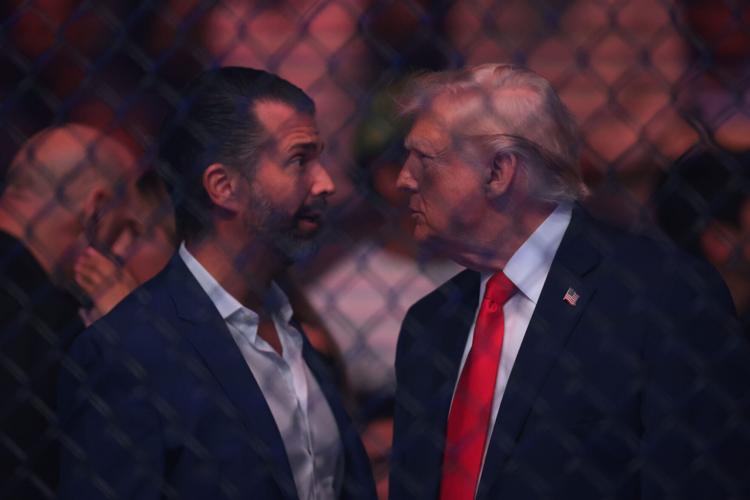
President Donald Trump is seen talking with Donald Trump Jr. during an April 11 UFC fight.
The Trump factor
Trump's close connections to the industry also muddles efforts in Congress to crack down on prediction markets.
While Trump said he's "not happy with any of that stuff," his own son, Donald Trump Jr., served as an adviser to Kalshi and Polymarket. Truth Social, the president's social media company, even launched a feature last year called Truth Predict.
All those ties don't seem to have blinded the president to the online betting world's ills, which he lamented recently to reporters.
"The whole world, unfortunately, has become somewhat of a casino," he said.