WASHINGTON — Republicans in the U.S. Congress revolted over President Donald Trump's $1.776 billion fund for people he says were victims of government "weaponization," setting the stage for a battle ahead of November's midterm elections.
On Thursday, the Senate called timeout on a $72 billion spending bill on immigration enforcement, which became a battleground over the "anti-weaponization" fund, after many Republican senators demanded it either be killed or subjected to tough guardrails.
Democrats also pledged to use the immigration bill to attack the fund.
A day earlier, Senate Majority Leader John Thune blocked $1 billion in federal funding for the White House ballroom that Trump already began to build. He said he did not have the Republican votes for it.

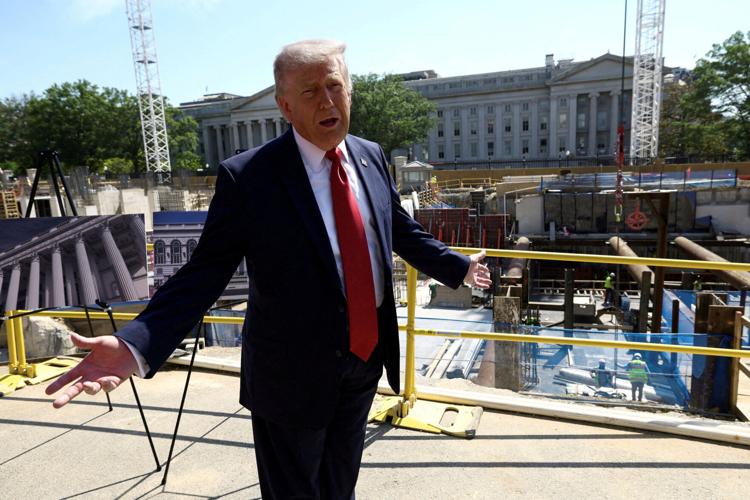
President Donald Trump gestures Tuesday at the site of ballroom construction at the White House in Washington.
On Friday, Trump shot back.
People are also reading…
"I am helping others, who were so badly abused by an evil, corrupt, and weaponized Biden Administration, receive, at long last, JUSTICE!" the president wrote on social media.
This battle between the president and his party, stoked by recent primary election victories of Trump-endorsed challengers over sitting lawmakers, threatens to intensify when Congress returns from recess next month, and could reverberate into the November midterms.
"The American people are going to reject this out of hand," Sen. Thom Tillis, R-N.C., said of the anti-weaponization fund, whose beneficiaries could include those convicted in the Jan. 6, 2021, attack on the Capitol.
While many Republican senators were uncharacteristically mum coming out of a Thursday meeting on the spending bill, Tillis and others were clear on just how politically unpalatable Trump's demands became.

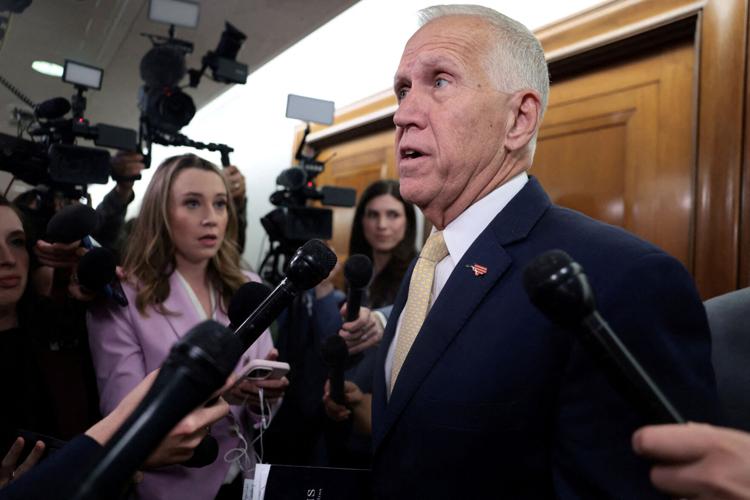
Sen. Thom Tillis, R-N.C., speaks to the media April 21 on Capitol Hill in Washington.
The fund "could potentially compensate someone who assaulted a police officer, admitted their guilt, got convicted, got pardoned and now we're going to pay them for that? That's absurd," Tillis, who is not running for reelection, said in a Thursday interview with Spectrum News.
Rep. Brian Fitzpatrick, R-Pa., who faces a tough reelection battle, teamed up with Rep. Tom Suozzi, D-N.Y., on legislation to prohibit the payment of claims submitted to the fund.
Retiring Rep. Don Bacon, R-Neb., said the ballroom and anti-weaponization funds in the immigration spending bill became "poison pills" for House Republicans who face tough reelection campaigns.
With Republicans holding only slim majorities in both houses of Congress, it would take only a handful of defiant lawmakers to defeat Trump's proposals.
But skepticism runs deep that congressional Republicans — loyal to the president on matters from tariffs to spending cuts to the Iran war — are ready to break ranks.

"We've heard this talk for 10 years now of rebellion and cracks in the coalition. It has never happened," said Doug Heye, a longtime Republican strategist.
He said Republicans are "constantly capitulating" on matters important to Trump, and a revolt would be "light years" away.
Many of Trump's backers in Congress, including Republican Reps. Abraham Hamadeh of Arizona and John Rose of Tennessee, defended him.
"Not a single congressional Republican was elected to oppose President Trump," Hamadeh posted on social media, adding: "Yet an insurgency is already brewing" in the Senate. "STOP slamming the brakes on the America First agenda."
Peter Ticktin, an attorney representing more than 400 Jan. 6 defendants, said he was confident his clients will receive payouts despite congressional pushback.
"They're fools if they think this is going to work," Ticktin said of Senate Republicans who oppose the fund. "It's still going to go through, and those opposing the fund will suffer in future elections."

Democrats, while largely powerless as the minority party in both houses of Congress, seized on what they see as the president's politically tone-deaf proposals.
They contrasted the plight of U.S. consumers, who are struggling to pay their bills amid inflation, with Trump's lavish ballroom plans and the large sums of government money he might direct to the Jan. 6 rioters or other allies.
"Is it possible on May 21, 2026, Republicans finally found an ethical bridge too far?" Sen. Dick Durbin, D-Ill., said at a Thursday news conference.
Senate Democratic Leader Chuck Schumer of New York on Thursday portrayed Republicans as in the throes of a "meltdown" over the ballroom and what they call a Trump "slush fund."

People walk past a digital billboard — paid for by Home of the Brave — about U.S. President Trump, the White House ballroom and gas prices Monday in Times Square, New York City.
One possibility for congressional Republicans after they return from recess June 1 is to seek some sort of middle ground.
One source familiar with the maneuverings, who asked not to be identified, said there are discussions about proposed guardrails on the fund, such as standards for who would serve on a commission overseeing it, or requiring judicial review of it.
At the very least, Democrats likely will do what they can to force their opponents to cast politically difficult votes on amendments to the spending bill.
Sen. Chris Coons, D-Del., told reporters he drafted 13 such amendments. One would bar payments to Jan. 6 rioters who assaulted law enforcement at the Capitol, while others would prohibit the use of taxpayer money to make payments, and require all payments to be made public if the fund survives, a spokesperson for the senator said.