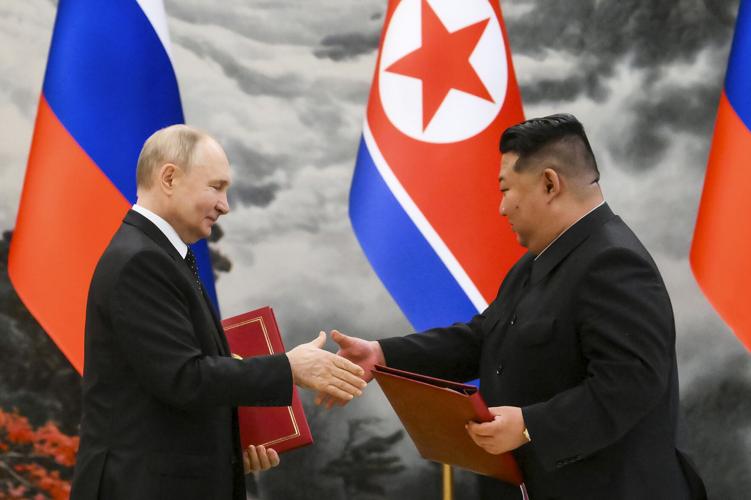
HANOI, Vietnam — Russian President Vladimir Putin and North Korean leader Kim Jong Un signed an agreement Wednesday that pledges mutual aid if either country faces "aggression," a strategic pact that comes as both face escalating standoffs with the West.
Details of the deal were not immediately clear, but it could mark the strongest connection between Moscow and Pyongyang since the end of the Cold War. Both leaders described it as a major upgrade of their relations, covering security, trade, investment, cultural and humanitarian ties.

Russian President Vladimir Putin, left, and North Korea's leader Kim Jong Un exchange documents Wednesday during a signing ceremony of a new partnership in Pyongyang, North Korea.
The summit came as Putin visited North Korea for the first time in 24 years and the U.S. and its allies expressed growing concerns over a possible arms arrangement in which Pyongyang provides Moscow with badly needed munitions for its war in Ukraine in exchange for economic assistance and technology transfers that could enhance the threat posed by Kim's nuclear weapons and missile program.
People are also reading…
From North Korea, Putin traveled to Vietnam. In Hanoi, Putin was scheduled to meet with Vietnam’s most powerful politician, Communist Party General Secretary Nguyen Phu Trong, and new President To Lam, as the Russian leader seeks to strengthen ties with a longtime partner.
During Putin's visit to North Korea, Kim said the two countries had a "fiery friendship," and that the deal was their "strongest ever treaty," putting the relationship at the level of an alliance. He vowed full support for Russia's war in Ukraine.
Putin called it a "breakthrough document" reflecting shared desires to move relations to a higher level.
North Korea and the former Soviet Union signed a treaty in 1961 that experts say necessitated Moscow's military intervention if the North came under attack. The deal was discarded after the collapse of the USSR, replaced by one in 2000 that offered weaker security assurances.

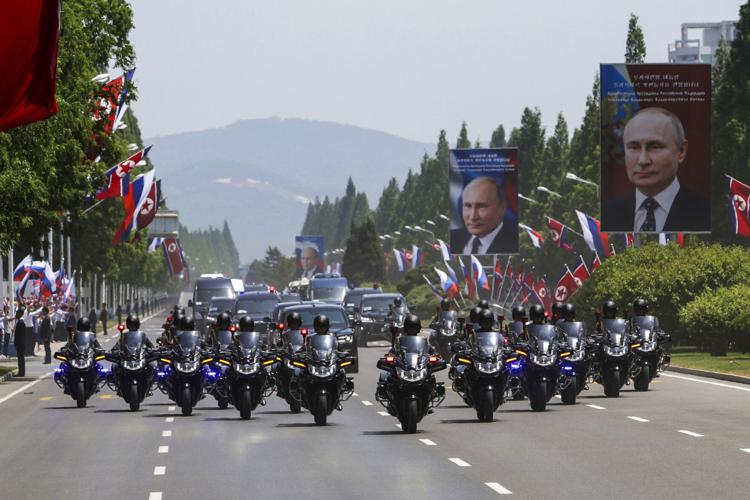
A motorcade with Russian President Vladimir Putin drives Wednesday along a street in Pyongyang, North Korea.
The North’s official Korean Central News Agency on Thursday reported the language of the comprehensive strategic partnership agreement. The agency said Article 4 of the agreement states that if one of the countries gets invaded and is pushed into a state of war, the other must deploy “all means at its disposal without delay” to provide “military and other assistance.”
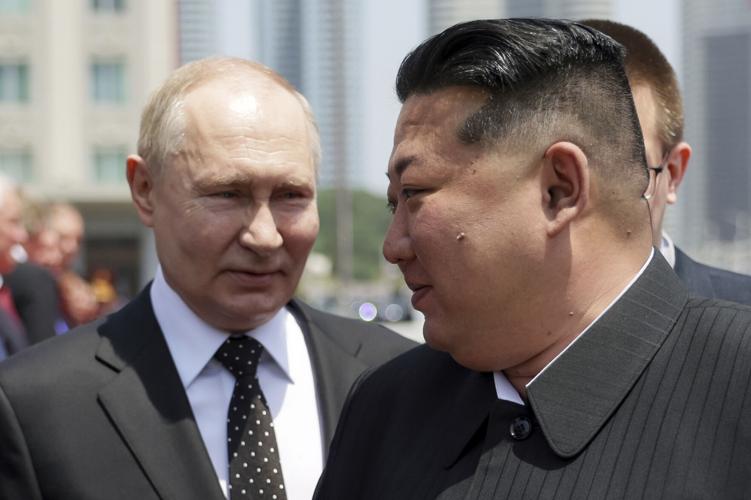
Kim met Putin at the airport, where the two shook hands, hugged twice and rode together in a limousine. The huge motorcade rolled through the capital's brightly lit streets, where buildings were decorated with giant Russian flags and portraits of Putin.
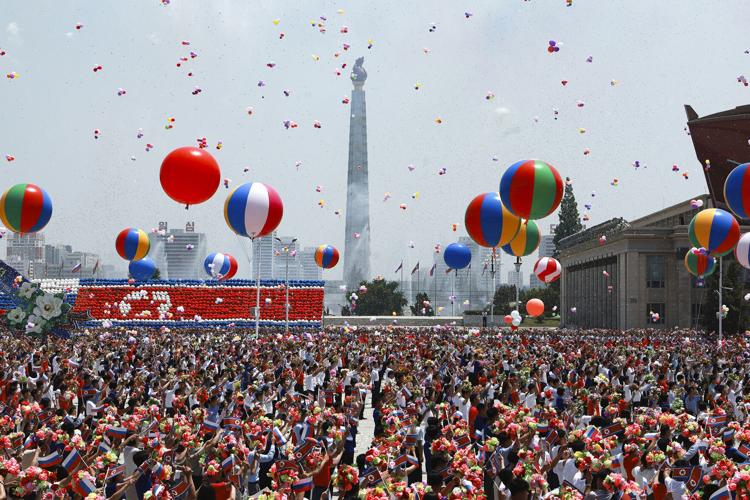
After spending the night at a state guest house, Putin was welcomed Wednesday morning in a ceremony at the city's main square, filled with what appeared to be tens of thousands of spectators, including children with balloons and people in coordinated T-shirts of the red, white and blue national colors of both countries. Crowds lining the streets chanted "Welcome Putin," and waved flowers and flags.
Putin and Kim saluted an honor guard and walked across a red carpet. Kim introduced key members of his leadership, including Foreign Minister Choe Son Hui; top aide and ruling party secretary Jo Yong Won; and the leader's powerful sister, Kim Yo Jong.
At their talks, Putin thanked Kim for North Korea's support in Ukraine, part of what he said was a "fight against the imperialist hegemonistic policies of the U.S. and its satellites against the Russian Federation."

Russian President Vladimir Putin, left, and North Korea's leader Kim Jong Un attend an official welcome ceremony Wednesday in in Pyongyang, North Korea.
Putin praised ties that he traced to the Soviet army fighting the Japanese military on the Korean Peninsula at the end of World War II, and Moscow's support for Pyongyang during the Korean War.
What kind of support was pledged in the agreement was not spelled out. Explanations of the agreement by the leaders did not specify what the "mutual assistance" would be in the event of aggression against either country — troops, materiel or some other sort of aid.
Kim has used similar language before, consistently saying North Korea supports what he describes as a just action to protect Russia's interests and blaming the crisis on the West's "hegemonic policy."
North Korea is under heavy U.N. Security Council sanctions over its weapons program, while Russia also faces sanctions by the U.S. and its Western partners over its invasion of Ukraine.
U.S. and South Korean officials accuse the North of providing Russia with artillery, missiles and other military equipment for use in Ukraine, possibly in return for key military technologies and aid.

North Koreans attend the official welcome ceremony with Russian President Vladimir Putin and North Korea's leader Kim Jong Un on Wednesday in Pyongyang, North Korea.
On Tuesday, a U.S. State Department spokesman said that in recent months, Washington has seen North Korea "unlawfully transfer dozens of ballistic missiles and over 11,000 containers of munitions to aid Russia's war effort."
Both Pyongyang and Moscow deny accusations of weapons transfers, which would violate multiple U.N. Security Council sanctions that Russia previously endorsed.
Along with China, Russia has provided political cover for Kim's efforts to advance his nuclear arsenal, repeatedly blocking U.S.-led efforts to impose fresh U.N. sanctions on the North over its weapons tests.
In Washington, U.S. Secretary of State Antony Blinken said Putin's visit illustrates how Russia tries, "in desperation, to develop and to strengthen relations with countries that can provide it with what it needs to continue the war of aggression that it started against Ukraine."
Photos: Scenes of Russia's economy since war in Ukraine

FILE - People are seen through a window inside a restaurant at Patriarshiye Prudy with the word on the wall reads "Patriki" which means Patriarch's Ponds, a hip restaurants and bars district in Moscow, Russia, on Feb. 10, 2023. Russia has weathered sweeping Western economic sanctions better than many expected. Economic life for everyday Russians hasn't changed that much, with familiar imported goods either still available or replaced by local knockoffs. (AP Photo/Alexander Zemlianichenko, File)

FILE - The tanker Sun Arrows loads its cargo of liquefied natural gas from the Sakhalin-2 project in the port of Prigorodnoye, Russia, on Oct. 29, 2021. After a year of far-reaching sanctions aimed at degrading Moscow's war chest, economic life for ordinary Russians doesn't look all that different than it did before the invasion of Ukraine. But with restrictions finally tightening on the Kremlin's chief moneymaker — oil — the months ahead will be an even tougher test of President Vladimir Putin's fortress economy. (AP Photo, File)

FILE - A view of the business tower Lakhta Centre, the headquarters of Russian gas monopoly Gazprom in St. Petersburg, Russia, on April 27, 2022. After a year of far-reaching sanctions aimed at degrading Moscow's war chest, economic life for ordinary Russians doesn't look all that different than it did before the invasion of Ukraine. But with restrictions finally tightening on the Kremlin's chief moneymaker — oil — the months ahead will be an even tougher test of President Vladimir Putin's fortress economy. (AP Photo, File)

FILE - An oil tanker is moored at the Sheskharis complex, part of Chernomortransneft JSC, a subsidiary of Transneft PJSC, in Novorossiysk, Russia, on Oct. 11, 2022, one of the largest facilities for oil and petroleum products in southern Russia. After a year of far-reaching sanctions aimed at degrading Moscow's war chest, economic life for ordinary Russians doesn't look all that different than it did before the invasion of Ukraine. (AP Photo, File)

FILE - Russian state-run Sberbank headquarters in downtown Moscow, Russia on July 29, 2014. After a year of far-reaching sanctions aimed at degrading Moscow's war chest, economic life for ordinary Russians doesn't look all that different than it did before the invasion of Ukraine. But with restrictions finally tightening on the Kremlin's chief moneymaker — oil — the months ahead will be an even tougher test of President Vladimir Putin's fortress economy. (AP Photo/Ivan Sekretarev, File)

FILE - People line up to visit a newly opened restaurant in a former McDonald's outlet in Bolshaya Bronnaya Street in Moscow, Russia, on Jan. 25, 2023. Crowds might have thinned at some Moscow malls, but not drastically. Some foreign companies like McDonald's and Starbucks have been taken over by local owners who slapped different names on essentially the same menu. (AP Photo/Alexander Zemlianichenko, File)

FILE - People wait in a line to pay for her purchases at the IKEA store on the outskirts of Moscow, Russia, on March 3, 2022. Furniture and home goods remaining after IKEA exited Russia are being sold off on the Yandex website. (AP Photo, File)

FILE - Russian President Vladimir Putin gestures while speaking at a news conference following a meeting of the State Council at the Kremlin in Moscow, Russia on Dec. 22, 2022. Russia's economy has weathered the West's unprecedented economic sanctions far better than expected. But with restrictions finally tightening on the Kremlin's chief moneymaker — oil — the months ahead will be an even tougher test of President Vladimir Putin's fortress economy. (Sergey Guneyev, Sputnik, Kremlin Pool Photo via AP, File)

FILE - Deputy Chairman of the Russian Security Council Dmitry Medvedev, second left, accompanied by Russian Presidential Envoy to Ural Federal District Vladimir Yakushev, left, visits the Uralvagonzavod factory in Nizhny Tagil in Nizhny Tagil, Russia, on Oct. 24, 2022. Russia has weathered sweeping Western economic sanctions better than many expected. (Ekaterina Shtukina, Sputnik, Government Pool Photo via AP, File)

A view of the Audi Center Altufievo one of 36 dealerships of Avtodom in Moscow, St. Petersburg and Krasnodar, in Moscow, Russia, Friday, March 10, 2023. The auto industry is facing bigger hurdles to adapt. Western automakers, including Volkswagen and Mercedes-Benz, have left Russia. Foreign cars are still available but far fewer of them and for higher prices, said Andrei Olkhovsky, CEO of Avtodom, which has 36 dealerships in Moscow, St. Petersburg and Krasnodar. (AP Photo/Alexander Zemlianichenko)

People walk past a Sviaznoy mobile phone shop in a shopping mall in St. Petersburg, Russia, Friday, March 10, 2023. Apple has stopped selling products in Russia, but Wildberries, the country's biggest online retailer, offers the iPhone 14 for about the same price as in Europe. Online retailer Svaznoy lists Apple AirPods Pro. (AP Photo)

FILE - Few visitors pass inside the GUM department store with lots of boutiques closed due to sanctions in Moscow, Russia, on June 1, 2022. U.S. officials say Russia is now the most sanctioned country in the world. But as the war nears its one-year mark, it's clear the sanctions didn't pack the instantaneous punch that many had hoped. (AP Photo/Alexander Zemlianichenko, File)

New made "Moskvich" cars are seen at the assembly shop of Moscow Automobile Plant "Moskvich" with the banner reads: "Moskvich (Muscovite) returns" in Moscow, Russia, Wednesday, Nov. 23, 2022. The auto industry is facing bigger hurdles to adapt. Russia launched production of the Moskvich car brand at a plant near Moscow given up by the French carmaker Renault, with a new, modern Chinese design that barely resembles the Soviet-era classic. (Kirill Zykov, Moscow News Agency via AP)

FILE - Employees of the Almaz-Antey Corporation's Obukhov Plant work at its assembly shop in St. Petersburg, Russia, on Jan. 18, 2023. After a year of far-reaching sanctions aimed at degrading Moscow's war chest, economic life for ordinary Russians doesn't look all that different than it did before the invasion of Ukraine. The boon helped bolster the ruble after a temporary post-invasion crash and provided cash for government spending on pensions, salaries and — above all — the military. (Ilya Pitalev, Sputnik, Kremlin Pool Photo via AP, File)

A view of the Dealership Mercedes-Benz "Avilon" in Moscow, Russia, Saturday, March 11, 2023. The auto industry is facing bigger hurdles to adapt. Western automakers, including Volkswagen and Mercedes-Benz, have left Russia, but foreign cars are still available but far fewer of them and for higher prices. (AP Photo/Dmitry Serebryakov)

FILE - Newly built nuclear-powered icebreaker Ural, third of five icebreakers of Project 22220, begins its passage from the Baltiysky Shipyard to the northern city of Murmansk, in St. Petersburg, Russia, on Nov. 23, 2022. After a year of far-reaching sanctions aimed at degrading Moscow's war chest, economic life for ordinary Russians doesn't look all that different than it did before the invasion of Ukraine. But with restrictions finally tightening on the Kremlin's chief moneymaker — oil — the months ahead will be an even tougher test of President Vladimir Putin's fortress economy. (AP Photo/Dmitri Lovetsky, File)

FILE - A logo of a newly opened Stars Coffee in the former location of a Starbucks in Moscow, Russia, on Jan. 24, 2023. Crowds might have thinned at some Moscow malls, but not drastically. Some foreign companies like McDonald's and Starbucks have been taken over by local owners who slapped different names on essentially the same menu. (AP Photo/Alexander Zemlianichenko, File)

FILE - New vehicles Gazelle are parked in the territory of the Gorky Automobile plant (GAZ), one of the main budget-forming enterprises in the region in Nizhny Novgorod, Russia, on Aug. 11, 2022. After a year of far-reaching sanctions aimed at degrading Moscow's war chest, economic life for ordinary Russians doesn't look all that different than it did before the invasion of Ukraine. But with restrictions finally tightening on the Kremlin's chief moneymaker — oil — the months ahead will be an even tougher test of President Vladimir Putin's fortress economy. (AP Photo, File)

FILE - People line up to enter an H&M shop and buy items on sale in the Aviapark shopping mall in Moscow, Russia, on Aug. 9, 2022. Russians are snapping up While 191 foreign companies have left Russia and 1,169 are working to do so, some 1,223 are staying and 496 are taking a wait-and-see approach, according to a database compiled by the Kyiv School of Economics. (AP Photo/Alexander Zemlianichenko, File)

FILE - Men walk at the Nokian Tyres tire manufacturing plant in Vsevolozhsk, outside St. Petersburg, Russia, on June 29, 2022. Russia's economy has weathered the West's unprecedented economic sanctions far better than expected. But with restrictions finally tightening on the Kremlin's chief moneymaker — oil — the months ahead will be an even tougher test of President Vladimir Putin's fortress economy. (AP Photo/Dmitri Lovetsky, File)