CHICAGO — The secretary of the Smithsonian Institution announced Tuesday that he will retire after months of accusations from the Trump administration that the national museums he’s led portrayed a skewed and divisive version of the United States.
Historian, curator and author Lonnie Bunch has led the Smithsonian — 21 museums and galleries, 21 libraries, the National Zoo, and a number of research and education centers — as its secretary since 2019. He is expected to step down by the end of the year.

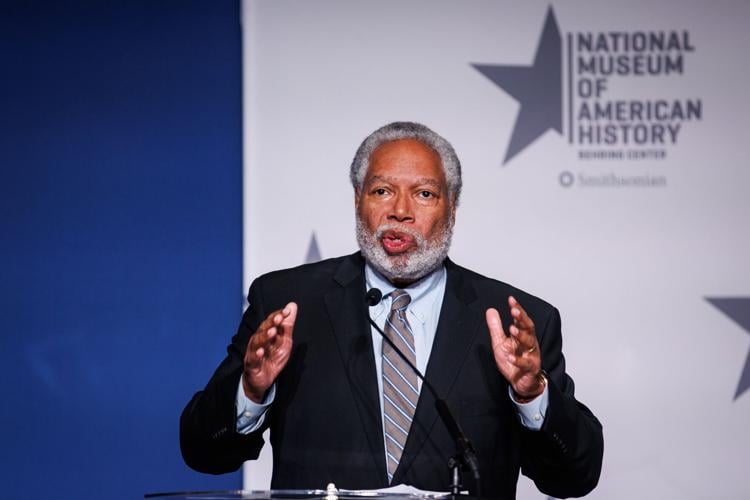
Secretary of the Smithsonian Institute Lonnie Bunch speaks Feb. 20 during the presentation of U.S. First Lady Melania Trump’s 2025 inaugural gown to the Smithsonian at the National Museum of American History in Washington.
“It is time for my next chapter, a chapter that will allow me to continue to protect the integrity of the Smithsonian and to champion the importance of a history that illuminates and celebrates the complex story of our nation,” he said in a statement.
Bunch, the Smithsonian's first Black leader, took the top role after developing and opening the Smithsonian's popular National Museum of African American History and Culture, which was vilified by President Donald Trump and long targeted by conservatives. Bunch also held positions at the institution's National Museum of American History.
People are also reading…
The Trump administration steadily increased pressure on Bunch and the Smithsonian in what critics fear is part of a broader campaign to tell America's story from a conservative and even white supremacist point of view.

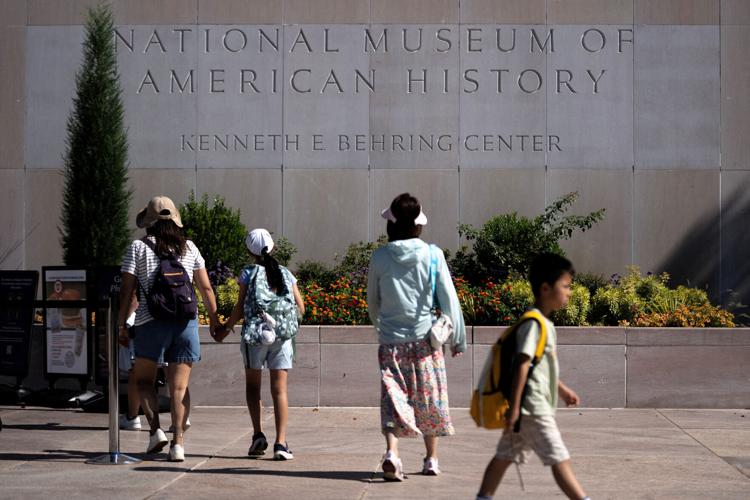
Visitors arrive July 30 at the Smithsonian National Museum of American History in Washington.
On July 4, the 250th anniversary of the Declaration of Independence, the White House posted on its website a report by its Domestic Policy Council that suggested "it would benefit most Americans, especially parents bringing their children for a tour, if the Smithsonian’s flagship history museum had a label at every entrance that reads: 'Warning: the exhibits in this museum were prepared by people who don’t want you to love your country.'”
Bunch sent a memo to his staff a few days after the report was released saying, "while there will always be room for improvement, this report is not a fair characterization of the work and totality of the National Museum of American History."
Trump wrote on social media that the "Smithsonian is OUT OF CONTROL, where everything discussed is how horrible our Country is, how bad Slavery was, and how unaccomplished the downtrodden have been — Nothing about Success, nothing about Brightness, nothing about the Future."

The New York Times said Tuesday that Bunch said in an interview that the pressure from the White House had not led to his departure. Still, he acknowledged the strain of the role.
“And at a certain point, I’d like to wake up in the morning and not look at my cellphone,” he told the Times.
Historian David Blight, head of the Gilder Lehrman Center for the Study of Slavery, Resistance, and Abolition at Yale University, described Bunch as an "indispensable voice in our collective defense of the historical crafts under attack from the Trump administration."
"Lonnie has been a leader like no other in this fight and it is far from over," Blight said.
John Dichtl, president and CEO of the American Association for State and Local History, said Bunch "knew when to fight and he knew when to give in and move on and survive to fight another day."

In an essay marking the 250th anniversary in the Smithsonian Institution's flagship magazine, Bunch did not shy from stances that Trump made controversial, including lauding the contributions to the nation made by immigrants and by those who arrived enslaved and their descendants. He said the latter two saw in the U.S. "the potential to eventually become the land of freedom."
"An incomplete telling of our past, with rough edges smoothed, inhibits the country’s ability to forge a better shared future," Bunch wrote.
Trump announced in May 2025 that he would fire Kim Sajet, the first woman to direct the Smithsonian's National Portrait Gallery, accusing her of supporting diversity, equity and inclusion efforts. It was unclear whether Trump had the legal authority to fire her. Sajet resigned the next month.

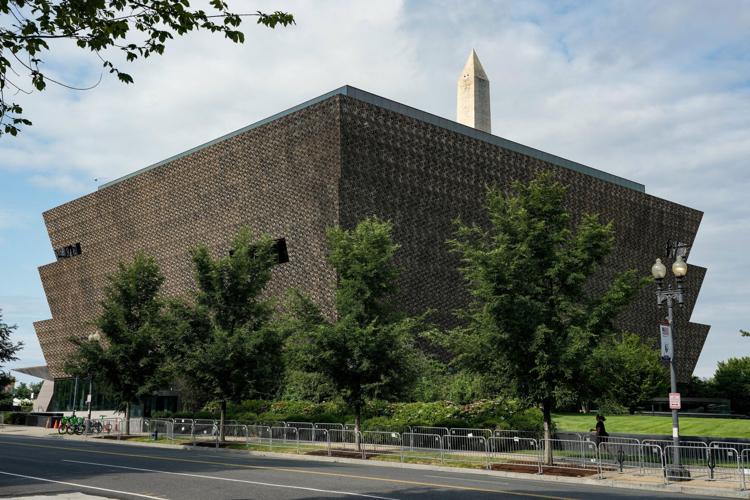
The Smithsonian National Museum of African American History & Culture is seen July 25 in Washington.
Trump signed an executive order in March directing Vice President JD Vance, who sits on the Smithsonian's board of regents, to remove "improper, divisive or anti-American ideology" from the Smithsonian Institution. The order singled out the National Museum of African American History and Culture.
Conservatives depicted museums with an ethnic lens as inherently divisive.
In a memoir about developing the African American history museum, Bunch said his goal was a museum about African Americans that would help all Americans understand they had a shared if fraught history and common hopes for a better future.