Multiple times during Donald Trump's second presidency, Congress debated his military authority, first in Latin America and now the Middle East.
The latest tests came Wednesday and Thursday, when the GOP-controlled Senate and House voted down a Democratic measure to limit Trump, at least theoretically, in the U.S.-Israeli war against Iran.
Like many predecessors, Trump claims broad power over U.S. forces. He approved boat strikes near Venezuela, established a naval blockade and authorized a military operation to arrest and depose its leader, Nicolás Maduro — all arguable acts of war under international law. He made noise about additional action in Greenland and Latin America, before launching a sweeping bombing campaign in Iran.
Under the Constitution, the military reports to the president but the document grants oversight roles to Congress. Trump says he won't sign anything limiting his options — proof for some experts that control over a civilian-led military skewed from its original design.
People are also reading…
"The Constitution gives war powers to two different branches of government," said military historian Peter Mansoor, an Ohio State University professor and retired U.S. Army colonel. "The pendulum has swung towards the executive," he lamented, arguing, "the framers meant for Congress to be the most powerful branch."
The US Senate failed to advance a resolution to limit US President Donald Trump’s authority to take military action in Iran, while US-Israeli strikes continue in the region. The War Powers Resolution was rejected in a 53-47 party-line vote. If passed, it would have halted US military action in Iran without congressional approval. Most Republicans opposed the measure, but some indicated that they may reconsider if the war escalates in the coming weeks. Nearly all senators voted along party lines, except for Democratic Senator John Fetterman, who opposed the measure, and Republican Senator Rand Paul, who supported it. The failed vote undermines Democrats’ attempts to limit the conflict early and reinforce Congress’s authority over war decisions. Supporters of the resolution argued that Trump exceeded his constitutional authority by initiating military action alongside Israel. Under Article II of the US Constitution, presidents may launch such attacks only in self-defense in response to an immediate threat; otherwise, Congress has the sole power to declare war. As the war rages on, so too does uncertainty about its end date, with Defense Secretary Pete Hegseth saying it could last eight weeks.
What the Constitution says
Article I, which established Congress, states lawmakers "shall have power … to declare war." Article II, which established the presidency, makes the chief executive the "commander in chief of the Army and Navy." The Constitution also gives Congress authority over military budgets.
Congress has not declared an official state of war since World War II. Yet since 1945, U.S. service members fought and died in full-scale conflicts in Korea, Vietnam, Iraq and Afghanistan, among others.
In the Maduro mission, an Army pilot was injured, leading Trump to award him the Medal of Honor — recognition legally restricted to actions taken when fighting a foreign enemy. As of Wednesday, six U.S. service members died in the Iran war.
During Senate debate last month on Venezuela, Sen. Rand Paul, R-Ky., said it's "an absurdity" to argue that Trump's actions were anything other than waging war.
Sen. Tim Kaine, the Virginia Democrat who sponsored Venezuela and Iran war powers resolutions, said the latest version — which failed 47-53 — would prevent a presidential "end-run around the Constitution."

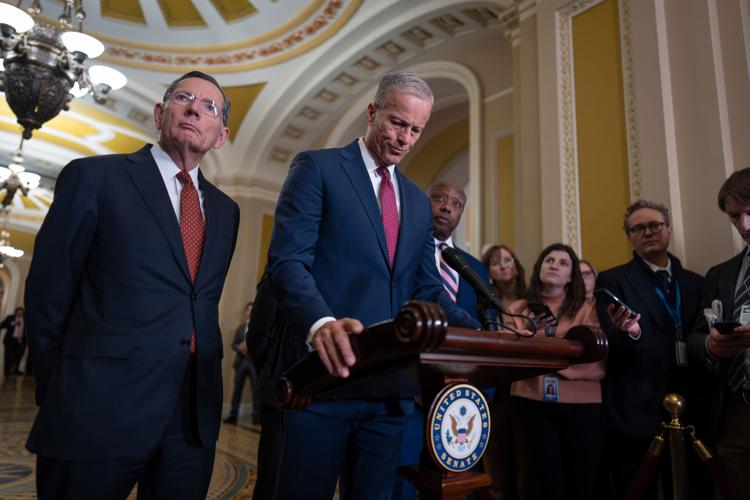
Senate Majority Leader John Thune, R-S.D., center, joined at left by Sen. John Barrasso, R-Wyo., the GOP whip, speaks to reporters Tuesday at the Capitol in Washington.
Declarations of war
Congress declared war against 11 nations across across five wars. Three declarations came in the 19th century, two during World War I and six during World War II. Each time, the president formally asked Congress to act, citing a specific attack on the U.S. or another national interest.
President James K. Polk asked even for the Mexican War, which was principally about expanding U.S. territory.
Over the same span, Congress voted many times to authorize force without declaring war. Early measures were usually for specific naval actions defending U.S. commercial interests. Congress first took this route in 1798; it became a roadmap for the post-World War II era.

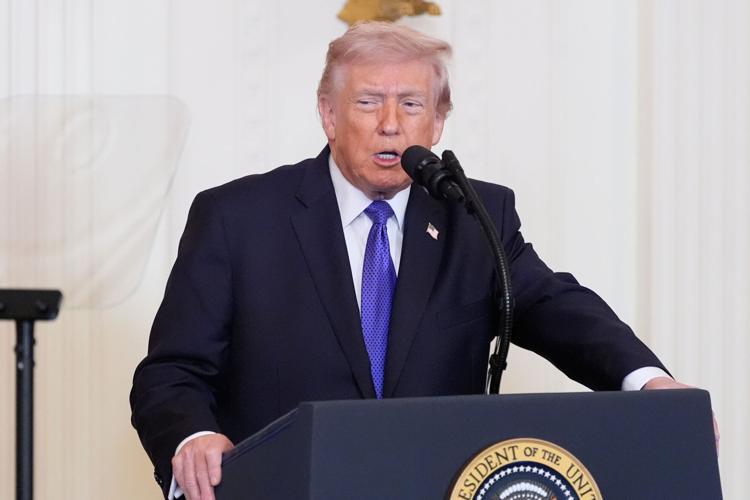
President Donald Trump speaks about Iran before a Medal of Honor ceremony Monday in the East Room of the White House in Washington.
Turn toward presidential power
President Harry Truman won World War II under declarations issued while Franklin Roosevelt was president. Then, in 1950, the fledgling United Nations voted to act in Korea and asked member nations to assist.
Citing the U.N., Truman engaged U.S. troops in a so-called "police action" without seeking lawmakers' approval. Congress that year approved the Defense Production Act to mobilize U.S. war capacity as an after-the-fact endorsement of Truman's decision, and the law remains a potential Pentagon tool.
Presidents from Dwight Eisenhower to Gerald Ford presided over "the Vietnam conflict" as U.S. administrations expanded southeast Asia operations.

Lyndon Johnson persuaded Congress to pass the Gulf of Tonkin Resolution in 1964 and used that to accelerate U.S. involvement. As U.S. deaths rose, the war grew unpopular, but Johnson — then Richard Nixon — had broad authority from lawmakers. Congress repealed the measure in 1971, but Nixon did not withdraw.
Mansoor said war declarations don't just define the start of a war. They also effectively require an official end — which triggers the Senate's role in ratifying peace treaties. Sidestepping those legal bookends, Mansoor said, is "how you get in these forever wars."

War Powers Act
In 1973, Congress passed the War Powers Resolution, intending to impose guardrails on presidents by requiring certain communication with lawmakers and allowing Congress to hold votes setting parameters for military action. That was the legislative trigger this year for the failed Venezuela and Iran resolutions.
In 2020, a Democratic-controlled House narrowly adopted a measure intended to curtail Trump's powers against Iran at that point but, in practice, the War Powers Resolution has not served as a functional check on executive power.
Commander in chief role
Ronald Reagan sent troops to Lebanon in 1982 as part of a multinational peacekeeping force. He did not cite the War Powers Resolution when notifying Congress and did not agree to congressional authorization until 1983 — after service members died.
In 1990, George H.W. Bush notified Congress under the War Powers Resolution that he'd dispatched troops to the Middle East after Iraq invaded Kuwait. Bush asked Congress for "support" — as opposed to "authorization" — only after securing U.N. backing for action by an international coalition led by U.S. forces. Congress authorized force in January 1991.
Bill Clinton deployed U.S. troops multiple times — to Somalia, Haiti, Rwanda, Bosnia and Herzegovina, Kosovo and Iraq. He asked Congress for appropriations but not explicit authorizations. When some lawmakers pressed Clinton to seek approval for strikes in Iraq in 1998, Clinton asserted his interpretation of presidential authority — not unlike Trump's arguments.
George W. Bush quickly mobilized the military after terrorist attacks on Sept. 11, 2001. He consulted quickly with Congress, resulting in a joint resolution authorizing sweeping action. It was unique because no specific country was targeted and it initially focused on al-Qaida. Congress nearly unanimously supported the measure but asked for reports every 60 days.
Mansoor noted Bush used the vote to conduct antiterrorism efforts anywhere in the world. Bush returned to Congress in 2002, telling leaders he wanted authorization for action against Iraq.
What Congress passed for Bush had no effective end date. His successor, Barack Obama, inherited troops in Iraq and did not initially withdraw them. Afghanistan carried on through Obama's two terms and Trump's first presidency and into Joe Biden's term.
Biden withdrew U.S. troops from Afghanistan after it had become the longest U.S. war — never declared — in the nation's history.
Photos show US-Israeli strikes and Iran's response

Large fire and plume of smoke is visible after, according to the authorities, debris of an Iranian intercepted drone hit the Fujairah oil facility, in Fujairah, United Arab Emirates, Tuesday, March 3, 2026. (AP Photo/Altaf Qadri)

The sun sets behind a plume of smoke rising after a U.S.–Israeli military strike in Tehran, Iran, Tuesday, March 3, 2026. (AP Photo/Vahid Salemi)

The sun sets behind a plume of smoke rising after a U.S.–Israeli military strike in Tehran, Iran, Tuesday, March 3, 2026. (AP Photo/Vahid Salemi)

An Iranian flag is placed among the ruins of a police station struck Monday during the U.S.–Israeli military campaign in Tehran, Iran, Tuesday, March 3, 2026. (AP Photo/Vahid Salemi)

Residents and officials attend the funeral of people killed in what Iranian officials said was an Israeli-U.S. strike Feb. 28 on a girls' elementary school in Minab, Iran, Tuesday, March 3, 2026. (Abbas Zakeri/Mehr News Agency via AP)

A woman throws rose petals on the coffins during funeral of mostly children killed in what Iranian officials said was an Israeli-U.S. strike Feb. 28 on a girls' elementary school in Minab, Iran, Tuesday, March 3, 2026. (Amirhossein Khorgooei/ISNA via AP)

Coffins holding the bodies of mostly children are prepared for the funeral of those killed in what Iranian officials said was an Israeli-U.S. strike Feb. 28 at a girls' elementary school in Minab, Iran, Tuesday, March 3, 2026. (Amirhossein Khorgooei/ISNA via AP)

A woman crosses almost deserted square with a billboard at rear showing a portrait of the late Iranian Supreme Leader Ayatollah Ali Khamenei, who was killed in the U.S.–Israeli military campaign, in Tehran, Iran, Tuesday, March 3, 2026. (AP Photo/Vahid Salemi)

Large fire and plume of smoke is visible after, according to the authorities, debris of an Iranian intercepted drone hit the Fujairah oil facility, in Fujairah, United Arab Emirates, Tuesday, March 3, 2026. (AP Photo/Altaf Qadri)

Smoke rises on the skyline after an explosion in Tehran, Iran, Saturday, Feb. 28, 2026.(AP Photo)

People watch as smoke rises on the skyline after an explosion in Tehran, Iran, Saturday, Feb. 28, 2026.(AP Photo)

Paramedics evacuate wounded people from the site of a deadly Iranian missile strike in Beit Shemesh, Israel Sunday, March 1, 2026. (AP Photo/Leo Correa)

A black plume of smoke rises from a warehouse at the industrial area of Sharjah City in the United Arab Emirates following reports of Iranian strikes in Dubai, United Arab Emirates, Sunday, March 1, 2026. (AP Photo/Altaf Qadri)

A man walks away after watching as a black plume of smoke rises from a warehouse in the industrial area of Sharjah City, United Arab Emirates, Sunday, March 1, 2026, following reports of Iranian strikes in Dubai. (AP Photo/Altaf Qadri)

Israeli security forces inspect a damaged road after a missile launched from Iran struck Jerusalem, Sunday, March 1, 2026.(AP Photo/Mahmoud Illean)

A man holds an Iranian flag as he looks at the damaged façade of Gandhi Hospital, which was hit Sunday when a strike also struck a state TV communications tower and nearby buildings across the street during the ongoing joint U.S.–Israeli military campaign in Tehran, Iran, Tuesday, March 2, 2026. (AP Photo/Vahid Salemi)

Clerics and other government supporters mourn in a gathering after state TV officially announced the death of Iranian Supreme Leader Ayatollah Ali Khamenei, in Tehran, Iran, Sunday, March 1, 2026. (AP Photo/Vahid Salemi)

Government supporters gather in mourning after state TV officially announced the death of Iranian Supreme Leader Ayatollah Ali Khamenei, in Tehran, Iran, Sunday, March 1, 2026. (AP Photo/Vahid Salemi)

Rescue workers and military personnel survey the scene of a direct hit a day after an Iranian missile struck in Tel Aviv, Israel, Sunday, March 1, 2026. (AP Photo/Oded Balilty)

A plume of smoke rises after a strike in Tehran, Iran, Sunday, March 1, 2026. (AP Photo/Vahid Salemi)

Leah Guttmann holds her son, Teddy, as other people take shelter in an underground parking garage while air-raid sirens warn of incoming missiles launched by Iran toward Tel Aviv, Israel, Sunday, March 1, 2026. (AP Photo/Ohad Zwigenberg)

Rescue workers and military personnel operate at the scene where several people were killed in an Iranian missile strike in Beit Shemesh, Israel Sunday, March 1, 2026. (AP Photo/Leo Correa)

An Israeli rescue personal carries a child after missiles attack from Iran hit in Tel Aviv, Israel, Saturday, Feb. 28, 2026. (AP Photo/Ohad Zwigenberg)

An explosion is seen as an Iranian missile directly hits a building in Tel Aviv, Israel, Saturday, Feb. 28, 2026. (AP Photo/Tomer Neuberg)

Rescue workers bandage a wounded man and provide first aid at the site of a direct hit from an Iranian missile strike in Tel Aviv, Israel, Saturday, Feb. 28, 2026. (AP Photo/Tomer Neuberg)

Firefighters try to extinguish flames in a building after a direct hit by an Iranian missile strike in Tel Aviv, Israel, Saturday, Feb. 28, 2026. (AP Photo/Tomer Neuberg)

Officers from Israel's Home Front Command search through the rubble of a damaged apartment building after an Iranian missile strike, in Tel Aviv, Israel, early Sunday, March 1, 2026. (AP Photo/Ohad Zwigenberg)

Officers from Israel's Home Front Command search through the rubble of a damaged apartment building after an Iranian missile strike in Tel Aviv, Israel, early Sunday, March 1, 2026. (AP Photo/Ohad Zwigenberg)

Government supporters mourn during a gathering after state TV officially announced the death of Iranian Supreme Leader Ayatollah Ali Khamenei, shown in the poster, in Tehran, Iran, Sunday, March 1, 2026. (AP Photo/Vahid Salemi)

Firemen and rescue workers inspect the site of an explosion at the Fairmont The Palm Hotel in Dubai, United Arab Emirates, Saturday, Feb. 28, 2026. (AP Photo/Altaf Qadri)

This image provided by Airbus shows the strike on Iranian Supreme Leader's compound on Saturday, Feb. 28, 2026 in Iran. (Pléiades Neo (c) Airbus DS 2026 via AP)

This image from video provided by U.S. Central Command shows a missile being launched from a U.S. Navy ship in support of Operation Epic Fury on Saturday, Feb. 28, 2026. (U.S. Central Command via AP)

Rescue workers and residents search through the rubble in the aftermath of what Iranian officials said was an Israeli-U.S. strike on a girls' elementary school in Minab, Iran, Saturday, Feb. 28, 2026. (Abbas Zakeri/Mehr News Agency via AP)

A man hold a children's backpack as rescue workers and residents search through the rubble in the aftermath of what Iranian officials said was an Israeli-U.S. strike on a girls' elementary school in Minab, Iran, Saturday, Feb. 28, 2026. (Abbas Zakeri/Mehr News Agency via AP)

Traces of an air defense missile interception are seen, left, over Jerusalem's Old City, Saturday, Feb. 28, 2026. (AP Photo/Mahmoud Illean)

An incoming projectile explodes over the water as Israel issues a nationwide alert following its strikes on Iran, in Haifa Bay, northern Israel, Saturday, Feb. 28, 2026. (AP Photo/Leo Correa)

People rush to take shelter as warning sirens sound following missile fired towards Israel, in Tel Aviv, Israel, Saturday, Feb. 28, 2026. (AP Photo/Ohad Zwigenberg)

People take shelter in an underground metro station as air raid sirens warn of incoming strikes by Iran, in Ramat Gan, Israel, Saturday, Feb. 28, 2026. (AP Photo/Oded Balilty)

The flare of a projectile is seen over the skyline of Dubai, United Arab Emirates, Saturday, Feb. 28, 2026. (AP Photo/Fatima Shbair)