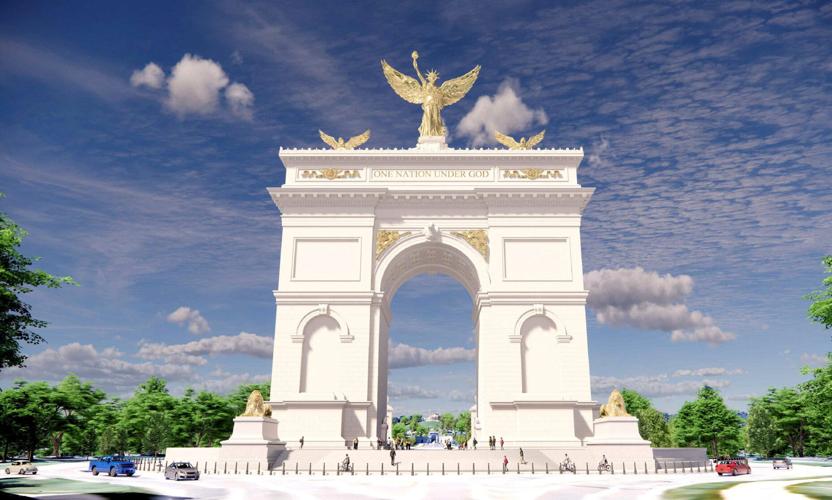
WASHINGTON — Interior Secretary Doug Burgum this week announced the start of construction of a 250-foot-tall Triumphal Arch across the Potomac River from the capital, despite legal challenges and the lack of final approval from a government planning authority.
On Friday, three military veterans and an architectural historian asked a U.S. judge to block the Trump administration from starting work on the arch.
In a U.S. District Court filing seeking a temporary restraining order, lawyers for the plaintiffs said the administration has "no legal basis for the construction work." They said the arch violates federal law and needs approval from Congress.
The administration argued a 1925 law that authorized a now-defunct commission to build Washington's Arlington Memorial Bridge provides congressional approval for the arch, which the opponents dispute.
People are also reading…
On social media Thursday, Burgum said excavation would begin during the next two weeks at Memorial Circle near Arlington National Cemetery. “This will be one of the Great Pieces of American Architecture, honoring the history and significance of Arlington Cemetery and befitting the most powerful Capital in the World,” he said.

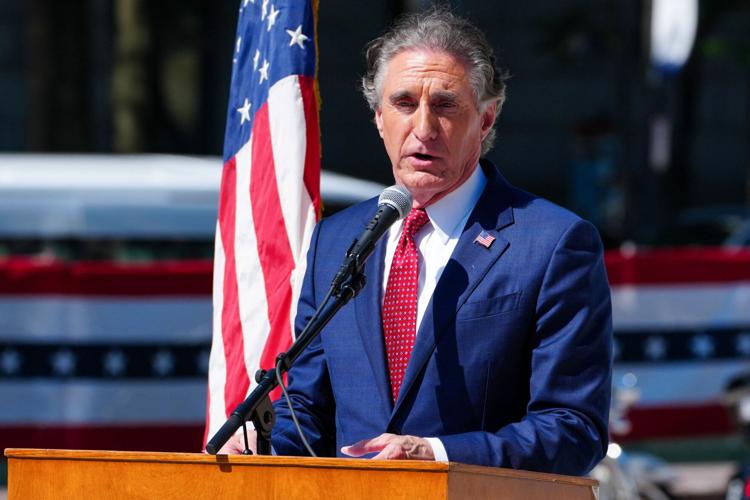
Interior Secretary Doug Burgum speaks June 30 at the ceremonial reopening of Freedom Plaza with new statues, including one of controversial founding father and slave owner Caesar Rodney, in Washington.
Despite his announcement, the government said in a court filing Friday the planned excavation work at the arch site was "not construction, or demolition in preparation for construction, of an arch."
The government added in its court filing that it plans to dig four "test pits" to assess if any artifacts or cultural materials are present, starting on or after Sept. 21. It said it would restore the site by Oct. 31.
The arch is one of multiple projects Trump proposed that will change Washington's landscape. Other projects include a White House granite helipad, a new ballroom, renovations at the Kennedy Center and an overhauled Reflecting Pool near the Lincoln Memorial.
Rep. Don Beyer, D-Virginia, opposed the arch project, which he called illegal and narcissistic. He argued that the project would significantly increase traffic problems in the region.
“Burgum and the Trump Administration are disregarding the risks and rushing this towering monument to Trump’s vanity because they believe Republicans will get crushed in November," Beyer said. “This project is not even close to being ready for prime time."


An artist's rendering of U.S. President Donald Trump's proposed 'Independence Arch'
A lawsuit is pending against the arch. U.S. District Judge Tanya Chutkan hasn’t decided whether to block the project, but in April she ordered the National Park Service to provide two weeks' notice before "commencement of construction, or demolition in preparation for construction, of an arch on Memorial Circle."
The three veterans and historian filed a lawsuit in February opposed to the arch and argued that Congress hadn't authorized it. The opponents said the arch would be larger than the Lincoln Memorial and disrupt the view across Memorial Bridge to the cemetery, which was designed to represent the unification of the country after the Civil War.
The National Capital Planning Commission approved preliminary site and building plans for the arch on July 9. The project has yet to receive final approval from that commission, which is considering whether to grant an exception to the 130-foot building height limit that applies to most of Washington.
The Interior Department said the arch would "celebrate the triumphs of the American people, inspire patriotism and love of country, and beautify the nation’s capital."

The National Park Service, which governs land for the arch, supported the project in a report Aug. 28 despite finding that it would negatively affect the views of other monuments and historic sites in Washington.
The arch would "celebrate 250 years of American independence by honoring America’s founding principles,” the report said, and would be "consistent with the avenue's established role as a ceremonial gateway and 'Avenue of Heroes' celebrating valor, sacrifice, and American heritage.”
Congress and commissions planned for a monument at the site for more than 125 years, according to Burgum. The Senate's McMillan Commission called for “a concourse suited to memorial treatment be established” at the west end of Memorial Bridge, he said.
In the Friday court filing, opponents of the project pointed to Trump's ballroom construction as a "cautionary tale," saying the government proceeded with construction even though a District Court found it unlawful and the Circuit Court affirmed the ruling.