

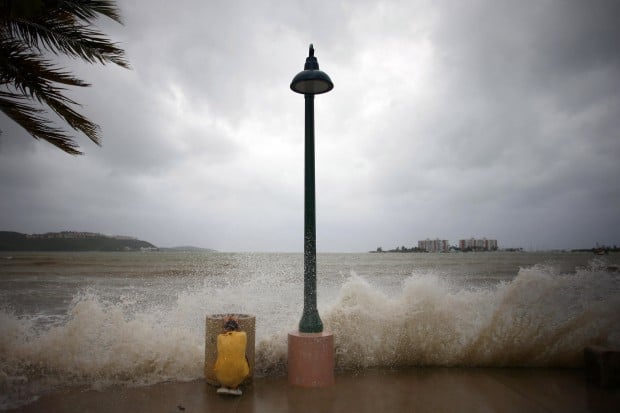
Hurricane Earl quickly gathered strength Monday, becoming a Category 4 storm as it roared past Puerto Rico and the U.S. Virgin Islands.
While hurricane warnings came down in the islands, meteorologists warned that Earl is likely to intensify over the next day and remains a threat to travelers and businesses on the U.S. mainland, as it carves a northerly arc off the East Coast later this week.
Earl, with sustained winds of 135 mph, was about 110 miles northeast of San Juan, Puerto Rico, on Monday evening, moving at about 15 mph and is expected to turn northwest today, according to the latest update from the National Hurricane Center in Miami.
Category 4 is the second- most-powerful rating on the Saffir-Simpson scale and packs an enormously destructive punch if it makes landfall, including heavy damage to buildings, trees and power lines.
People are also reading…
Some forecasters are predicting that the storm could eventually swing to within a few hundred miles of the U.S. Atlantic Coast, kicking up a powerful surf.
"The track of Earl has been trending west for a couple of days now," wrote Allan Huffman, a meteorologist and weather consultant in Raleigh, N.C. "Although there is some variation in the model guidance, I think that Earl will turn north around longitude 73-74W, and then turn northeast around 35N."
That would bring it within "a couple hundred miles of the North Carolina Outer Banks and Cape Cod," he added. "Obviously, any slight shift west would be big."
Should Earl get that close to the coast - or worse, make landfall somewhere along it - it likely would not be until late Thursday or early Friday, according to a path projected by Weather.com.
Either way, it is likely to close airports and sea lanes, wreaking havoc with commercial and passenger travel while ground transportation would likely be affected far inland by heavy accompanying rains.
As of Monday afternoon, according to the National Weather Service, tropical-storm conditions extended across Puerto Rico and the northern U.S. Virgin Islands. Carriers including American, United and JetBlue canceled dozens of flights into and out of San Juan's Luis Munoz Marin Airport.


