Jesse Katayama has been stranded in Peru since the country implemented strict travel restrictions because of the coronavirus pandemic, barring him from leaving. But in reward for his long wait, the 26-year-old Japanese tourist has become the first person in seven months to be allowed to enter Machu Picchu. The resident of Osaka who normally works as a boxing teacher had purchased his ticket to enter the park on March 15th only to have it close the next day. "This is totally amazing. Thank you Minister of Culture Alejandro Neyra for letting me see Machu Picchu," said Katayama. "Jesse decided to stay in Machu Picchu until it opened its doors," said Jose Bastante, the Parks Director. He spent his time teaching boxing classes to local children in Aguas Calientes, the gateway to the Inca citadel of Machu Picchu, which in contrast to its usual bustle, now looks like a ghost town. “It has been a good experience for me, I have friends that I have met here, now I know a lot about this place,” he said. Peru's government rewarded his thwarted effort by giving him an exclusive private tour of the ruins as a way to highlight the country being awarded the Safe Travel seals by the World Travel and Tourism Council in London. The seal designates Peru to be a safe tourist destination that meets international hygiene standards and biosecurity against COVID-19. "Peru is one of the first countries that implemented the eight protocols in the tourist sectors and today we are receiving the seal which is very important for the country," said Walter Martos Ruíz, President of Peru Council of Ministers. This is a step to reactivate all of the tourist activities which is one of the areas which has been very, very heavily affected by the pandemic" There is no date yet for the reopening of Machu Picchu, which received 1.5 million tourists a year, and which is the largest Peruvian attraction for international tourism. As for the rest of the country, a total of 17 archeological sites and museums have opened their doors to visitors and another nine sites will do so progressively until the end of the month, and six more are expected to open gradually between November and January. Peru's Culture Minister Alejandro Neyra, speaking in the Pachacamac archaeological site in Lima, said that visitors can make sure authorities are taking precautions. "What is important for us is that there is complete security so you can attend with the protocols we are taking, allowing only a 50% capacity," said Alejandro Neyra, Peru's Culture Minister. Among the archaeological sites that opened are Ollantaytambo, Chichero, both in Cusco, Chan Chan in the north, some of the best known for national and international tourism, while the Nazca lines will be available to visitors from November 12.
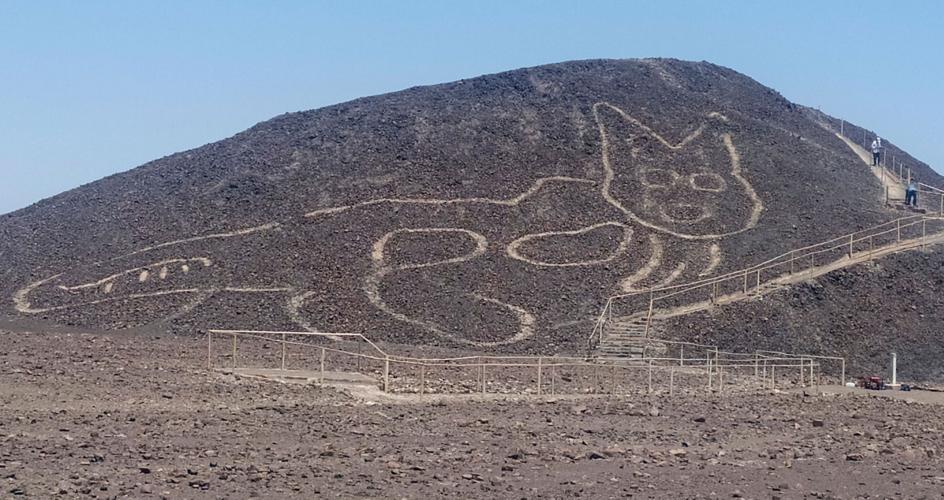
NAZCA, Peru — A huge feline figure carved into an arid hillside more than 2,000 years ago has been discovered in southern Peru, according to the country's Ministry of Culture.
The ancient geoglyph, which measures 121 feet across, forms part of the Nazca Lines, a collection of hundreds of mysterious artworks etched onto a plateau 250 miles south of Lima.

This handout photo provided by Peru's Ministry of Culture-Nasca-Palpa shows the figure of a feline on a hillside in Nazca, Peru.
The cat joins an array of other drawings found across the region's landscape over the last century, including depictions of a hummingbird, a monkey and a pelican. The discovery was made during maintenance work at a visitor vantage point in what is already a popular tourist destination.
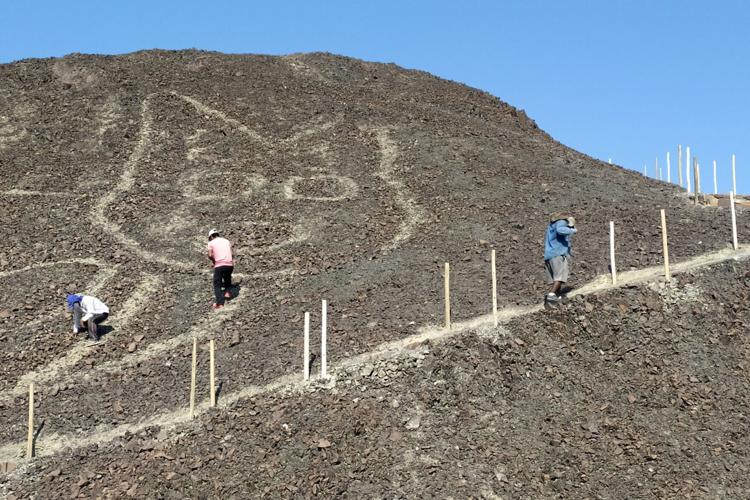
"The figure was barely visible and was about to disappear as a result of its location on a fairly steep slope and the effects of natural erosion," according to a ministry press release.
After undertaking cleaning and conservation work, archaeologists uncovered a series of lines varying in width from 12 to 16 inches. The style of the artwork suggests that it was created between 200 B.C. to 100 B.C. in the late Paracas period, the ministry said.
People are also reading…

Peruvian archaeologists carrying out maintenance work in the renowned Nazca Lines geoglyphs site have discovered the figure of a feline that was barely discernible and almost completely erased, the Ministry of Culture reported.
The Nazca Lines were created by people from pre-Hispanic societies who removed the top layers of rock and gravel to reveal a lighter-colored bedrock beneath. Although very few human-like figures have been found in the region, archaeologists have discovered large-scale depictions of animals, birds, plants and everyday objects.
A number of mysterious geometric shapes and patterns, including spirals and triangles, were also carved into the desert landscape.
The lines and geoglyphs cover an area of about 174 square miles and were created between 500 B.C. and 500 A.D., according to UNESCO, which added the site to its World Heritage List in 1994, describing it as one of "archaeology's greatest enigmas."
The region has been of interest to historians since the 1920s, when Peruvian archaeologist Toribio Mejia Xesspe first discovered mysterious lines carved into the landscape. With the growth of air travel in the 1930s, further artworks were discovered from above, and researchers have continued to uncover more lines and develop theories about how and why they were created.
As recently as 2019, researchers from Japan's Yamagata University discovered more than 140 geoglyphs in the region with the help of 3D imaging.
19 incredible archaeological finds and what we learned from them:
19 incredible archaeological finds and what we learned from them
Introduction

After the discovery of a "lost city" underneath a field in Kansas, people were reminded that a wealth of amazing, ancient information rests under our feet. In the last century, there have been famous archaeological discoveries that have changed our understanding of history and ourselves. Here are some of the most impactful finds ever. (Bettina Hansen/Hartford Courant/MCT)
Lost city in Kansas

In 2018, Donald Blakeslee, an anthropologist and archaeology professor at Wichita State University, located what he believes are the remains of the lost city of Etzanoa underneath Arkansas City, Kansas. He told the LA Times he suspects the city was home to up to 20,000 people for almost 200 years between 1450 and 1700. This urban hub would upend the traditional belief that Midwestern tribes were scattered nomads. This lost city in Kansas isn't the first time old remains have filled in gaps in American history. (Dreamstime/TNS)
Jamestown, Virginia

In 1994, archaeologists excavated the remains of Jamestown, the first permanent English settlement in the Americas. They learned about the country's early settlers, the town's trade with the nearby Powhatan Native Americans and the severity of their early hardships, including disease and starvation. (Mort Fryman/Virginian Pilot/TNS)
Rosetta Stone

While it is now the name of a popular language learning software, the original Rosetta Stone was a stone slab found in 1799 that proved to be the key to deciphering Egyptian hieroglyphics. The stone was inscribed with three versions of a decree issued 196 B.C.: one in hieroglyphic script, one in Egyptian Demotic script and one in Ancient Greek. It allowed researchers translate hieroglyphics for the first time to understand ancient Egyptian writings and culture. (Dreamstime/TNS)
King Tut

The discovery of the pristine tomb of King Tutankhamun in 1922 made worldwide headlines and became an international fascination. English archaeologist Howard Carter spent six years searching for the rumored hidden tomb. One of the few not looted by grave robbers, the untouched tomb's thousands of objects and artwork gave researchers a window into ancient Egyptian funeral practices, including mummification and daily life in their society. (Dreamstime/TNS)
Uluburun shipwreck

One of the oldest shipwrecks ever excavated, the Uluburun shipwreck is also one of the most important underwater archaeological discoveries in the world, according to National Geographic. Sunk in 1300 B.C. and discovered in 1982 off the coast of Turkey, the wide variety of luxury goods from around the world found on board paints a picture of trading routes and cultural exchange taking place in the Bronze Age. (Dreamstime/TNS)
Newgrange

Older than both Stonehenge and the Egyptian pyramids, the prehistoric monument of Newgrange in Ireland was built around 3200 B.C. Since 1890, it has been conserved and has been the site of archaeological excavations that revealed its function and how it had been built. The site provides insight into ancient art, technology and religion, including the importance of the winter solstice. On that day each year, a small opening calibrated to the location of the sun allows light to stream inside the central chamber. (Dreamstime/TNS)
Cliff Palace

The largest cliff dwelling in North America was built by ancestral Puebloans 700 years ago in what is now Colorado's Mesa Verde National Park. It was through to be abandoned in 1300 and was rediscovered by cowboys looking for stray cattle in 1888. The palace's 150 rooms revealed the tribe's family and community structure, technology and mathematical knowledge, and more. (Brad Branan/Sacramento Bee/TNS)
Easter Island

Easter Island is one of the most remote islands in the world, and its almost 900 monumental statues, called moai, made by the Rapa Nui people, have captivated the imagination of outsiders. They average 13 feet tall and weigh 14 tons. Though it's generally accepted they were built to honor ancestors and former chiefs, the real mystery was how an isolated, small and seemingly primitive people moved these massive blocks miles from a quarry to their locations across the island. Studying the island revealed things about ancient Polynesian culture and society as well as the ecological rise and collapse of the island's ecosystem. (Jane Wooldridge/Miami Herald/MCT)
Machu Picchu

Built around 1450, Peru's Machu Picchu was lost to the surrounding tropical forests until it was brought back to the attention of the outside world in 1911. This icon of Inca civilization is a testament to their social and religious organization, diet, immigration and trade patterns and their technological developments, such as terrace farming. (Chris Riemenschneider/Minneapolis Star Tribune/TNS)
Terracotta Army

Chinese farmers digging a well in 1974 struck one of the most iconic and important archaeological discoveries in the world. The Terracotta Army is a collection of thousands of soldier sculptures, along with horses, weapons and chariots, buried with Qin Shi Huang, the first Emperor of China, to protect him in the afterlife. Other figures found in the tomb include musicians, dancers and acrobats, all with different faces and expressions. According to Smithsonian magazine, the thousands of figures and items in the underground pits are an imitation of the real organization within the Qin dynasty. The army's deterioration also points to the collapse of that dynasty not long after Qin's death. (Keri Wiginton/Chicago Tribune/MCT)
Dead Sea Scrolls

The Dead Sea Scrolls are a series of hundreds of ancient religious scrolls discovered along the coast of the Dead Sea between 1947 and 1956. Described as the greatest manuscript discovery of modern times, the scrolls contain books of what Christianity refers to as the Old Testament as well as prophecies, psalms and religious writings not contained in the modern Bible. The scrolls were written in Hebrew, Greek and Aramaic, which expanded scholars’ understanding of the latter ancient language. They also reveal important developments in the history of Judaism and Christianity. (Kristyna Wentz-Graff/Milwaukee Journal Sentinel/MCT)
Pompeii

When the Italian volcano Mount Vesuvius erupted in 79 A.D., the ash and magma spewed out buried the ancient Roman port city of Pompeii, entombing thousands of victims and the city's buildings until the site was rediscovered in 1748. These preserved artifacts taught historians so many things about everyday ancient life, from their diets to their health and hygiene. (Bill Hogan/Chicago Tribune/TNS)
Herculaneum Scrolls

Like its neighbor Pompeii, the ancient Roman city of Herculaneum was also destroyed by Mount Vesuvius in 79 A.D. When the city was re-discovered in the 1700s, scientists found a buried library filled with hundreds of preserved papyrus scrolls. Unfortunately, the scrolls were so brittle and burnt that they couldn't be unrolled to read their contents. That is until 2015, when researched developed an X-ray that would allow them to digitally unfurl and read the lost texts. So far the library has proven to contain philosophical texts, but the hope it that there are more first-century Latin texts as well as early Christian writings that could provide more insight into the Roman world. (Brent Seales /Lexington Herald-Leader/MCT)
Troy

Immortalized in Homer's "Iliad," the ancient city of Troy is both a literary legend and real-life archaeological site located in modern-day Hisarlik, Turkey. Though it was long debated whether or not Troy was purely a work of fiction, both literary and historic descriptions of its location align with the city found at the present-day site, leading some to believe they're one and the same. Regardless, the area, which was first excavated in 1870 and is still being explored today, bears evidence to the evolution of Mediterranean civilization. (Manuel Cohen/Aurimages via ZUMA Press)
The Cave of Altamira

Altamira is a Paleolithic cave located in northern Spain that was discovered in 1868. The cave's detailed drawings were dismissed as fake for decades because of their intricacy and vibrancy, but a 1902 study confirmed their authenticity as dating from 35,000 to 11,000 B.C. The paintings depict fauna of the time period, while early tools were found during excavations of the cave. It's a protected UNESCO World Heritage Site, and the organization describes the drawings as "masterpieces of creative genius" and as "humanity’s earliest accomplished art." In 1940, another preserved series of Paleolithic caves was discovered in Lascaux, France. (Dreamstime/TNS)
Lucy

In 1974, scientists discovered a skeleton in Ethiopia that was more than 3 million years old, then the oldest confirmed early human ever discovered. On top of that, the skeleton was 40 percent preserved, according to the BBC. Nicknamed "Lucy" after the Beatles song "Lucy in the Sky with Diamonds," the skeleton became one of the most important fossils ever discovered because it revealed a new species of early human ancestors and continues to teach scientists about the course of human evolution. (Dreamstime/TNS)
Olduvai Gorge

Olduvai Gorge is a 30-mile stretch in Tanzania that seemingly holds the secrets of human history. The site is where the oldest evidence of the existence of our ancient human ancestors was discovered. The ravine's deposits date back up to 2 million years ago and have yielded more than 60 hominids as well as other teeth, bones and tools, which have all drastically increased our understanding of human evolution. (Dreamstime/TNS)
La Brea Tar Pits

More than 100 natural asphalt pits in the middle of Los Angeles ensnared and fossilized now-extinct Ice Age animals such as saber-toothed cats, dire wolves and giant sloths. The pits contain more than 3.5 million fossils of at least 600 species. They also preserved plants, wood and pollen, allowing scientists to track ancient climate and ecosystem changes. (Don Bartletti/Los Angeles Times/TNS)
Solnhofen, Germany

This area in Bavaria is famous in geology and archaeology because its layer of Jurassic limestone is ideal for preserving fossil specimens of dinosaurs, dragonflies, plants, insects and more from 155 million years ago. Perhaps the most influential discovery made here was a feather and two Archaeopteryx specimens in the 1860s. With its combination of reptile and bird features, the Archaeopteryx proved to be the "missing link" that illustrated Charles Darwin's then-recently published theory of evolution. (Dreamstime/TNS)
Golden age of archaeology

With the vast increase in technology as well as the scientific exploration of previously remote or closed off areas of the world, the modern era is becoming the golden age for archaeological discoveries. For example, according to National Geographic, today’s paleontologists are discovering 50 new species of dinosaurs a year, which is roughly a new species every week. This means we have even more amazing discoveries to come. (Dreamstime/TNS)